
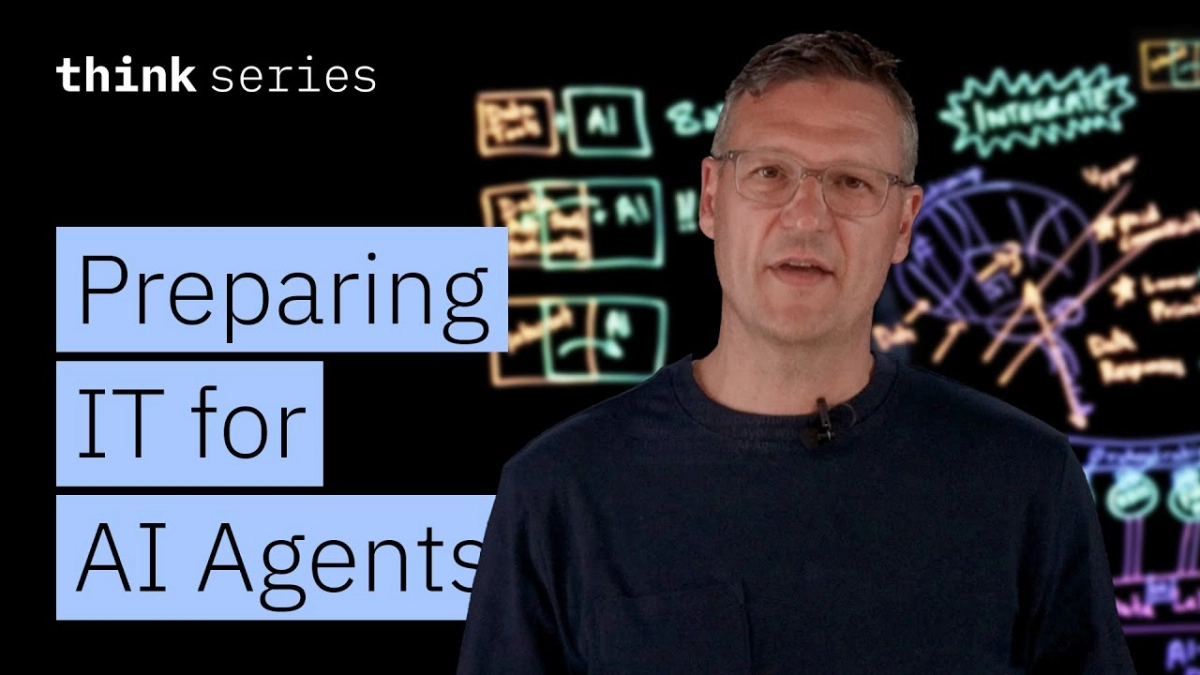
"We're trying to mimic the human brain," Eric Pritchett, President/COO of Terzo, stated in a recent discussion about preparing IT for the advent of AI agents. Pritchett, speaking with an interviewer, elaborated on how modern IT infrastructures need to evolve to become "AI-ready," drawing a compelling analogy between the human brain's processing capabilities and the future architecture of AI-driven systems.
The core of Pritchett's argument centers on a fundamental shift in how we approach AI integration within organizations. He illustrated this by sketching a conceptual model of the human brain, dividing it into three primary regions: the lower brain, the mid-brain, and the upper brain. The lower brain, he explained, handles primitive functions, processing raw data and generating basic responses. This is akin to how early AI systems, and even current large language models, process vast amounts of information from the internet to generate text or images. "AI swallows the internet and processes it," Pritchett described, highlighting the sheer volume of data these models consume.
However, he quickly pivoted to the limitations of this approach for enterprise-level AI. "The data we care about inside an organization is very different than all the data that's on the internet," Pritchett emphasized. This distinction is crucial. While the internet provides a broad, often unfiltered, dataset, enterprise data is specific, contextual, and often proprietary. The challenge, therefore, lies in bridging the gap between the broad, generalized capabilities of current AI models and the specific, nuanced needs of a business.
Pritchett articulated this challenge by contrasting the current AI paradigm with a more integrated, human-like approach. He noted that while current AI models "swallow the internet and process it," leading to models with a "very heavy overlap with AI," this doesn't necessarily translate to effective internal enterprise applications. The failure rate for AI initiatives, he suggested, is high precisely because organizations often try to "jam AI into the existing enterprise" without re-architecting their foundational systems.
The key insight here is the need for a more sophisticated AI architecture, one that mirrors the brain's ability to process, store, and selectively recall information. Pritchett highlighted that just as the human brain has distinct regions for processing sensory input, memory, and executive functions, IT infrastructures need to be similarly segmented and interconnected. He proposed a three-tiered approach: applications, data, and network. "We have applications, we have data, we have network," he stated, laying the groundwork for a more structured AI integration.
This structured approach allows for the development of what Pritchett termed an "AI-ready data layer," where data is not merely stored but is also processed, categorized, and made accessible in a way that AI agents can efficiently utilize. He drew a parallel to the human brain's ability to process different types of data—auditory, visual, olfactory—and integrate them for a cohesive understanding of the environment. Similarly, enterprise AI needs to ingest data from various sources like CRM, HR, and financial systems, but critically, it needs an "orchestration layer" to manage and process this data effectively.
Pritchett introduced the concept of the "Model Context Protocol" (MCP) as a critical component of this new architecture. He explained that MCP acts as an intermediary, allowing AI agents to interact with various tools and data sources in a standardized way. "MCP services are what we call tools data," he clarified, emphasizing that this protocol enables AI agents to understand and utilize the data and functionalities provided by different enterprise systems. This is a vital step in moving beyond simple data ingestion to intelligent automation.
The ultimate goal, as Pritchett outlined, is to move from a paradigm where AI "swallows the internet" to one where AI agents can effectively "integrate into the enterprise." This involves not just processing data but also understanding context, making decisions, and executing tasks based on specific goals and desired outcomes. By building an AI-ready infrastructure that mirrors the brain's integrated approach to processing information, organizations can unlock the true potential of AI agents, enabling them to perform complex tasks and drive significant business value. The future of IT, in this vision, is one where AI agents are not just consumers of data but sophisticated partners in driving enterprise operations.