

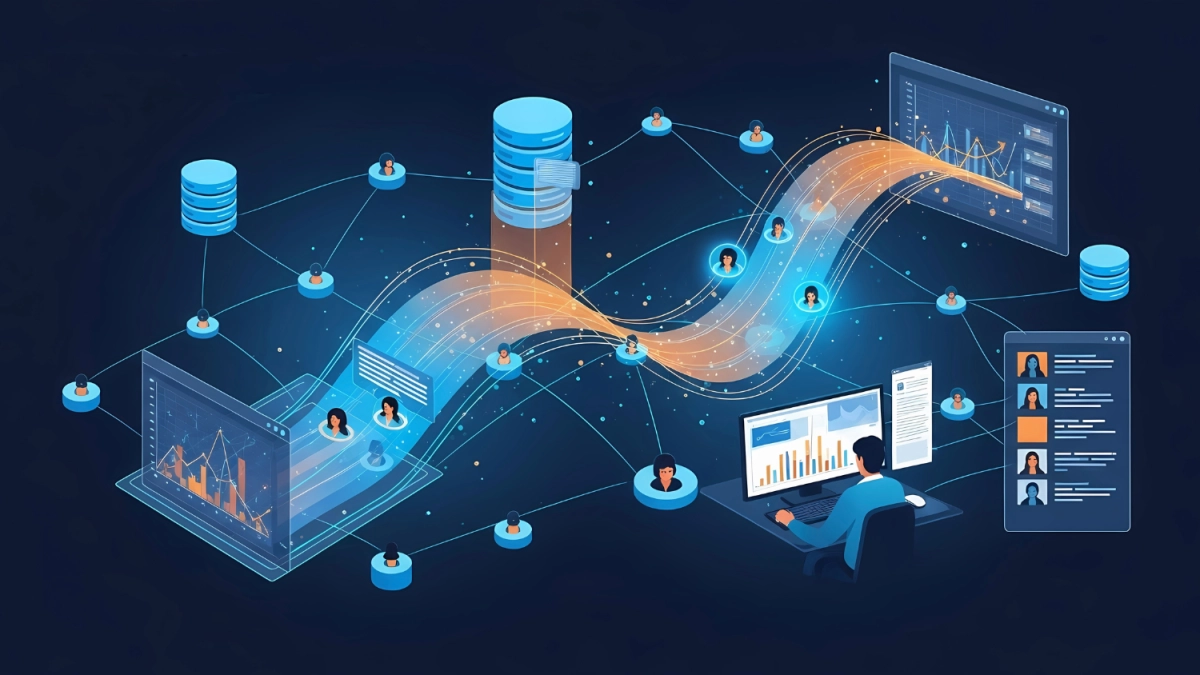
The promise of AI agents accessing vast enterprise data often collides with the reality of their inability to understand it. Despite access to every database and data lake, agents frequently falter on basic business questions, delivering hesitant or incorrect answers. This isn't a data volume problem; it's a profound gap in semantic understanding. According to the announcement, enterprises building reliable AI agents critically need two distinct yet interconnected types of ontologies: descriptive and structural. This dual-ontology approach is emerging as the foundational layer for AI agents to move beyond mere information retrieval to genuine comprehension and trustworthy action.
The core issue stems from the divergence between how businesses conceptualize operations and how data is physically stored. A "qualified pipeline" means something specific to sales methodology, involving criteria like deal size and decision-maker engagement, which rarely map neatly to single database columns. This semantic disconnect leads to ambiguous intent, inconsistent interpretations across teams, and brittle integrations that break with every schema change. Simply throwing more data at AI or refining prompts offers only temporary fixes. The enduring solution requires creating complementary translation layers that equip machines with both business meaning and data reality, moving beyond raw data to actionable intelligence.
Descriptive ontologies serve as the enterprise's definitive business dictionary for AI agents. They meticulously capture the meaning, policies, relationships, and causal logic that govern an organization's actual operations, independent of underlying data structures. These ontologies define critical business concepts such as customer entitlement, service level agreements, and qualified opportunities, along with roles, responsibilities, and the rules dictating how events should unfold. Owned by domain experts and product owners, descriptive ontologies evolve as business meaning shifts, providing agents with the essential context to understand user intent, enforce policies, and guide next-best actions.
Structural ontologies, conversely, function as the data atlas for AI agents, mapping directly to the physical and virtual locations of information. They detail data entities, schemas, attributes, relationships, and constraints across data warehouses, lakes, and semantic layers. These ontologies are the domain of data architects and knowledge engineers, changing as platforms evolve or data models are refactored. They enable agents to navigate from abstract business concepts to concrete data pathways, translating natural language queries into precise SQL or SOQL, ensuring consistent metric definitions, and facilitating entity resolution across disparate sources.
Bridging Meaning and Data
The true power of this dual-ontology architecture lies in its synergistic operation. When an AI agent processes a query, it first consults the descriptive ontology to grasp the business intent, translating a high-level question like "premium support entitlement" into a specific set of criteria (e.g., contract type, active status, tier level). Subsequently, the agent leverages the structural ontology to pinpoint where the necessary data for these criteria resides across various systems and how those data points relate. After retrieving the raw facts, the descriptive ontology is re-engaged to apply business rules and policies, formulating a trustworthy, contextually accurate answer. This separation allows each layer to evolve independently while maintaining a robust, auditable connection, preventing the common problem of business logic drifting from data reality.