

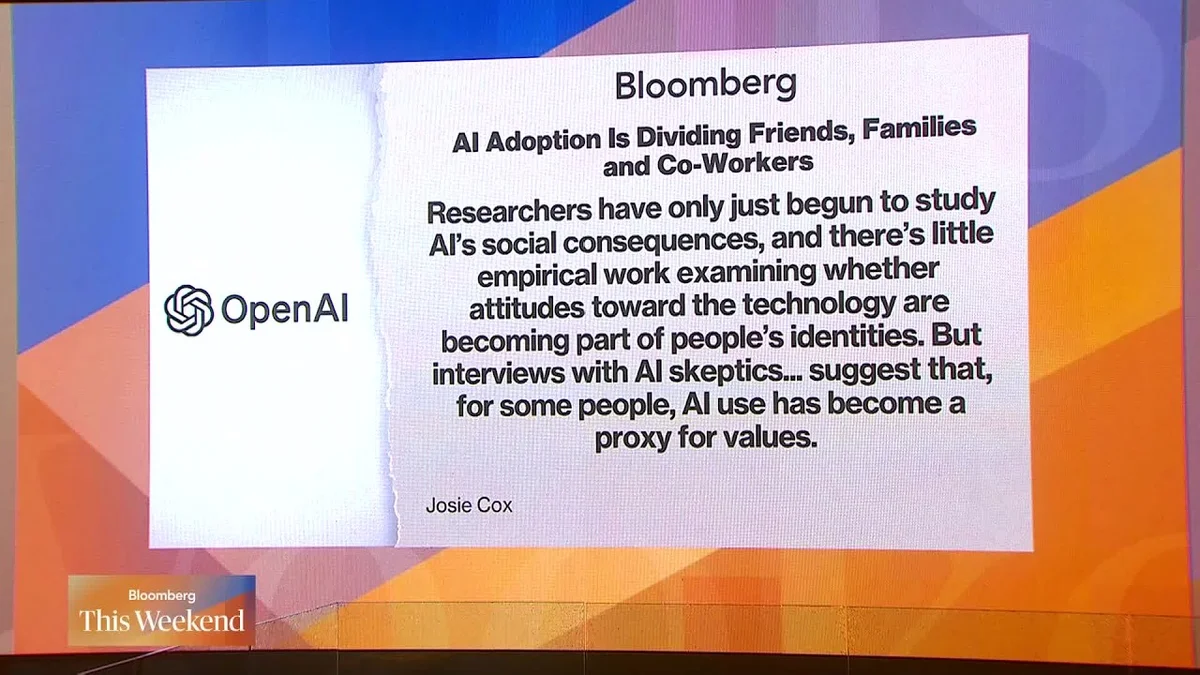
AI Adoption Sparks Cultural Divide, Fuels Identity Conflicts

Josie Cox discusses how AI adoption is creating a cultural divide, impacting personal communication and raising concerns about authenticity and workplace pressures.

9 min read
Josie Cox speaking on a panel about AI adoption
Bloomberg Podcast

Visual TL;DR. Rapid AI Adoption leads to Cultural Divide. Cultural Divide manifests as AI Refusenik Phenomenon. AI Refusenik Phenomenon fuels Identity Conflicts. Rapid AI Adoption impacts Erosion Personal Communication. Cultural Divide exacerbates Generational Divides. Rapid AI Adoption creates Workplace Pressures. Identity Conflicts contributes to Societal Polarization. Erosion Personal Communication adds to Societal Polarization. Generational Divides feeds Societal Polarization. Workplace Pressures drives Societal Polarization.

  1. Rapid AI Adoption: AI transforming industries, creating deep societal divisions and interpersonal ramifications
  2. Cultural Divide: polarizing individuals, fostering a rift between early adopters and hesitant or opposed
  3. AI Refusenik Phenomenon: individuals resisting AI due to environmental, ethical, copyright concerns, personal identity
  4. Identity Conflicts: resistance evolving into a matter of personal identity, creating an 'us versus them' dynamic
  5. Erosion Personal Communication: AI's impact on authenticity and personal interactions, raising concerns about trust
  6. Generational Divides: older generations more skeptical, younger generations embracing AI with less hesitation
  7. Workplace Pressures: AI mandates creating stress and resistance among employees, impacting job roles
  8. Societal Polarization: overall outcome of AI integration leading to fragmented communities and values
Visual TL;DR
Visual TL;DR, startuphub.ai Rapid AI Adoption leads to Cultural Divide. Cultural Divide manifests as AI Refusenik Phenomenon. AI Refusenik Phenomenon fuels Identity Conflicts. Identity Conflicts contributes to Societal Polarization leads to manifests as fuels contributes to Rapid AI Adoption Cultural Divide AI Refusenik Phenomenon Identity Conflicts Societal Polarization From startuphub.ai · The publishers behind this format
Visual TL;DR, startuphub.ai Rapid AI Adoption leads to Cultural Divide. Cultural Divide manifests as AI Refusenik Phenomenon. AI Refusenik Phenomenon fuels Identity Conflicts. Identity Conflicts contributes to Societal Polarization leads to manifests as fuels contributes to Rapid AI Adoption Cultural Divide AI RefusenikPhenomenon IdentityConflicts SocietalPolarization From startuphub.ai · The publishers behind this format
Visual TL;DR, startuphub.ai Rapid AI Adoption leads to Cultural Divide. Cultural Divide manifests as AI Refusenik Phenomenon. AI Refusenik Phenomenon fuels Identity Conflicts. Identity Conflicts contributes to Societal Polarization leads to manifests as fuels contributes to Rapid AI Adoption AI transforming industries, creating deepsocietal divisions and interpersonalramifications Cultural Divide polarizing individuals, fostering a riftbetween early adopters and hesitant oropposed AI Refusenik Phenomenon individuals resisting AI due toenvironmental, ethical, copyrightconcerns, personal identity Identity Conflicts resistance evolving into a matter ofpersonal identity, creating an 'us versusthem' dynamic Societal Polarization overall outcome of AI integration leadingto fragmented communities and values From startuphub.ai · The publishers behind this format
Visual TL;DR, startuphub.ai Rapid AI Adoption leads to Cultural Divide. Cultural Divide manifests as AI Refusenik Phenomenon. AI Refusenik Phenomenon fuels Identity Conflicts. Identity Conflicts contributes to Societal Polarization leads to manifests as fuels contributes to Rapid AI Adoption AI transformingindustries,creating deep… Cultural Divide polarizingindividuals,fostering a rift… AI RefusenikPhenomenon individualsresisting AI due toenvironmental,… IdentityConflicts resistance evolvinginto a matter ofpersonal identity,… SocietalPolarization overall outcome ofAI integrationleading to… From startuphub.ai · The publishers behind this format
Visual TL;DR, startuphub.ai Rapid AI Adoption leads to Cultural Divide. Cultural Divide manifests as AI Refusenik Phenomenon. AI Refusenik Phenomenon fuels Identity Conflicts. Rapid AI Adoption impacts Erosion Personal Communication. Cultural Divide exacerbates Generational Divides. Rapid AI Adoption creates Workplace Pressures. Identity Conflicts contributes to Societal Polarization. Erosion Personal Communication adds to Societal Polarization. Generational Divides feeds Societal Polarization. Workplace Pressures drives Societal Polarization leads to manifests as fuels impacts exacerbates creates contributes to adds to feeds drives Rapid AI Adoption AI transforming industries, creating deepsocietal divisions and interpersonalramifications Cultural Divide polarizing individuals, fostering a riftbetween early adopters and hesitant oropposed AI Refusenik Phenomenon individuals resisting AI due toenvironmental, ethical, copyrightconcerns, personal identity Identity Conflicts resistance evolving into a matter ofpersonal identity, creating an 'us versusthem' dynamic Erosion Personal Communication AI's impact on authenticity and personalinteractions, raising concerns about trust Generational Divides older generations more skeptical, youngergenerations embracing AI with lesshesitation Workplace Pressures AI mandates creating stress and resistanceamong employees, impacting job roles Societal Polarization overall outcome of AI integration leadingto fragmented communities and values From startuphub.ai · The publishers behind this format
Visual TL;DR, startuphub.ai Rapid AI Adoption leads to Cultural Divide. Cultural Divide manifests as AI Refusenik Phenomenon. AI Refusenik Phenomenon fuels Identity Conflicts. Rapid AI Adoption impacts Erosion Personal Communication. Cultural Divide exacerbates Generational Divides. Rapid AI Adoption creates Workplace Pressures. Identity Conflicts contributes to Societal Polarization. Erosion Personal Communication adds to Societal Polarization. Generational Divides feeds Societal Polarization. Workplace Pressures drives Societal Polarization leads to manifests as fuels impacts exacerbates creates contributes to adds to feeds drives Rapid AI Adoption AI transformingindustries,creating deep… Cultural Divide polarizingindividuals,fostering a rift… AI RefusenikPhenomenon individualsresisting AI due toenvironmental,… IdentityConflicts resistance evolvinginto a matter ofpersonal identity,… Erosion PersonalCommunication AI's impact onauthenticity andpersonal… GenerationalDivides older generationsmore skeptical,younger generations… WorkplacePressures AI mandatescreating stress andresistance among… SocietalPolarization overall outcome ofAI integrationleading to… From startuphub.ai · The publishers behind this format

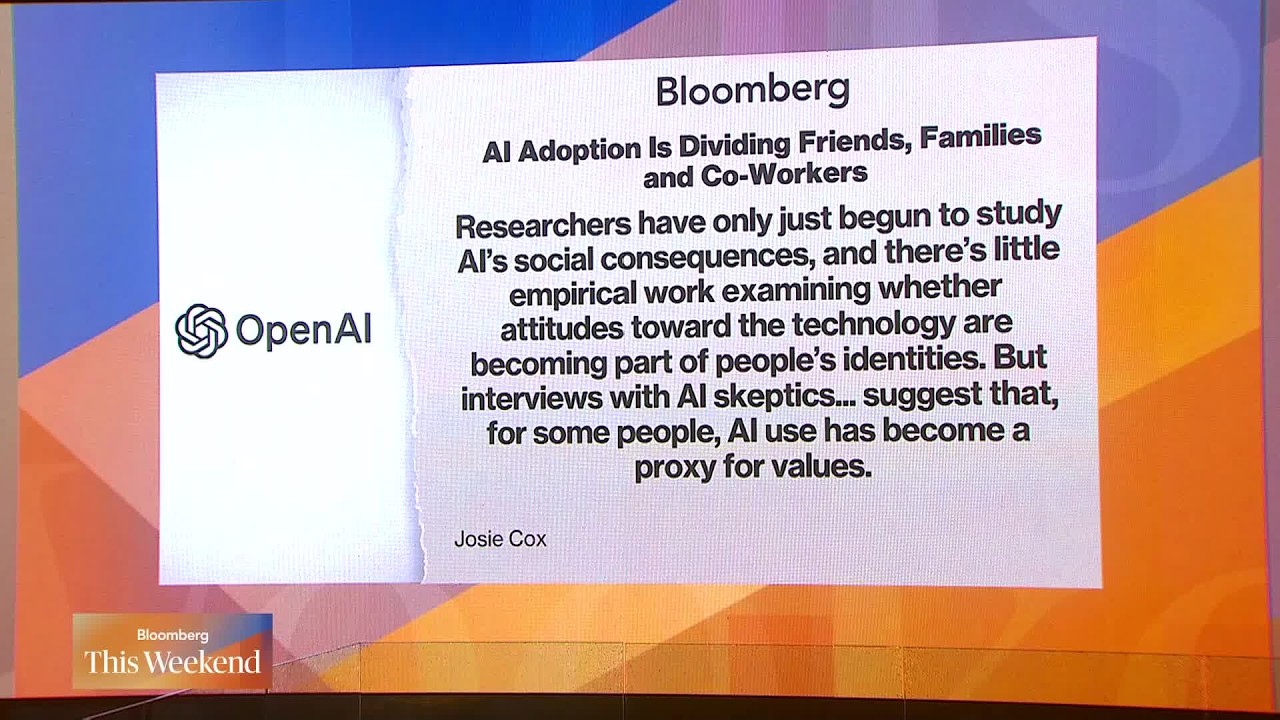
The rapid ascent of artificial intelligence is not only transforming industries but also creating deep societal divisions, according to Bloomberg News contributor Josie Cox. In a recent discussion, Cox highlighted how AI adoption is polarizing individuals, leading to interpersonal ramifications and even impacting personal identities. She noted that while AI is becoming ubiquitous, its integration is not universally welcomed, fostering a cultural rift between early adopters and those who are hesitant or outright opposed to the technology.
The "AI Refusenik" Phenomenon

Cox observed that many individuals who resist AI, whom she terms "AI refuseniks," cite various reasons for their stance, including environmental impact, ethical concerns, and copyright issues within creative industries. However, she suggests that for some, this resistance has evolved into a matter of personal identity, creating a stark "us versus them" dynamic. "It was almost tribal," Cox stated, reflecting on her conversations with those who are wary of AI's pervasive influence.

She expressed surprise at the speed at which some people, particularly those in her own age group, have embraced AI for everyday tasks. "I am one of those people who gets very surprised by the people in my life who have started relying on AI so quickly," Cox admitted. This rapid adoption, even among those whose livelihoods might be threatened by AI, strikes her as counterintuitive to their stated values.

The full discussion can be found on Bloomberg Podcast's YouTube channel.

AI Adoption Sparks Cultural Divide - Bloomberg Podcast
AI Adoption Sparks Cultural Divide, from Bloomberg Podcast

AI and the Erosion of Personal Communication

A significant point of contention for Cox and others is AI's increasing role in personal communication. She recounted an anecdote where a friend opted to use AI for a simple Google search instead of manually searching, a choice that struck her as emotionally jarring. Cox believes this stems from AI's encroachment into deeply personal areas like communication. "Communication is one of the most personal things that we rely on and one of the most sort of personal building blocks of our lives," she explained.

Citing academic research, Cox pointed to skepticism surrounding AI's use in personal expressions such as wedding vows, birthday greetings, and even dating app interactions. The idea of AI facilitating these exchanges, or even having dating apps communicate with each other via AI, raises profound questions about authenticity and the state of human connection. "If we're relying on a machine to do that, you know, what does that tell us about the state of humanity, quite frankly?" she questioned.

Generational Divides and AI Skepticism

A recent survey by the dating app Hily revealed that 64% of Gen Z and 56% of millennial daters would not date someone who relies on AI for everyday decisions. Cox found this data point particularly interesting, suggesting a growing backlash against AI reliance. She noted that while empirical data on AI's societal impact is still scarce, this survey indicates a potential trend. "There is a sort of hankering for personal connection amid this AI era that we're all finding ourselves in," she commented.

Regarding generational differences in AI adoption, Cox observed that younger generations, having grown up with the internet, might exhibit a more intuitive skepticism towards AI. "The younger generations are individuals who grew up with the internet. They don't know a time before the internet. So maybe that sort of skepticism is a little bit more intuitive for them," she stated.

Workplace Pressures and AI Mandates

The conversation also touched upon the increasing pressure to adopt AI in professional settings. Cox highlighted that some companies are not only incentivizing but actively mandating AI use among employees. "There are large companies that are not only incentivizing employees to use AI, but actively almost forcing them to, right, mandating it," she said.

This forced adoption raises concerns for employees who may be hesitant due to ethical reservations or a belief that AI might not be beneficial. Cox pointed out that these individuals are often reluctant to voice their concerns for fear of jeopardizing their jobs. "If you're being forced to do something in your work, that becomes a productivity issue, that becomes an engagement issue. Ultimately, that could become a workforce issue," she concluded.

© 2026 StartupHub.ai. All rights reserved. Do not enter, scrape, copy, reproduce, or republish this article in whole or in part. Use as input to AI training, fine-tuning, retrieval-augmented generation, or any machine-learning system is prohibited without written license. Substantially-similar derivative works will be pursued to the fullest extent of applicable copyright, database, and computer-misuse laws. See our terms.