

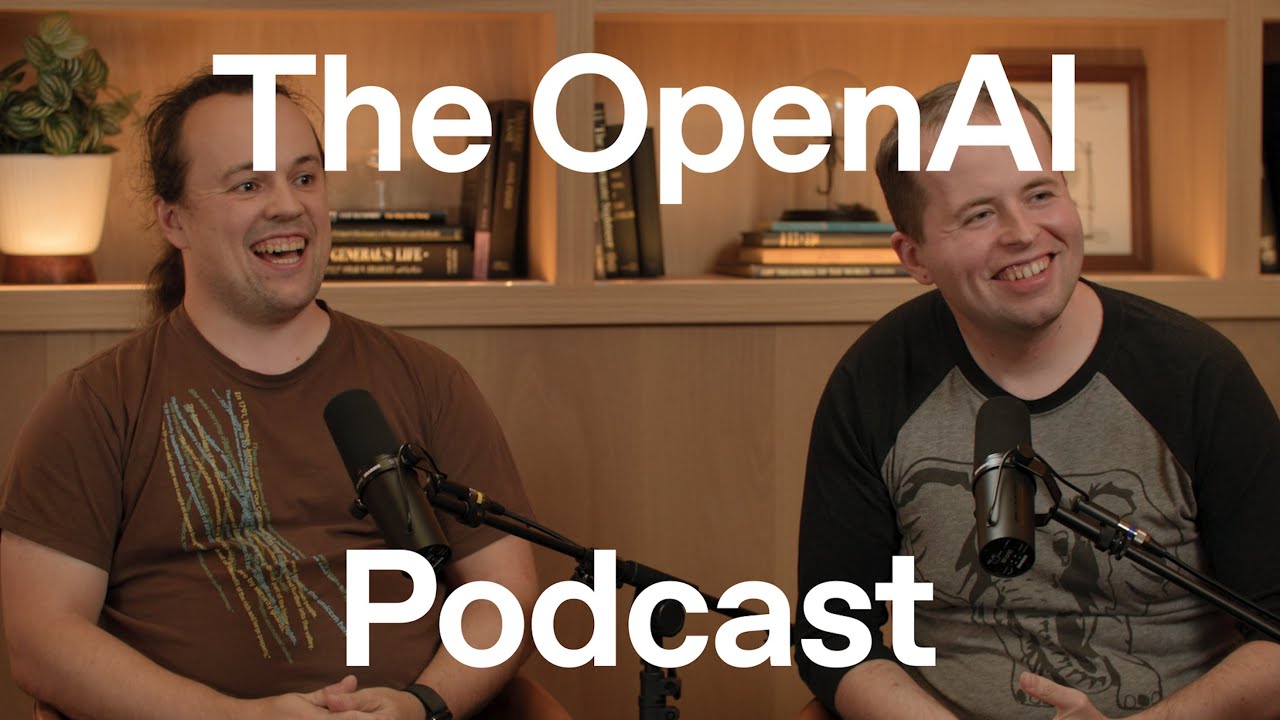
The landscape of artificial intelligence is transforming at an unprecedented pace, moving beyond incremental advancements to profound breakthroughs that challenge our very understanding of intelligence. In a recent episode of the OpenAI Podcast, host Andrew Mayne delved into this accelerating journey with OpenAI's Chief Scientist Jakub Pachocki and researcher Szymon Sidor, exploring the evolving definition of Artificial General Intelligence (AGI) and its imminent impact on scientific discovery and human endeavor.
A significant theme emerging from the discussion is the rapid obsolescence of traditional AI benchmarks. Pachocki noted that just a few years ago, the concept of AGI felt "a little bit abstract, right? And far away." However, the swift progression of models like GPT-2, GPT-3, and now GPT-4 has led to "benchmark saturation," where AI systems routinely outperform human-designed tests. This necessitates a shift in how progress is measured, moving beyond isolated metrics to evaluate real-world impact and the capacity for generalized problem-solving.
This evolving capability is exemplified by AI models achieving gold medal levels in the International Math Olympiad (IMO) and excelling in competitive programming contests like AtCoder. These milestones, once considered distant markers for AGI, reveal surprising leaps in reasoning. Pachocki highlighted the profound implications: "For me personally, the thing that I think about when I think about how AI progress really impacts the world meaningfully, I first think about its potential for automating the discovery and production of new technology."
The vision extends to AI becoming an automated researcher, capable of generating novel ideas and fundamentally changing our understanding of the world.
Szymon Sidor shared his "personal AGI moment," recalling how ten years ago, natural language processing models could barely classify sentiment accurately. Today, models can produce coherent paragraphs of text, engage in natural conversation across a wide range of topics, and even solve complex math problems requiring creative thought, not just formulaic application. He emphasized the exponential nature of this progress, stating, "the pace of progress just like from the perspective of somebody working on this technology is like absolutely amazing."