

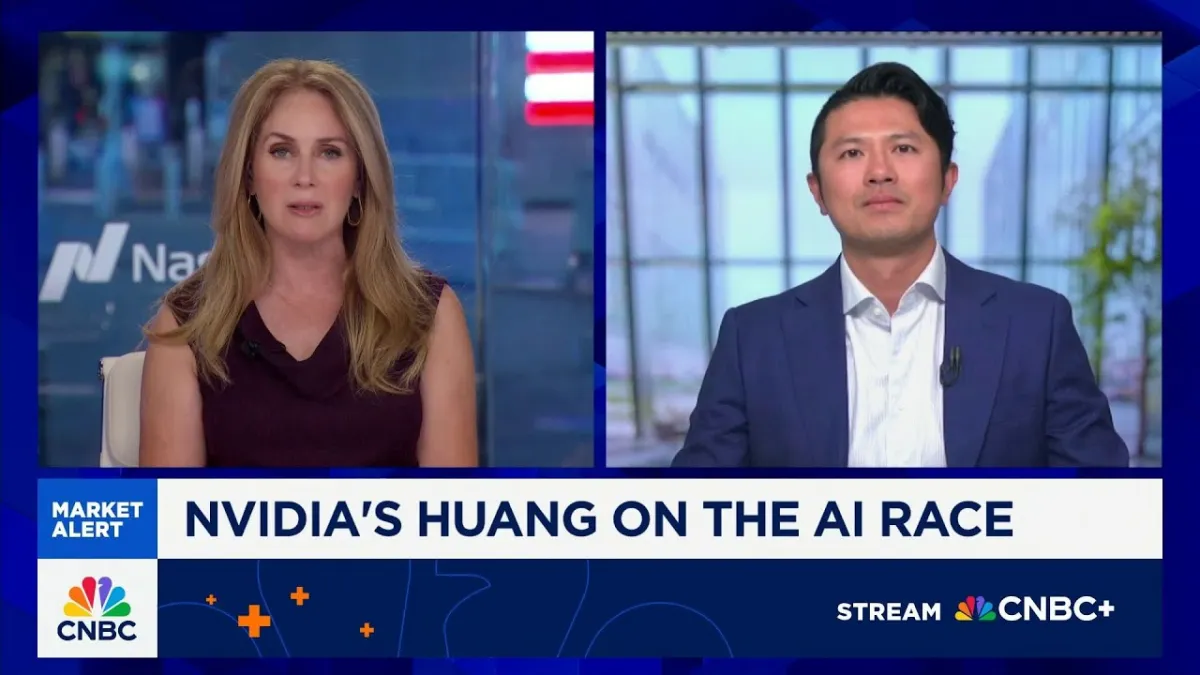
The artificial intelligence landscape is witnessing a profound transformation, moving beyond foundational models to a future powered by autonomous agents. As T. Rowe Price portfolio manager Tony Wang articulated, "There's a lot of new demand drivers that will materialize we can't see at the present day," underscoring the nascent, yet explosive, potential of this evolving market. This sentiment echoes the foundational principle laid out by NVIDIA CEO Jensen Huang, who, in an earlier discussion, emphasized the critical importance of platform dominance: "In order to win the AI race, you need to have all of the world's AI developers to be building on your platform." Huang's analogy of an App Store or an operating system, where developers gravitate towards a singular, powerful ecosystem, highlights the strategic imperative for companies vying for leadership in the AI arena, a dynamic equally relevant whether developers are in the United States or China.
Tony Wang, joining CNBC's 'Squawk Box', elaborated on the immense valuations currently observed in AI companies, asserting that such figures necessitate the emergence of tangible, serious business use cases to justify the investment. His focus quickly shifted to the burgeoning field of agentic AI, a domain he is actively monitoring. Wang foresees a future where "a lot of digital workers... are going to work alongside human workers, and that's going to really uncap productivity." This vision extends beyond mere software augmentation, encompassing "physical AI to manifest itself with robotics," signaling a convergence of digital and physical automation.
The inflection point for agentic AI, Wang notes, has arrived "pretty quickly over the last few months," accelerating from theoretical discussions to practical implementation. This rapid evolution is particularly evident at the intersection of IT services and software. He described a paradigm shift in IT services, moving from a traditional "pyramid shape"—reliant on billable human hours—to a "diamond shape" model. In this new structure, a human orchestrator manages "thousands of AI agents," essentially small, specialized pieces of software that augment existing legacy systems, driving unprecedented efficiency.
This shift underscores a critical investment theme: the infrastructure underpinning AI. Wang highlighted that companies are actively building the foundational infrastructure, including cloud players and chip manufacturers like NVIDIA, Broadcom, and AMD, all of whom are well-positioned for this burgeoning market. He also pointed to the rise of "neo-clouds" – custom-built cloud solutions specifically designed to meet the unique demands of AI infrastructure, experiencing a significant surge in demand. This foundational build-out is a capital-intensive undertaking, akin to "laying down the tracks for the railroad," requiring creative financing, strategic partnerships, and a strong focus on ecosystem development.
Wang’s investment philosophy acknowledges the dual nature of this market. While recognizing the need for demand to continue scaling and new drivers to emerge, his portfolio construction leans towards "well-positioned compounders that... have durable competitive advantages." These are the established tech giants like Apple, Alphabet, NVIDIA, Meta Platforms, and Microsoft, companies with robust market positions and proven innovation capabilities. However, his strategy is not limited to these behemoths. He also actively invests in "various companies that are earlier on their S-curve of adoption," seeking out those on the cusp of significant growth and market penetration.
His approach prioritizes identifying "technological inflections" rather than simply pursuing the cheapest companies. This means seeking businesses poised for exponential growth as their innovations move from niche applications to widespread adoption. The current era, Wang concluded, presents an unparalleled opportunity for those investing in technology, a testament to the transformative power of AI.



