


AcouBatt raised £1.1m to listen inside batteries

UCL spinout AcouBatt raised £1.1m led by Creator Fund to scale AI acoustic sensors that cut battery formation time by up to 30%.

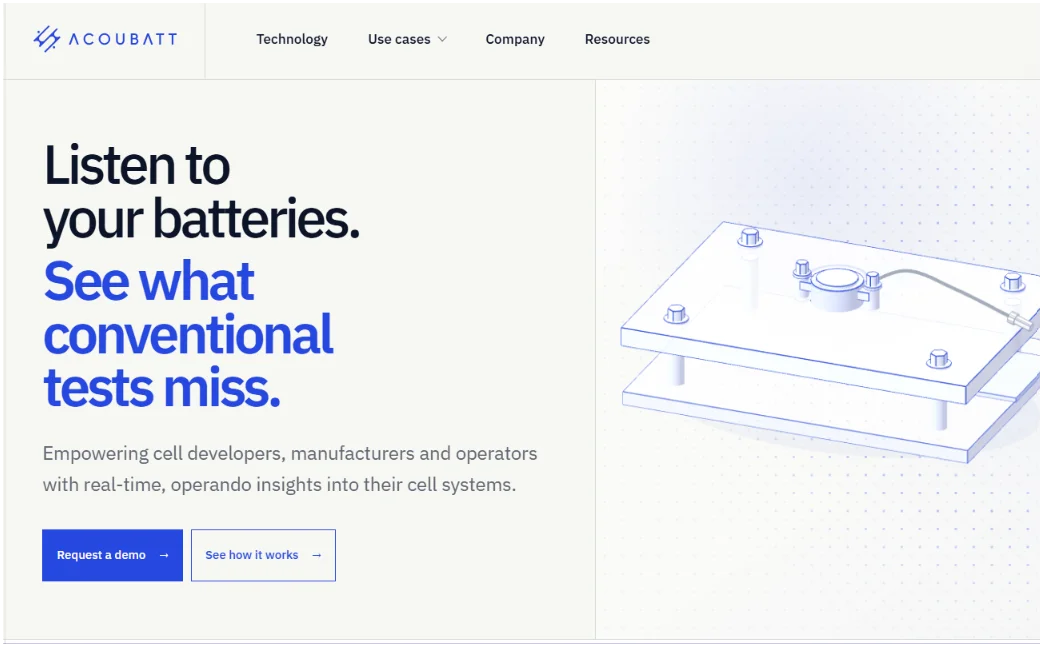
AcouBatt acoustic emission sensor monitoring battery cell for defects
Real-time acoustic sensing reveals invisible battery flaws during production and operation
Key Takeaways
  • 1
    AcouBatt raised £1.1m pre-seed led by Creator Fund with Ada Ventures to commercialize acoustic emission diagnostics.

  • 2
    Sensors listen to formation and AI filters noise to pinpoint when processes finish and when faults start.

  • 3
    System syncs acoustic data with electrochemical signals to cut formation time by up to 30% without changing the line.

AcouBatt raised £1.1 million in pre-seed funding to put a stethoscope on lithium-ion production. The London startup, spun out of UCL Ventures, will use the round led by Creator Fund with participation from Ada Ventures to move its acoustic diagnostics from lab to factory floor.

The problem it targets is concrete.

During formation, a new cell is charged and discharged for the first time. Today that stage is a black box. Manufacturers have almost no real-time visibility, so cells sit for up to two weeks on conservative time buffers while operators wait blind. The result is a bottleneck that inflates cost, wastes material with up to 30 percent rejection rates, and still lets defects slip through.

AcouBatt listens instead. As electrochemical and mechanical changes happen inside the cell they emit tiny acoustic signals. The company places proprietary acoustic emission sensors on or near the cell during formation and streams that audio together with the cycler’s voltage and current traces. Its AI learns to separate meaningful battery activity from factory background noise, then interprets the signatures as they occur.

That sync is the product. By aligning acoustic events with electrochemical data, the system declares when key formation reactions are actually complete, so the line can drop the buffer and move the batch. AcouBatt says that trims formation time by up to 30 percent without hurting performance. The same signal path flags the earliest acoustic signatures of a developing fault, the kind traditional end-of-line electrical tests miss, and catches process drift before a whole batch is scrapped.

Integration is designed to be non-invasive. Jamie Macfarlane, CEO at Creator Fund, which led the round, said the appeal is that it is not destructive and does not change anything in the manufacturing process but allows producers to understand what is happening inside batteries at speed. For now the hardware lives in the lab at the UK Battery Industrialisation Centre, the UK’s national scale-up facility, where AcouBatt is benchmarking diagnostics against production-relevant cells. Commercial scale products are targeted for next year.

Beyond formation, the company wants the same sensor and models to sit on battery energy storage systems to spot underperforming or failing cells before they trigger safety incidents or unplanned downtime. Over time that extends to EVs and other systems as a through-life health monitor. Co-founder and CEO Dr. Arthur Fordham, whose PhD at UCL’s Electrochemical Innovation Lab under the Faraday Institution’s SafeBatt project underpins the IP, said batteries have been tightly locked in a black box and diagnostics are the next frontier from formation to end of life. Co-founder and Commercial Director Chris Haoxin Xu, who met Fordham through London Business School’s Innovation to Market programme, framed it as a way to cut waste and get safer cells out faster under pressure to scale Western production.

There are limits in the current disclosure. The system is still in pilot at UKBIC, not yet proven across multiple chemistries or form factors at line speed, and AcouBatt has not published false positive rates or how its models handle variable acoustic coupling and factory noise over months of operation. Will Mortimore, business manager at UCL Ventures, which assigned the IP into the company, and Matt Penneycard, co-founding partner at Ada Ventures, both pointed to the waste and safety cost of blind formation as the reason to back the approach.

If the acoustic fingerprint holds up outside the lab, manufacturers gain a control signal they have never had, not a new chemistry but a way to know when to stop waiting.

© 2026 StartupHub.ai. All rights reserved. You may not republish this article in full without a license. Search engines and AI research tools may crawl and summarize for reference. Bulk reproduction or model training requires a license. See our terms.
Arthur Fordham

Written by

Arthur Fordham

Dr Arthur Fordham is co-founder and CEO of AcouBatt, a UCL spinout developing AI-powered acoustic emission sensing technology to improve battery manufacturing, performance and safety. Arthur completed his PhD at UCL’s Electrochemical Innovation Laboratory, supported by the Faraday Institution’s SafeBatt project, where his research into acoustic battery diagnostics formed the scientific foundation for AcouBatt. His research spans lithium-ion and sodium-ion battery technologies and has been published in leading scientific journals including Joule. Arthur has also worked with Ilika and Breathe Battery Technologies on cell engineering, battery diagnostics, validation and fast-charging technologies. He also continued his research at UCL through a Hyundai-funded postdoctoral project focused on lithium-ion battery characterisation and degradation.