

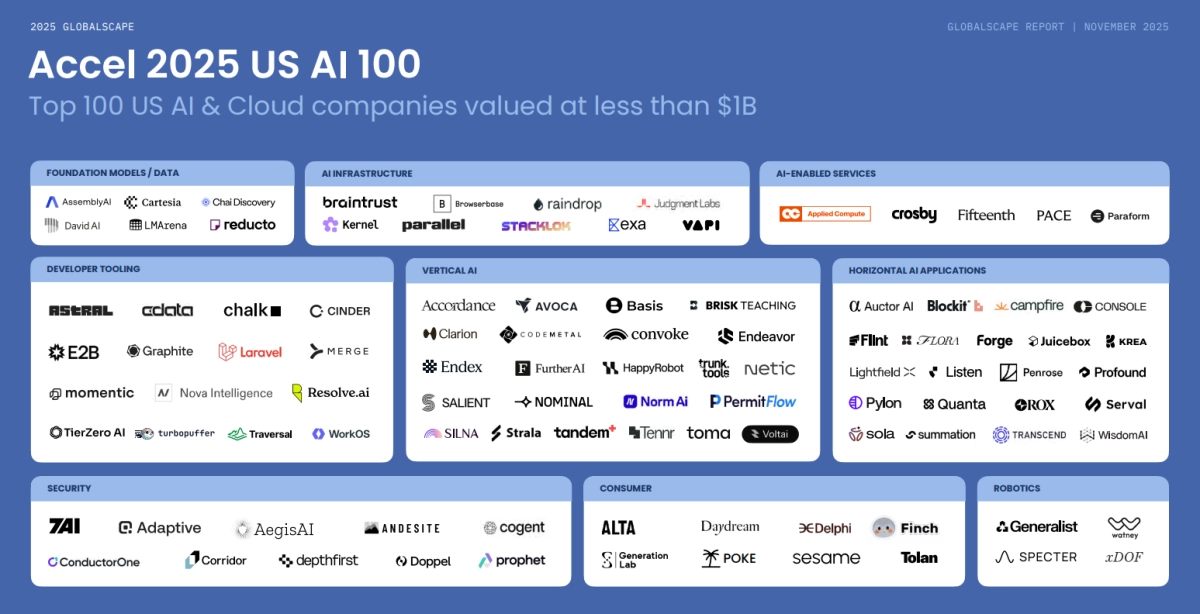
When Accel launched its Euroscape report in 2016, the focus was on crystallizing the momentum of Europe’s emerging cloud ecosystem. Today, that regional lens is obsolete. The AI revolution has fundamentally redefined the scale of global technology, forcing the venture firm to relaunch its flagship analysis as the ‘Accel 2025 Globalscape,’ a report released today at Web Summit in Lisbon.
The central finding of the Globalscape report is stark: AI is driving one of the largest concentrations of tech leadership ever recorded, while simultaneously demanding a staggering, multi-trillion-dollar infrastructure buildout that only a handful of companies can afford.
The platform shift driven by AI remains seemingly unstoppable, pushing the Nasdaq to new highs and creating the world’s first $5 trillion company in Nvidia. But this success is highly concentrated. Accel identifies the "Super Six"—Nvidia, Microsoft, Apple, Alphabet, Amazon, and Meta—who now represent roughly half of the entire Nasdaq Composite Index.
This dominance is cemented by cash flow. The Super Six are projected to generate $0.6 trillion in operating cash flow in 2024 alone. This financial moat allows them to sustain the massive, continuous investment required to maintain AI leadership, strengthening their position as the gatekeepers of the new industrial revolution. Their combined market capitalization has already increased by more than $4.9 trillion this year, a clear market recognition of their strategic advantage.
The $4 Trillion Compute Bill
The sheer scale of the infrastructure required to power the next decade of AI development is perhaps the most alarming figure in the Globalscape analysis. The massive growth of AI-native applications, combined with the expected acceleration of agentic deployment across enterprises, is driving a frenetic race for compute.
Current estimates cited by Accel reveal the need to build 117GW of new AI data center capacity by 2030. To put that into perspective, that is enough power to run the UK, Italy, and Spain combined. This translates directly into around $4 trillion of capital expenditure required over the next five years.
This astronomical figure raises immediate questions about feasibility, but Accel suggests the hyperscalers might just have the means. The combined projected operating cash flows of Amazon, Apple, Google, Meta, and Microsoft are expected to hit $5.5 trillion over the same period (2026–2030). The investment is massive, but the companies best positioned to spend it are the same ones already dominating the market.
For this investment to pay off, however, AI must deliver on its promise of productivity. Accel calculates that roughly $3.1 trillion in new revenues would be required to pay back the infrastructure investments. This is equivalent to a 1-2% increase in the global annual GDP growth rate for the next five years. The entire economic justification for the AI boom hinges on whether it can deliver that uplift.
While the infrastructure layer is consolidating, the software landscape remains robust. Accel’s Globalscape Public Cloud Index has grown 25% year-over-year, and the tech IPO market is showing signs of life, with companies like Circle, Figma, and Netskope trading above their listing prices. Existing cloud giants like Salesforce and ServiceNow are betting heavily on "agentic automation" to leverage their existing platforms, suggesting a resurgence is likely as these workflows hit the inflection point of the S-curve.
Meanwhile, the financing of AI models and the new breed of AI-native applications is pushing venture cloud and AI investment in the US, Europe, and Israel to an all-time high. Funding across these regions is expected to hit $184 billion in 2025—an increase of almost 80% over 2024 levels.
While the lion’s share of that funding is driven by massive raises for model makers like OpenAI ($47B), Anthropic ($19B), and xAI ($15B), the playing field is leveling at the application layer. European and Israeli-founded cloud and AI application companies attracted $30 billion this year, two-thirds of the funding secured by their US peers, marking a 36% increase over 2024.
This investment is translating into global champions emerging from outside Silicon Valley, including ElevenLabs and Synthesia in London, Cyera in Tel Aviv, and Helsing in Munich. Accel notes this is clear evidence that the region’s AI talent pool is shining, and founders have the ambition to build global category-defining companies.
Accel, which has deployed over $13 billion across 450+ AI and cloud companies, remains bullish on the transformation ahead, partnering with emerging leaders like Perplexity, Scale, and Vercel. The firm concludes that AI winners will come from anywhere—a necessary counterpoint to the report’s own data showing the unprecedented concentration of power at the very top of the stack.


