

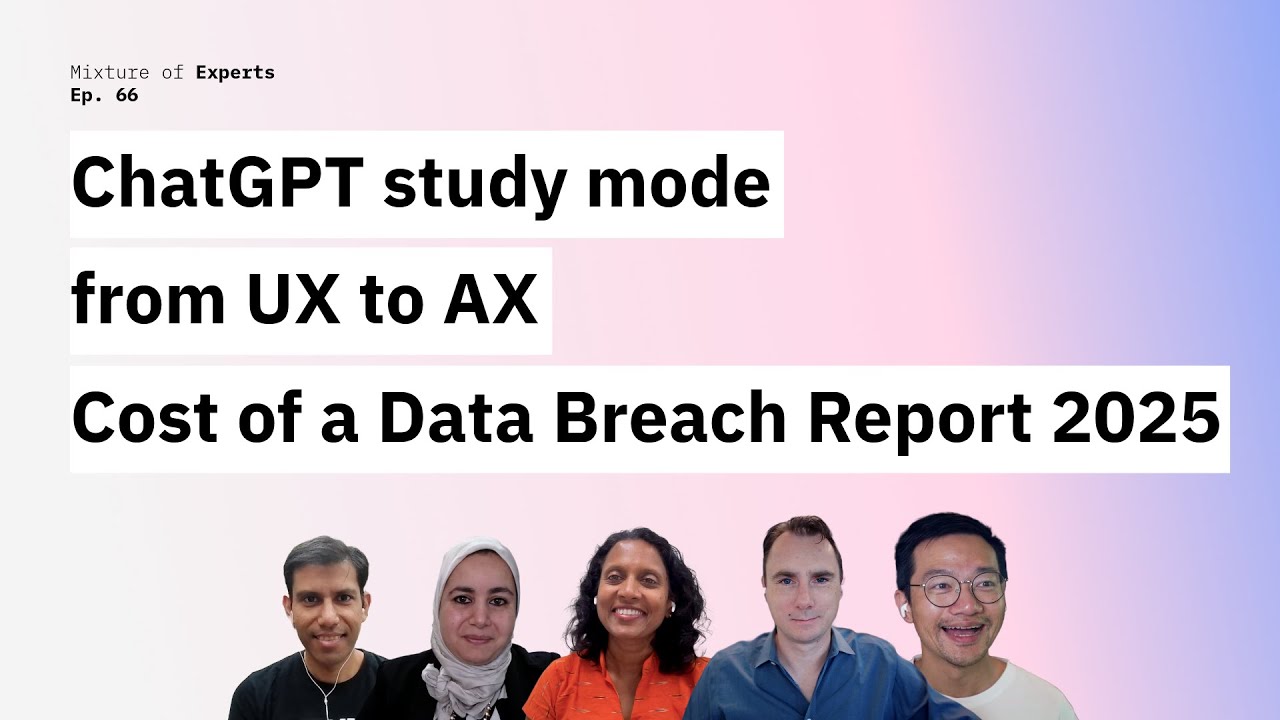
In a recent discussion on IBM's "Mixture of Experts" podcast, host Tim Hwang and a panel of AI professionals explored the implications of OpenAI's new ChatGPT Study Mode. The feature, designed as an interactive learning experience, directly confronts a pervasive anxiety: is AI making us dumber? The conversation revealed that the answer depends less on the technology itself and more on the design philosophy behind it.
Kaoutar El Maghraoui, a Principal Research Scientist at IBM, spoke with host Tim Hwang and fellow experts Kush Varshney and Volkmar Uhlig about the nuances of integrating AI into education. The panel dissected whether Study Mode can successfully shift the use of large language models from a "cognitive crutch" that simply provides answers to a "cognitive gym" that strengthens a user's critical thinking and understanding. This distinction is central to the debate over AI's role in human development.
The core of the issue, the panel argued, is whether AI tools are built to replace human effort or to augment it. El Maghraoui suggested that the most valuable applications are not those that just deliver information faster. Instead, the goal is "building these systems that are expert Socratic partners… that should know when to give you the hint, when to ask a probing question, and when to force you to struggle a bit." This approach reframes the AI from a simple answer engine to an interactive tutor, a design choice that OpenAI appears to be embracing with Study Mode.
This new feature is OpenAI's direct response to that criticism. It aims to be a tutor, not just an answer engine.
Volkmar Uhlig, VP of AI Infrastructure Portfolio at IBM, emphasized that a key advantage of AI-driven education is its potential for personalization. Unlike traditional classroom settings, which often employ a uniform teaching method, AI can adapt to individual needs. "People learn differently," Uhlig noted, explaining that while some students prefer videos, "other people want to be quizzed." An adaptive AI can cater to this diversity, offering different pathways to comprehension that are impossible to scale with human teachers alone.