

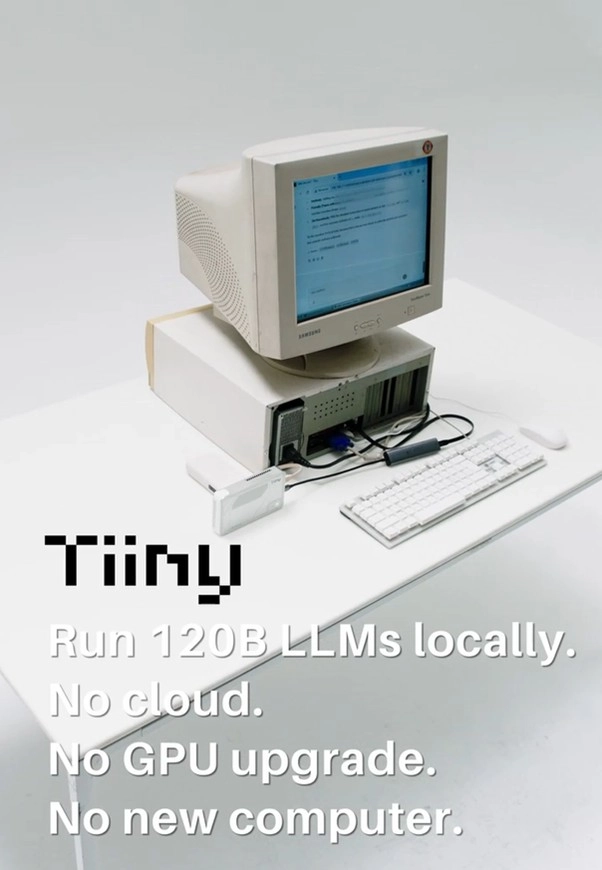
For years, the rule of AI has been simple: bigger models require bigger data centers. Tiiny AI just broke that rule. The deep-tech startup demonstrated a 120-billion-parameter large language model (LLM) running fully offline on a 14-year-old consumer PC, a 2011 machine rocking an Intel Core i3-530 and 2GB of DDR3 RAM.
This isn't just a clever stunt; it’s a direct challenge to the cloud-centric model dominating the industry. The demonstration, captured in one uninterrupted take, shows the GPT-OSS 120B model operating at speeds approaching 20 tokens per second, all while the host PC remains completely disconnected from the internet.
The trick is not the ancient host computer, but the external hardware: the Tiiny AI Pocket Lab. This pocket-sized device, recently verified by Guinness World Records for its local LLM capacity, handles the entire inference workload. Tiiny AI GTM Director Samar Bhoj stated that advanced AI "no longer needs massive GPU clusters or cloud infrastructure."
The End of Cloud Rental
If a 120B model can run locally, the necessity of renting compute time from AWS or Azure for high-end inference evaporates. This shift promises true data privacy and ownership over AI capabilities, moving intelligence away from data centers and onto the user’s desk.
The performance is enabled by Tiiny AI’s proprietary stack, specifically TurboSparse, a neuron-level sparse activation method, and PowerInfer, a heterogeneous inference engine. These technologies allow the massive model to execute efficiently within the Pocket Lab’s 65W power envelope, dynamically distributing workloads across its custom NPU and ARMv9.2 CPU.