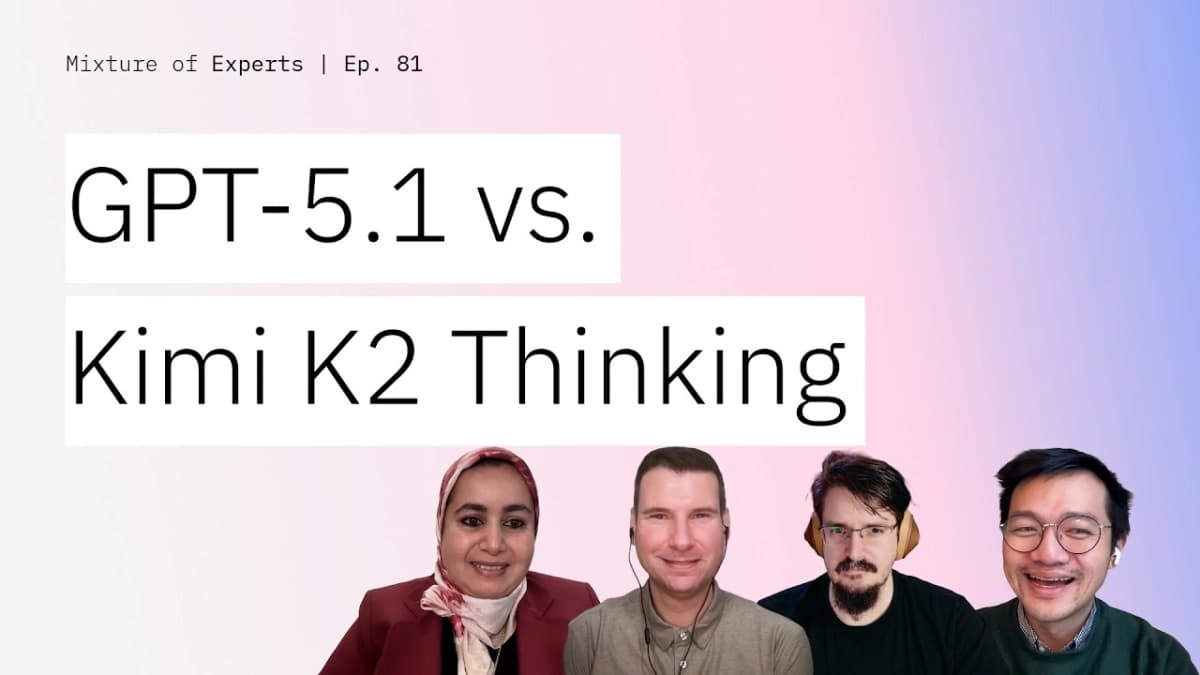
"Great AI should not only be smart, but also be enjoyable to talk to." This insight, quoted directly from OpenAI's own blog post regarding their latest release, encapsulates a pivotal shift in the artificial intelligence landscape, moving beyond raw intelligence benchmarks toward a more nuanced appreciation for user experience and conversational style. This was a central theme of the "Mixture of Experts" podcast, where host Tim Hwang, alongside panelists Kaoutar El Maghraoui (Principal Research Scientist and Manager, Hybrid Cloud Platform), Aaron Baughman (IBM Fellow, Master Inventor), and Mihai Criveti (Distinguished Engineer, Agentic AI), dissected the implications of OpenAI's GPT-5.1, Moonshot AI's Kimi K2 Thinking, and Microsoft's foray into agentic users for enterprise. The discussion painted a picture of an industry undergoing rapid evolution, where the very definitions of AI superiority and responsible deployment are being redefined.
The conversation around OpenAI's GPT-5.1 revealed a community with "mixed feelings," as Mihai Criveti noted, suggesting it felt "more of a cost optimization as opposed to really an issue with how warm the model is responding." While acknowledging the inherent improvements in intelligence, the panel highlighted OpenAI's strategic emphasis on "conversational style" as a key differentiator. Aaron Baughman elaborated on the critical role of style in fostering "empathy" and "trust" with users, facilitated by a "router mechanism" within GPT-5.1 that intelligently switches between "instant" (fast) and "thinking" (advanced) variants based on the interaction. This approach, Kaoutar El Maghraoui argued, marks a strategic move to differentiate through user experience, recognizing that raw intelligence is steadily becoming a commoditized asset in the burgeoning AI market. The push for a "warmer" and more personalized AI signals a battle for emotional connection, not just computational prowess.
This drive for personalization and user experience gains sharper contrast when juxtaposed with Moonshot AI's Kimi K2 Thinking. This open-source model has made significant waves, claiming superior performance against even proprietary models on a range of substantial benchmarks, including humanities last exam, browse comp, and swe bench. Mihai Criveti dubbed Kimi K2 a "very, very powerful open-source model," highlighting its ability to execute "300 sequential tool calls" and offer a "256k context" at a cost ten times cheaper than GPT-5. This potent combination of performance and accessibility positions Kimi K2 as a potential "Linux moment" for AI, as Kaoutar El Maghraoui suggested, shifting the "center of gravity in AI from secret models to shared ecosystems." The open-source triumph over proprietary giants on core reasoning tasks signals a democratization of advanced AI capabilities, forcing a re-evaluation of the value proposition for closed-source development.
Related Reading
- GPT-5.1: OpenAI’s Leap Towards Human-Centric AI and Enterprise Efficiency
- ChatGPT Atlas: Redefining the Web as an AI-Powered Agent
The panel also delved into Microsoft's ambitious plans for "agentic users" within enterprise workflows—a new class of AI agents designed to operate as independent users, attend meetings, edit documents, and communicate autonomously. While seemingly a leap forward in productivity, Mihai Criveti immediately raised red flags, labeling it a "security nightmare." He emphasized the profound implications for governance and compliance, questioning accountability when an AI agent, with its own identity and access, makes decisions or violates policies. "The organization really needs a unified audit log that can differentiate between human and agent actions," Kaoutar El Maghraoui stressed, underscoring the legal and ethical quagmire this introduces. The shift from AI as a mere tool to AI as a "teammate" or "co-worker" presents unprecedented management challenges, demanding new frameworks for oversight, trust, and even cultural integration within human-centric organizations.
The overarching insight from the discussion is the accelerating commoditization of raw AI intelligence, pushing developers to seek differentiation in user experience, personalization, and the strategic advantages of open-source ecosystems. The "IQ war" is giving way to an "EQ war," where the ability of AI to interact naturally and build trust is becoming as crucial as its processing power. However, this progress also ushers in a complex set of challenges, particularly with agentic AI, which demands a robust re-thinking of security, accountability, and the very nature of human-AI collaboration in the enterprise.