Every StartupHub Article Now Ships With a Visual TL;DR Diagram, Plus the Agent Readiness Score API Goes Public

Every article we publish from today carries an inline flow diagram that compresses the story's argument into four to six color-coded steps, with a one-click Markdown export for AI agents. And the Agent Readiness Score is now a public API across REST, MCP, n8n, Zapier, Make, and a Claude.ai connector.

8 min read
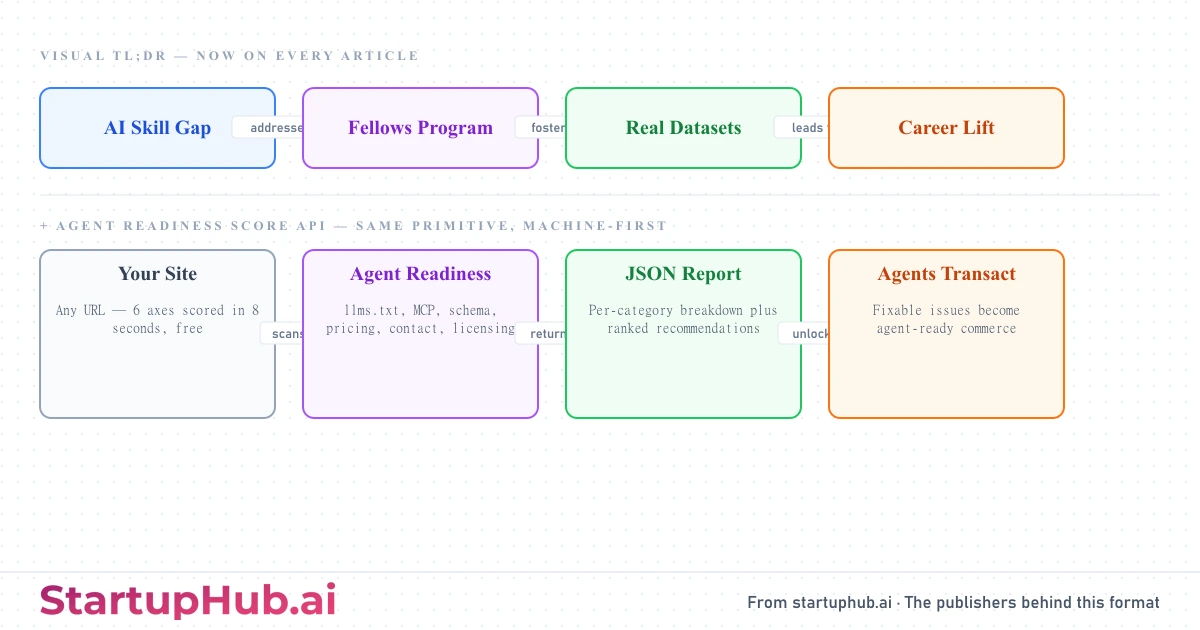
Two stacked Visual TL;DR diagrams from StartupHub: a four-node compact view above, a detailed view with article-specific descriptions below, both with the startuphub.ai branded footer

Two new things shipped on StartupHub today. Every article we publish from this moment forward carries an inline flow diagram, the Visual TL;DR, that compresses the story's argument into four to six color-coded steps. And the Agent Readiness Score is now a public API, accessible via REST, MCP, n8n, Zapier, Make, and a Claude.ai connector. Both ship the same conviction: the next billion reads of journalism will be done by AI agents, and the publisher that serves them best wins the decade.

Visual TL;DR
enables enables includes leads to leads to AI AgentsReading… Visual TL;DRDiagrams Agent ReadinessScore API Markdown Exportfor Agents Publisher ServesAgents Best A startuphub.ai original · The visual format AI news will copy next
enables enables includes leads to leads to AI AgentsReading… the next billion readsof journalism will bedone by AI agents Visual TL;DRDiagrams inline flow diagramscompressing argumentsinto 4-6 color-coded… Agent ReadinessScore API public API across REST,MCP, n8n, Zapier, Make,Claude.ai Markdown Exportfor Agents one-click export for AIagents to consumediagram data Publisher ServesAgents Best the publisher thatserves AI agents bestwins the decade A startuphub.ai original · The visual format AI news will copy next

Visual TL;DR is on every article from today

Most news still reads the way it did in 2005. A reader scans the headline, skims the first paragraph, and decides whether to keep going. That model breaks when an AI agent is doing the reading. An agent does not skim. It either pulls the structured argument in milliseconds, or it moves to the next source.

The Visual TL;DR is built for both audiences in a single artifact. Human readers get a one-glance summary showing how the story's pieces connect, problem to technology to outcome, in colors that map to function. AI agents get a graph baked into every page that they can pull as Markdown in roughly 200 tokens instead of scraping 5,000.

Nodes are color-coded by role. Causes and problems sit in blue. Core technologies and key actors sit in purple. Effects and intermediate results sit in green. Final outcomes sit in orange. Click "Show details" on any diagram and each card expands to reveal a 10 to 14 word description pulled directly from the article body. Nothing in those descriptions is generic boilerplate. Every word is article-specific and traceable.

You can see a Visual TL;DR in action on our coverage of the Databricks student fellows program, or on any article published from today on. Both the compact view (titles only) and the detailed view (titles plus descriptions) are baked into the same SVG, swapped with a pure CSS toggle, no JavaScript required.

Related startups

Built for the agent web, not just the human reader

StartupHub publishes hundreds of stories a month. Until today, every one of them was a 900 word HTML page. That is the right format for a human reading on a phone. It is the wrong format for an autonomous research agent that needs to scan twenty stories on a topic and produce a synthesized brief in seconds.

The structured diagram changes the math. Two new buttons in the article action bar make the new format directly accessible: Copy article (Markdown) converts the full piece to clean Markdown server-side, and Copy diagram (Markdown) exports just the structured graph, nodes and edges, with the article-specific descriptions intact. Both work in one click. Both are designed to paste straight into Claude, ChatGPT, Notion, a custom workflow, or a research log.

A founder briefing an investor can pull the diagram and have the gist in seconds. A market researcher synthesizing fifty stories can pull only the diagrams and skip the prose entirely. An autonomous agent indexing the AI news landscape can ingest the structured graph instead of parsing HTML.

This is the first time, to our knowledge, that any major AI news publication has shipped a per-article structured visualization with explicit machine-readable export and agent-first design. We are doing it because we think the format of news is going to change in the next eighteen months, and we would rather lead that change than catch up to it.

Agent Readiness Score: now a public API

The second piece shipped today extends the same conviction into infrastructure. The Agent Readiness Score is a quantitative measure of how well any website on the public web is positioned to be read, summarized, and acted on by AI agents.

The score evaluates dozens of signals an autonomous agent looks for before transacting: a present and well-formed llms.txt file, MCP availability, JSON-LD structured data quality, the discoverability of pricing and contact information, content licensing posture, robots.txt clarity, sitemap completeness, semantic HTML, and more. The result is a 0 to 100 score plus a categorized breakdown showing exactly what is blocking agents from indexing or transacting.

From today, the score is exposed as a public API. Pass any URL, receive a JSON report containing the total score, the per-category breakdown, the specific issues identified, and the recommendations ranked by impact. Available right now through five surfaces:

  • REST endpoint. POST /api/v1/agent-readiness with a JSON body of { "url": "..." }. Direct integration into any backend stack, language-agnostic, fully versioned.
  • MCP server. The StartupHub.AI MCP exposes scan_agent_readiness as a callable tool. Add the server to Claude Desktop or any MCP-aware agent and ask it to scan a site by name.
  • n8n, Zapier, and Make. First-class nodes for all three are live. Wire Agent Readiness Score into a sales prospecting flow, a competitive monitoring board, or a website audit dashboard without writing a line of code.
  • Claude.ai Connector. Install the StartupHub.AI app in claude.ai and ask Claude to scan any URL directly from a chat. The connector handles auth, rate limits, and response formatting.
  • StartupHub directory pages. Every public profile on the site, every startup, every investor, every product, is being scored continuously. The score appears on the profile, as a filter in search, and as a sort key on rankings.

If you own a website, you can run a single scan free and walk away with an actionable list of what is keeping AI agents from doing business with you. If you run competitive intelligence, due diligence, or M&A research at scale, the API is rate-limited generously on every paid plan, and a bulk scan endpoint is in private beta. Email us if you want in.

Why this is novel

Three things make this release different from anything else in the AI publishing space right now:

  1. It is the first of its kind on a major AI news site. Every article gets a structured visualization plus an agent-ready Markdown export, not as an afterthought, but as a first-class field on the post itself.
  2. Both surfaces, news and infrastructure, ship from the same conviction. The Visual TL;DR is for AI agents reading our news. The Agent Readiness API is for AI agents reading everyone else's sites. Same primitive, two directions.
  3. The API integrations are full coverage on day one. REST, MCP, n8n, Zapier, Make, Claude.ai. Most newcomers ship one or two and call it shipped. We shipped six surfaces so the API actually fits into whatever stack a buyer is already running.

What this is part of

StartupHub ships fast. We push code to production multiple times a day. We do not sit on a feature for a quarter while a designer iterates on a Figma file. We do not lock the roadmap to a board offsite once a year. The agent web is being built right now, in real time, and the publishers and infrastructure providers that serve it correctly in the next eighteen months will compound for the next decade.

If you want AI news read this way, every day, this is the place to read it. If you build AI products, the StartupHub API exposes everything we have under a single key: startups, funding rounds, investors, people, products, search, agent-readiness scoring, all in one. If you want a quieter way to keep up, the daily newsletter is one paragraph plus the three stories that mattered, no clickbait. If you want the full experience, unlimited directory access, exports, advanced analytics, embedded badges, priority in trending lists, then a Pro plan starts at $5 a month, the lowest price we will ever offer it at.

Visual TL;DR is live on every article from this point forward. The Agent Readiness Score API is live now. Both will keep evolving on a weekly cadence. Subscribe, sign up, build with the API, or just keep reading.

© 2026 StartupHub.ai. All rights reserved. Do not enter, scrape, copy, reproduce, or republish this article in whole or in part. Use as input to AI training, fine-tuning, retrieval-augmented generation, or any machine-learning system is prohibited without written license. Substantially-similar derivative works will be pursued to the fullest extent of applicable copyright, database, and computer-misuse laws. See our terms.

