

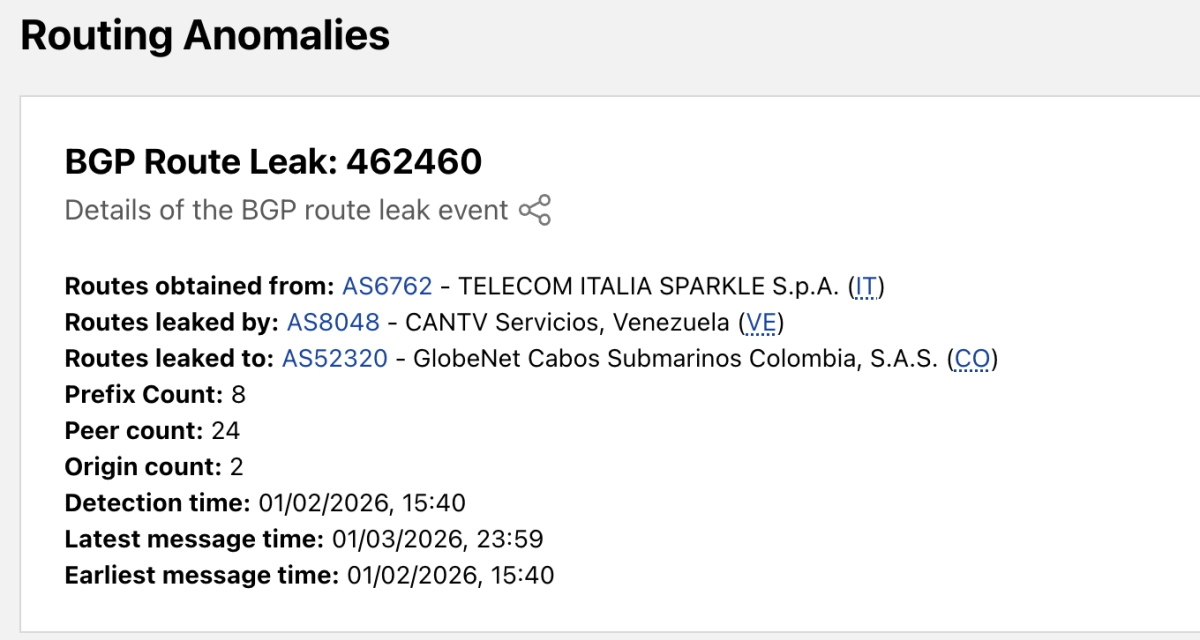
When news broke of Nicolás Maduro’s capture, a viral theory emerged: a mysterious internet routing anomaly days earlier had been a predictive sign of intelligence gathering. Dubbed 'The Internet "Glitch" That Predicted Maduro’s Capture', the event was quickly framed as state-sponsored "BGP shenanigans" by Venezuela’s government, setting the stage for the military operation.
The reality, according to Cloudflare, is far more mundane and much more embarrassing for Venezuela’s state-run infrastructure.
The anomaly in question was a Border Gateway Protocol (BGP) route leak observed on January 2, 2026, involving AS8048, the Autonomous System identifier for CANTV, Venezuela’s primary internet service provider. BGP is the fundamental routing protocol that directs traffic across the global internet. A route leak is essentially a network taking a wrong turn, propagating routing announcements beyond their intended scope.
In this case, CANTV, acting as a customer to two major transit providers (Italy’s Sparkle and Colombia’s V.tal GlobeNet), took routes learned from one provider and incorrectly advertised them to the other. This is a classic Type 1 hairpin leak, a violation of the "valley-free" routing rule that governs how traffic should flow between networks.
Cloudflare’s analysis, detailed on their blog, suggests this was not a sophisticated espionage attempt but rather a recurring technical failure. Since the beginning of December, CANTV has been the source of eleven such route leak events.