

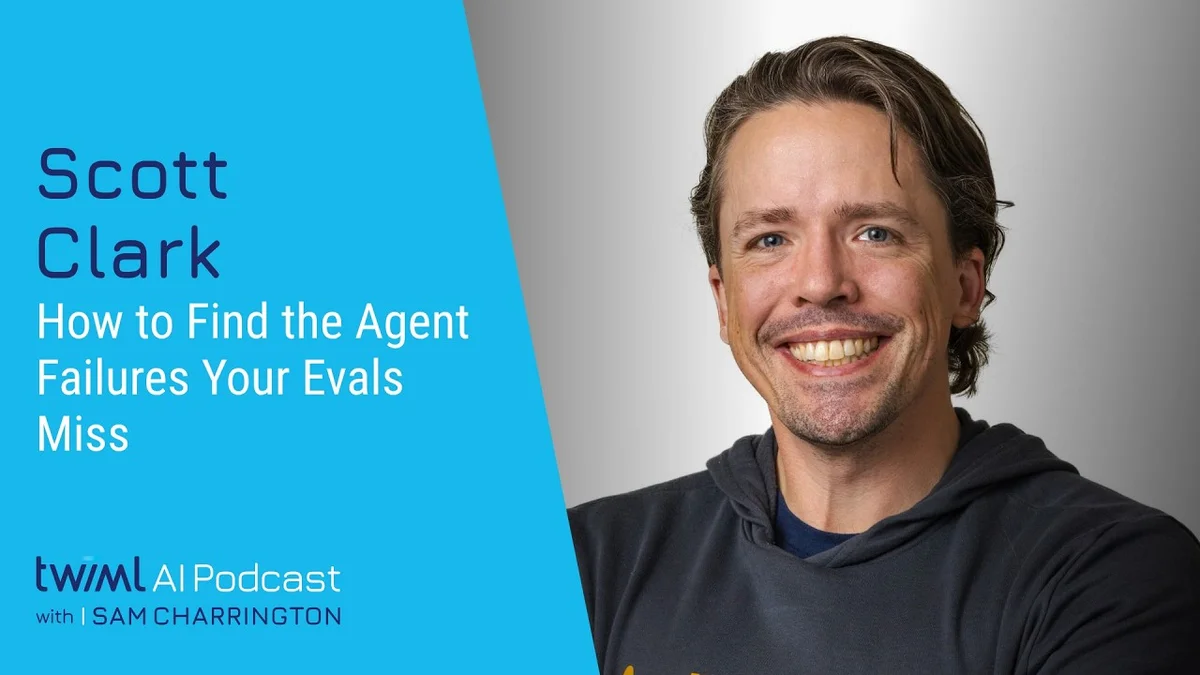
Scott Clark on Finding Agent Failures Beyond Standard Evals

Scott Clark on Finding Agent Failures Beyond Standard Evals
TWIML

In a recent TWIML AI Podcast episode, Scott Clark, co-founder and CEO of Distributional, joined host Sam Charrington to discuss the critical challenge of identifying agent failures that elude traditional evaluation methods. Clark, who previously worked at Intel and has a background in applied mathematics and AI, shared his insights on how to move beyond simple performance metrics to uncover the nuanced ways AI agents can falter in production.

Understanding the 'Unknown Unknowns'

Clark introduced a framework for understanding AI agent observability, likening it to a "Maslow's Hierarchy of Observability." At the base level is telemetry, followed by monitoring, and then, at the top, analytics. The core thesis is that while telemetry and monitoring provide visibility into expected behaviors, true robustness requires digging deeper to uncover what is not immediately apparent.

The full discussion can be found on TWIML's YouTube channel.

Related startups

How to Find the Agent Failures Your Evals Miss [Scott Clark] - 767 - TWIML
How to Find the Agent Failures Your Evals Miss [Scott Clark] - 767 — from TWIML

This is where the concept of "unknown unknowns" comes into play. Clark explained that standard evaluations often focus on expected performance, potentially missing failures that occur in unexpected scenarios or due to unforeseen interactions. His company, Distributional, aims to address this by focusing on identifying these unknown unknowns through advanced analytics and understanding the distribution of agent behaviors.

From Pre-Production to Post-Production Analysis

Clark highlighted the evolution of AI development, moving from a strong emphasis on pre-production testing to a greater need for continuous post-production analysis. He noted that while traditional methods like benchmarking and performance optimization are important, they are insufficient on their own. The real value, he argued, lies in understanding how agents perform in real-world, dynamic environments, where unexpected behaviors can emerge.

He elaborated on his own journey, starting from his PhD research in applied mathematics and physics, where he encountered similar challenges in understanding complex systems. This experience led him to realize that simply optimizing for a single metric isn't enough. Instead, he emphasized the need to identify patterns and anomalies in agent outputs and behaviors that might indicate underlying issues.

Distributional AI and its Core Principles

Clark explained that Distributional AI is built on the principle of understanding the distribution of an agent's behavior. By analyzing the outputs and actions of an agent over time, they aim to identify what is normal and what deviates from that norm. This allows them to detect potential failures, biases, or unintended consequences that might not be apparent through traditional evaluation methods.

He drew parallels to his experience at Intel, where he worked on AI optimization. While the goal was to improve performance, he realized that the true challenge was ensuring reliability and understanding the agent's behavior across a wide range of inputs. This led to the development of Distributional's approach, which focuses on identifying and addressing these complex, often subtle, failure modes.

The Role of Analytics in Uncovering Failures

Clark emphasized that analytics play a crucial role in this process. By analyzing the logs and outputs of AI agents in production, companies can gain insights into their behavior and identify potential issues before they impact users or business outcomes. This proactive approach, he argued, is essential for building trustworthy and reliable AI systems.

He further elaborated on the concept of "black box" optimization, where the underlying mechanisms of an AI model are not fully understood. While these models can achieve high performance, they can also exhibit unexpected behaviors or biases that are difficult to detect. Distributional's approach aims to bring more transparency and understanding to these complex systems.

Key Takeaways for AI Development

Clark stressed that the focus should shift from solely optimizing for performance metrics to a more holistic approach that includes understanding and mitigating potential failures. This involves developing better evaluation methods, leveraging advanced analytics, and building systems that can continuously monitor and adapt to changing environments.

Ultimately, Clark's message was clear: AI agents are complex systems, and ensuring their reliability and trustworthiness requires a deep understanding of their behavior, not just their performance on specific benchmarks. By focusing on observability, analytics, and the identification of unknown unknowns, companies can build more robust and effective AI systems.

© 2026 StartupHub.ai. All rights reserved. Do not enter, scrape, copy, reproduce, or republish this article in whole or in part. Use as input to AI training, fine-tuning, retrieval-augmented generation, or any machine-learning system is prohibited without written license. Substantially-similar derivative works will be pursued to the fullest extent of applicable copyright, database, and computer-misuse laws. See our terms.