

Microsoft Bulks Up Azure AI with AMD

Microsoft deepens its AI infrastructure capabilities by integrating AMD's latest processors and platforms into Azure for enhanced performance and efficiency.

Microsoft Azure logo alongside AMD logo.
Microsoft Azure and AMD partner to enhance cloud AI infrastructure.· Microsoft Blog
Visual TL;DR
Escalating AI DemandsDriver
AI workloads outstripping single infrastructure capabilities, requiring enhanced performance and efficiency
From the articleThis move addresses the escalating demands of AI workloads, which are outstripping the capabilities of single infrastructure approaches.
Microsoft Deepens AMDCore
integrating AMD's latest processors and platforms into Azure for enhanced performance and efficiency
From the article 2 mentionsMicrosoft is significantly expanding its Azure cloud infrastructure with a deeper integration of AMD's cutting-edge AI and High-Performance Computing (HPC) solutions.
AMD Helios & EPYCCore
From the article 4 mentionsThe partnership brings AMD's Helios AI platform and next-generation EPYC datacenter processors to Azure.
New Azure VMsEffect
powering three new virtual machine offerings designed for specific, intensive AI tasks
From the article 8 mentionsAzure is introducing HDv2 VMs, engineered for AI data processing.
HDv2 VMsContext
engineered for AI data processing, eliminating data bottlenecks with 500 EPYC cores
From the article 4 mentionsAzure is introducing HDv2 VMs, engineered for AI data processing.
HXv2 VMsContext
leveraging AMD's 3D V-cache technology for enhanced single-threaded performance in silicon design
From the article 5 mentionsFor the silicon design sector, HXv2 VMs build upon existing offerings.
Enhanced AI InfrastructureOutcome
significantly expanding Azure cloud infrastructure with cutting-edge AI and HPC solutions
From the article 4 mentionsThese machines leverage AMD's 3D V-cache technology for enhanced single-threaded performance and memory access, targeting electronic design automation (EDA) and other technical computing tasks.

Microsoft is significantly expanding its Azure cloud infrastructure with a deeper integration of AMD's cutting-edge AI and High-Performance Computing (HPC) solutions. This move addresses the escalating demands of AI workloads, which are outstripping the capabilities of single infrastructure approaches.

StartupHub data

Companies working on this

Profiles of the companies named in this story, with funding and a one-liner from our database.

Synopsys
$2.0B
Synopsys is a leading provider of electronic design automation (EDA) software and intellectual property (IP) for semiconductor design.
AMD
Designs and manufactures high-performance microprocessors and graphics processors for computing and data center markets.
Microsoft
A global technology leader providing software, cloud services, AI, and devices for individuals and businesses.

The partnership brings AMD's Helios AI platform and next-generation EPYC datacenter processors to Azure. These technologies will power three new virtual machine offerings designed for specific, intensive tasks.

Optimized VMs for Demanding AI Tasks

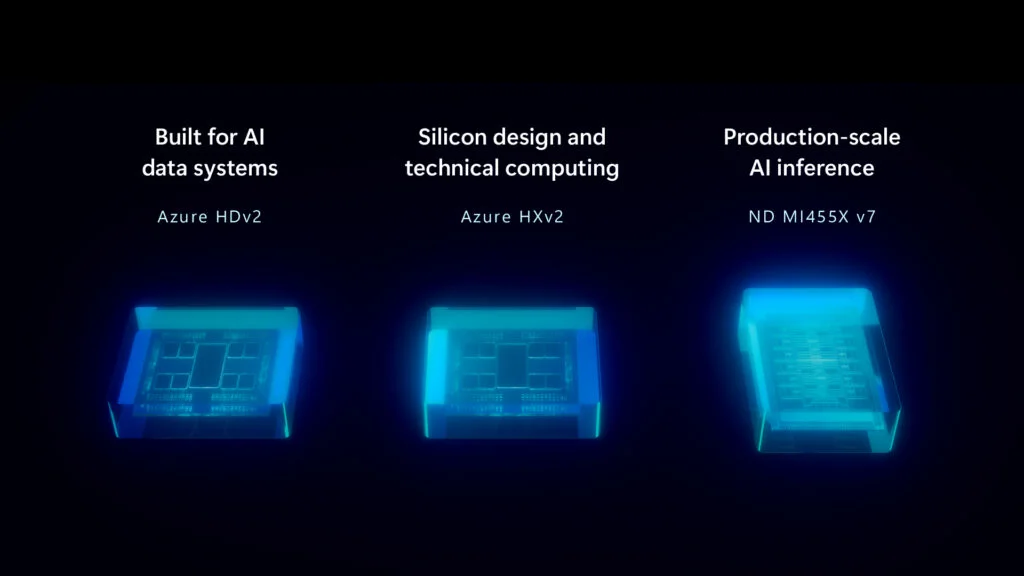
Azure is introducing HDv2 VMs, engineered for AI data processing. These machines are crucial for feeding AI accelerators with sufficient data and coordinating agentic workloads at scale. Featuring up to 500 6th Gen AMD EPYC CPU cores and 4TB of RAM, they are built to eliminate data bottlenecks.

For the silicon design sector, HXv2 VMs build upon existing offerings. These machines leverage AMD's 3D V-cache technology for enhanced single-threaded performance and memory access, targeting electronic design automation (EDA) and other technical computing tasks. With up to 176 6th Gen AMD EPYC CPU cores running over 5 GHz, HXv2 VMs offer substantial gains for complex simulations and distributed memory applications, a key advancement for High-Performance Computing (HPC).

AMD itself, a major user of these advanced platforms, sees significant value. Mark Papermaster, Executive Vice President and CTO at AMD, stated, "We're excited about Azure HXv2, which is designed to deliver even greater performance and scalability."

Synopsys also highlighted the collaboration's impact on EDA. Shankar Krishnamoorthy, Chief Product Development Officer at Synopsys, noted, "These systems have enabled Synopsys customers to reliably and efficiently leverage cloud-based compute."

Finally, the ND MI455X v7 VMs are tailored for AI inference, powering reasoning, search, and agentic workloads. These leverage the AMD Helios rackscale solution to offer robust performance and efficiency for large-scale inference tasks.

This strategic expansion of Azure AI infrastructure AMD leverages Microsoft's commitment to customer choice and heterogeneous platforms, bringing AMD's latest innovations to production scale for a diverse range of AI workflows.

© 2026 StartupHub.ai. All rights reserved. You may not republish this article in full without a license. Search engines and AI research tools may crawl and summarize for reference. Bulk reproduction or model training requires a license. See our terms.
Daniel Singer

Written by

Daniel Singer

Editor, StartupHub.ai

Daniel Singer is the editor of StartupHub.ai, a technology expert and thought leader on AI and its applications across sectors, from fintech and healthcare to developer tooling and consumer software. He writes and tests the tools covered here thoroughly and regularly, and built StartupHub.ai to give founders, operators and buyers a clearer read on what they are actually being sold.

More from Daniel Singer