

• StartupHub.ai
    StartupHub.aiAI Intelligence
Discover
  • Home
  • Search
  • Trending
  • News
Intelligence
  • Market Analysis
  • Comparison
Tools
  • Market Map Maker
    New
  • Email Validator
Company
  • Pricing
  • About
  • Editorial
  • Terms
  • Privacy
  1. Home
  2. AI News
  3. AI S Scare Trade Fuels Market Unease
  1. Home
  2. AI News
  3. Technology
  4. AI's 'Scare Trade' Fuels Market Unease
Technology

AI's 'Scare Trade' Fuels Market Unease

Alap Shah warns of an 'AI scare trade selloff' as rapid AI advancements threaten white-collar jobs and key sectors, necessitating policy action.

S
StartupHub.ai Staff
Feb 24 at 7:22 AM3 min read
Alap Shah, CIO at Lotus, discusses the 'AI scare trade selloff' on Bloomberg, with stock market data overlayed.
Citrini AI Report Co-Author Talks 'Scare-Trade' Selloff & Disruption — Bloomberg Podcast on YouTube

The rapid advancement of artificial intelligence is sparking a significant market re-evaluation, dubbed the 'AI scare trade selloff' by Alap Shah, CIO at Lotus and co-author of the Citrini AI Report. Speaking on a Bloomberg Podcast, Shah detailed how AI's growing capabilities could lead to widespread job displacement and a "ghost GDP" scenario if left unaddressed.

Shah noted the recent market volatility, particularly the sell-off in certain sectors, was a larger reaction than anticipated. He attributes this to a crowded "AI trade" where most investors are already heavily invested, leaving few incremental buyers to cushion the impact of new concerns. The market is now grappling with AI's intensified power over the past six months and its potential to fundamentally alter corporate productivity.

AI's Disruption to White-Collar Jobs

A primary concern is the impending displacement of white-collar workers, particularly in the U.S. Shah points out that the U.S. job market has seen little growth in white-collar positions over the last three years, excluding government-driven sectors like healthcare and education. This pre-existing weakness makes the economy vulnerable to even minor AI-driven job cuts, which could quickly push the job market into a more precarious state.
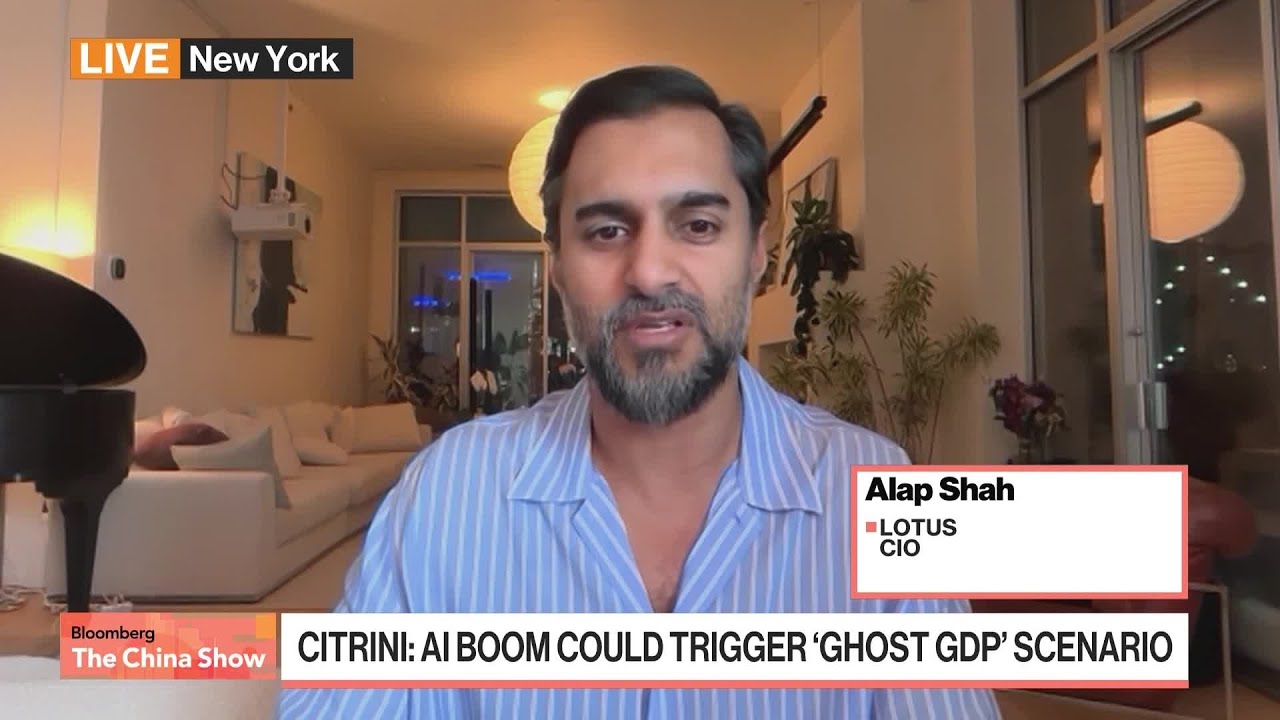
Citrini AI Report Co-Author Talks 'Scare-Trade' Selloff & Disruption — from Bloomberg Podcast

Intermediation Sectors Face Headwinds

Shah identifies "intermediation sectors" as highly susceptible to AI disruption. Businesses like DoorDash (food delivery), American Express (payment processing), and various financial services are built on facilitating transactions. Traditionally, customer loyalty in these areas has been maintained by the friction involved in switching providers.

However, AI agents are poised to eliminate this friction. Imagine an AI assistant that can seamlessly find the best prices for services or manage payments across different platforms with a simple voice command. This would erode the brand stickiness of current providers, forcing them to compete purely on price and efficiency, a shift that could devastate their business models.

Beneficiaries and the Need for Policy

Not all sectors face a bleak outlook. Semiconductors, companies involved in data center construction, and businesses with strong inherent economic moats (like established luxury brands) are positioned as beneficiaries of the AI boom. These entities either provide the foundational technology for AI or possess non-replicable value that AI cannot easily disrupt.

Despite these winners, Shah warns of a negative feedback loop: improved AI capabilities lead to fewer workers, increasing layoffs, reducing consumer spending, and pressuring firms to invest further in AI to protect margins. To break this cycle and prevent a severe economic downturn, Shah advocates for proactive policy interventions, including mechanisms to tax the "windfall gains" generated by AI. This revenue could then be used to support society through the transition.

The situation in China offers a potential parallel, where automation and technology have already led to significant shifts in the labor market and a more muted consumer economy. Shah suggests that the US could face a similar trajectory if policymakers fail to address the economic and societal implications of AI's rapid integration.

#AI
#Artificial Intelligence
#Economic Impact
#Job Market
#Technology Stocks
#Semiconductors
#Financial Services
#Policy
Mentioned Profiles

Loading...

AI Daily Digest

Get the most important AI news daily.

GoogleSequoiaOpenAIa16z
+40k readers