

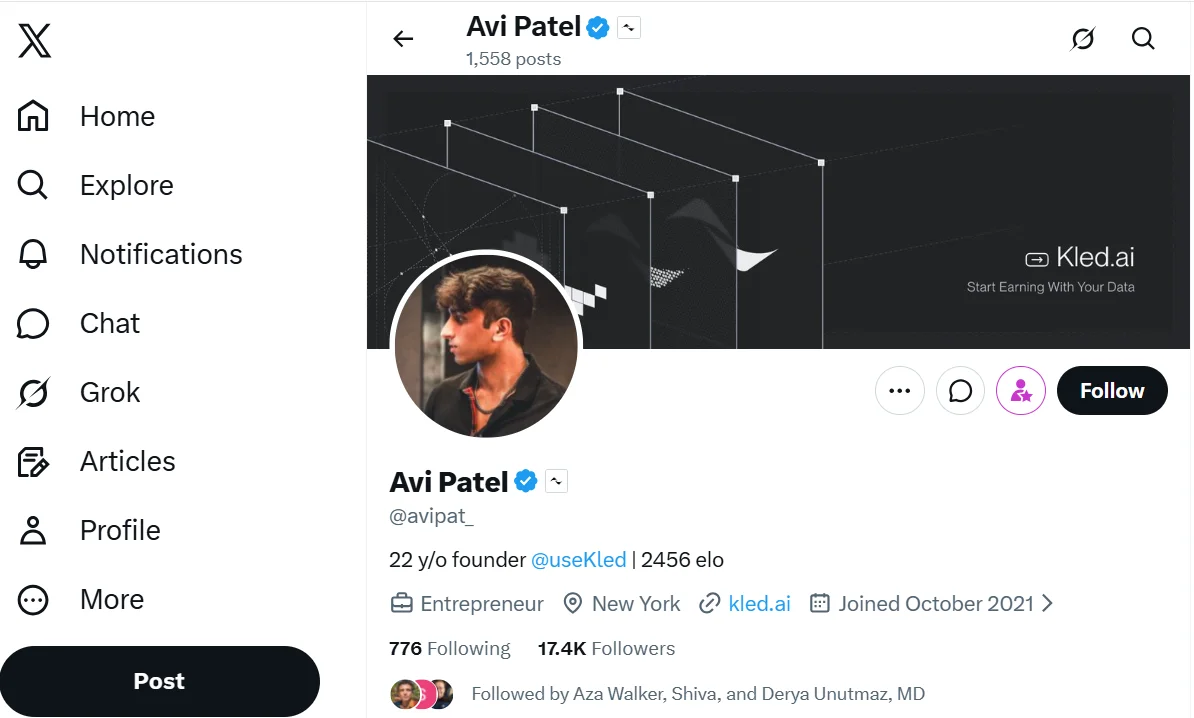
A 22-year-old founder pulled his app from a country of 230 million people this weekend, then explained the decision in a public thread that, taken on its own terms, is one of the more revealing tech-industry artifacts of the year.
Avi Patel, founder of Kled, an Andreessen Horowitz and Unshackled Ventures-backed data-licensing startup that pays users for camera-roll content, announced on X that the company had "removed Kled from the Nigerian app store and IP banned the entire region." His justification: a claimed 95% fraud rate on Nigerian uploads, against a sub-10% rate in Malaysia, Indonesia and the Philippines, plus a flood of "fake Japanese passports and identity cards with Nigerians photoshopped onto them" hitting his KYC system.
The cost of the bad data, Patel wrote, had become more than the company could absorb. So he banned the country.
Then, lest anyone misread the move, he opened with a disclaimer: "I have nothing against Nigeria. I have a ton of friends from this region."
Nigeria, by the numbers Patel did not look up
Before getting to the engineering, the math. Nigeria is the 52nd-largest economy in the world by nominal GDP, sized at roughly $285 billion in 2025, and the 19th-largest by purchasing power parity at $2.25 trillion. Population: 223 million people. The country accounts for 28% of all fintech companies on the African continent, and its telecom sector alone contributes more than 12% of national GDP.
Lagos, the city Patel just IP-blocked along with everything around it, is itself a roughly $259 billion economy. Per Startup Genome, the Lagos startup ecosystem is valued at $9.8 billion, hosts more than 2,000 startups, has produced 31 exits worth $446 million over the past five years, and ranks #1 in Sub-Saharan Africa for funding. There are three active unicorns based out of it. Nigerian startups raised more than $400 million in 2024 alone.
Kled, by contrast, has been "out of beta for 4 months."
This is the country Patel just declared a single fraud row in his dashboard. Not in the casual sense. In the literal sense: 223 million people, the third-fastest-growing tech ecosystem on the African continent, currently barred from his app at the IP layer because his startup, four months out of beta, decided that easier than fixing the funnel.
The thing he is actually doing
Within Patel's framing, "Nigeria" is a single row that returned a number he did not like. So he zeroed it out.
What is missing from the post, conspicuously, is any acknowledgement that "95% of submissions to one accelerator-stage app's KYC funnel" is a statement about that funnel. Not about a country. The post does not name which fraud-detection tooling failed, what the false-positive rate was, what was tried before the nuclear option, what review process classified images as "AI-generated," or what recourse the legitimate Nigerian users (who, by Patel's own admission, kept Kled "top 100 on the Nigerian app store for 4 months") now have. The receipts, where he offers them, are screenshots of his own internal flags.
The Lagos fintech sector has spent fifteen years building KYC stacks that work in a country where document fraud is real and routinely defeated. They did not get there by IP-banning the country. They got there by hiring people who understood the country and engineering against the actual threat. Kled's fraud system, four months in, was not equal to that. Fine. The honest sentence is "our fraud system is not yet good enough to operate in this market and we are pulling out until it is." That is not what Patel wrote. What Patel wrote externalised his own engineering deficit onto 223 million people.
The reply guys, and the answer he gave them
When pushed on the obvious problem, an entire nationality declared fraudulent because his startup could not engineer around its scammers, Patel doubled down. To one critic who called him racist, he replied that Kled "paid out tens of thousands of dollars to this community via a job sector that was completely and entirely non-existent until I came along."
Read that sentence twice. It is a 22-year-old asserting that the on-the-ground informal economy of Nigeria, a country with one of the largest tech and creator-economy footprints on the African continent, did not exist before his data-buying app showed up. The disclaimer was not "I have nothing against Nigeria." The disclaimer was the rest of the thread.
The full post, for the record
We have removed Kled from the Nigerian app store and IP banned the entire region.
The first thing I would like to say is I have nothing against Nigeria. I have a ton of friends from this region and these were some of our earliest app adopters. Genuinely, thank you all for the support.
Kled has been up and running and out of beta for 4 months now. We have paid out hundreds of thousands of people for their data, and our users have uploaded over 1 billion assets onto our platform.
After several months of uploads we found that Nigeria had a ≈95% fraud rate. Instead of real, usable data, users were uploading pictures of black screens, duplicate photos, internet generated images, AI generated images, etc. at an unimaginable scale.
In comparison, Malaysia, Indonesia, and the Philippines have a less than 10% fraud rate across 10x the userbase size.
Our fraud system is fast to catch these issues but the level of complexity of these schemes is getting out of hand.
This weekend we were flooded with thousands of fake Japanese passports and identity cards with Nigerians photoshopped onto them in our KYC system. That was the final straw.
As a startup we can't afford to eat the costs of that data overhead, so we temporarily removed the app from the region while we improved our fraud detection and banning system to quickly filter out bad actors when the time is right.
On top of all of this, every time we make a post there is someone asking us to bring the region back within seconds. We hear you, but it's gotten out of hand.
We've made this decision with great care. We love everyone who has genuinely supported Kled from Nigeria, and we hope to return when the time is right.
-Kled Team
Where the investors come in
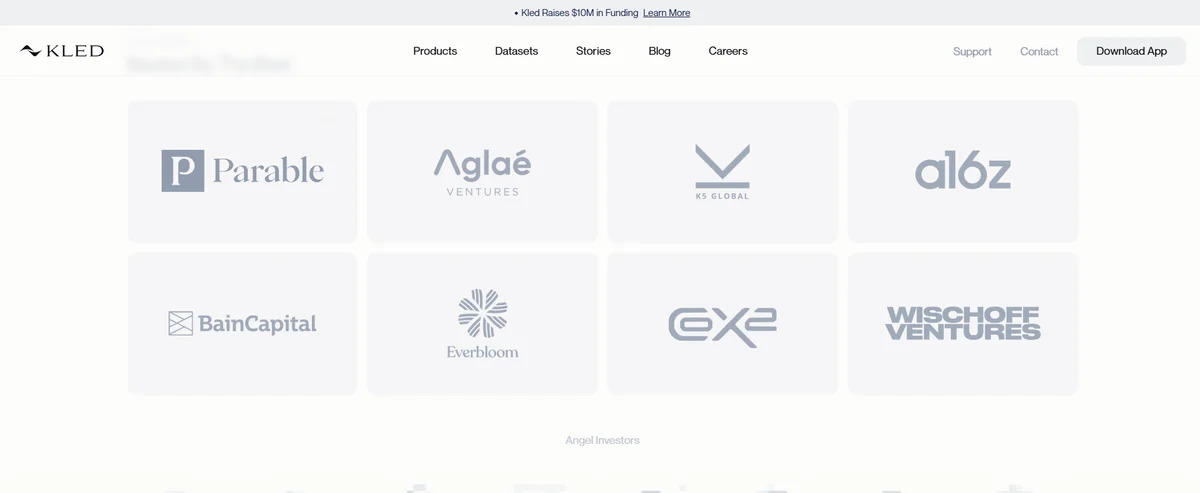
Kled's cap table, per our records, includes Andreessen Horowitz and Unshackled Ventures. The latter is particularly worth sitting with: Unshackled's stated mission is backing immigrant founders against systemic gatekeeping. Their portfolio company just told 230 million people, by IP block, that they are presumed bad actors. Both firms have, as of writing, said nothing.
This silence is a choice. Venture firms that fund 22-year-old founders are not passive bystanders on the cap table. They sit on boards or have observer seats. They review burn. They get pinged when a portfolio company is about to do something that will end up screenshotted on X. And when the founder they backed posts a thread that reduces a country of 230 million to a noisy data source, they have two options: pull him aside and tell him to delete the post and hire a better fraud team, or post a thread of their own. Neither has happened.
The reason matters. A serious investor who funded this founder has, downstream, a duty of care to the millions of people the founder's product touches. That duty does not end at the LP report. When a 22-year-old does this in public and the firms who wrote the check say nothing, the absence is not neutrality. It is endorsement.
The actual story
Fraud rings targeting paid-data apps are real, KYC abuse is real, and a startup's right to defend its margins is real. None of that is in dispute. What is in dispute is the framing that lets a founder collapse a real engineering problem (his fraud detection cannot keep pace with sophisticated submissions) into a national-character verdict (Nigerians cannot be trusted) and post it as if it were a quarterly update.
The story is not that Kled has a fraud problem. Every consumer app does. The story is that the founder's instinct, when his system was overwhelmed, was to ban the country rather than admit the system, and that the venture firms whose names sit on his deck have nothing to say about it.
For context on how serious teams handle startup fraud detection and the broader category of automating risk detection, the contrast is stark. Building a fraud system that scales across geographies is hard. Banning a flag is easy. The two are not interchangeable, even when the cap table thinks they are.
Patel is 22. He will get older. The decisions he made this weekend, and the silence of the people who gave him the money to make them, will not age the way he hopes. The Lagos ecosystem will, and so will the 223 million people he just told, by IP block, that they are presumed to be lying.
