

Google is taking another major step beyond the chatbot, releasing a new model designed to give AI agents eyes and hands to directly control software. Unveiled today, the Gemini 2.5 Computer Use model allows AI to interact with graphical user interfaces (GUIs) just like a person would, by looking at the screen, clicking buttons, typing in forms, and navigating complex websites.
Available in preview for developers via the Gemini API, this isn't about connecting to clean, structured APIs. It's about tackling the messy reality of the web, where most tasks still require direct human interaction. Google's demos show the model scraping pet details from one website and inputting them into a separate CRM, then booking an appointment, a multi-step, cross-application task that has long been the holy grail for AI assistants.
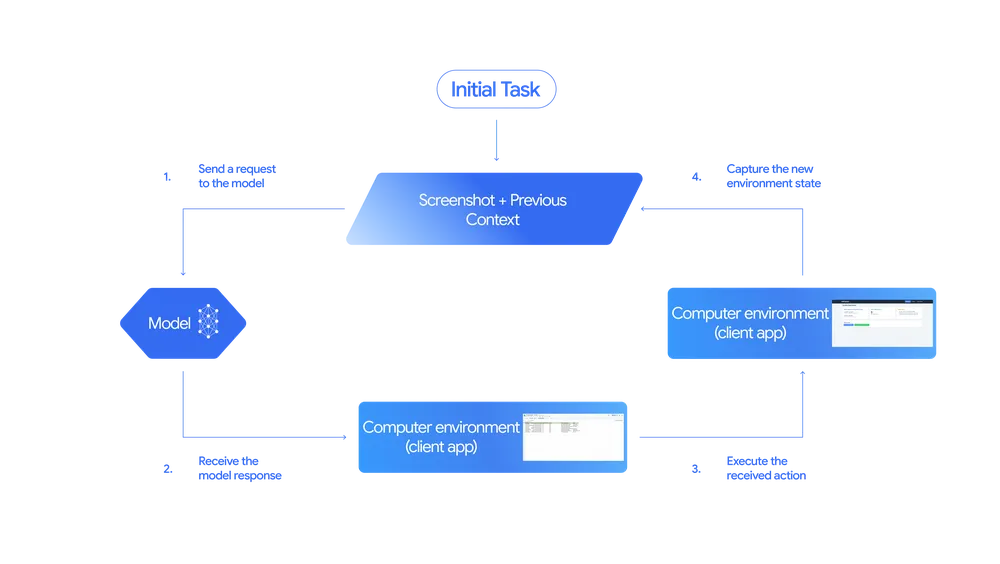
The system works in an iterative loop. A developer's agent sends the model a user's goal along with a screenshot of the current application window. Gemini Computer Use analyzes the image and the goal, then returns a specific action, like `click(x, y)` or `type("text")`. The agent executes that command, takes a new screenshot, and sends it back to the model for the next step. This continues until the task is complete.
The race for a true AI assistant
Google is making aggressive performance claims, positioning Gemini Computer Use as a direct challenger to similar efforts from OpenAI and Anthropic. According to benchmarks shared by Google DeepMind, the model outperforms leading alternatives on web and mobile control tasks like Online-Mind2Web and WebVoyager. More importantly, Google claims it does so with lower latency, a critical factor for agents that need to feel responsive, not sluggish. One chart shows Gemini achieving over 70% accuracy on a key benchmark in around 225 seconds, while competitors lag in both speed and accuracy.
This is the core of the AI agent race: creating a tool that can reliably and quickly perform complex digital chores. Early testers are already putting it to work. The AI assistant Poke.com claims the model is "50% faster and better" than other solutions, while the automation service Autotab saw an 18% performance boost on its hardest evaluations. Even Google's internal payments team is using it to salvage over 60% of its previously failing UI tests, turning a multi-day fix into an autonomous recovery.


