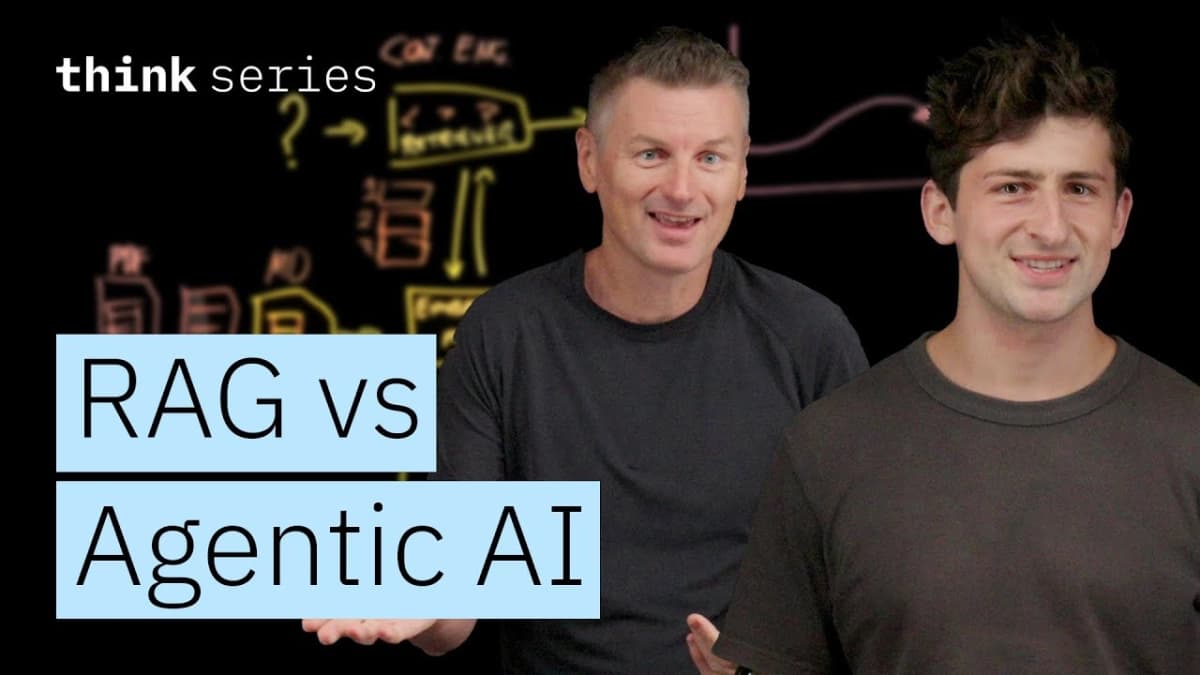
The evolving capabilities of Large Language Models (LLMs) are being dramatically reshaped by the synergistic application of Agentic AI and Retrieval Augmented Generation (RAG). Martin Keen, Master Inventor at IBM, and Cedric Clyburn, Sr. Developer Advocate at Red Hat, delved into this powerful combination during their discussion live from TechXchange in Orlando, clarifying how these approaches enhance AI’s ability to “think and act” with greater precision and autonomy. Their insights challenged common misconceptions, asserting that the optimal application of these technologies is rarely a simple "always" but rather, "it depends."
Agentic AI fundamentally transforms how LLMs operate by enabling them to engage in sophisticated multi-agent workflows. As Keen explained, these AI agents perceive their environment, consult memory, reason, act, and observe outcomes in a continuous, self-improving loop, all with minimal human intervention. This architectural pattern forms a closed feedback system, allowing AI to execute complex tasks autonomously rather than simply responding to single prompts. Keen articulated the agent’s lifecycle: "They perceive their environment, they make decisions, and they execute actions towards achieving a goal." These agents operate at the application level, utilizing tools and communicating with each other to achieve objectives.
Cedric Clyburn elaborated on practical applications, noting that "the primary use case for Agentic AI today is coding." He envisioned scenarios where specialized agents could plan and architect new ideas, write code directly to repositories, and even review generated code, effectively acting as a mini-developer team. Beyond coding, Agentic AI holds immense potential for enterprises needing to automate complex processes, such as handling support tickets or HR requests. The human role shifts from a direct instrument player to a "conductor of an orchestra," guiding the agents and overseeing their collective output rather than performing every task.
However, a critical vulnerability of standalone LLMs quickly surfaced in their discussion. Keen highlighted that "without reliable access to external information, these agents, they can quickly hallucinate... they can make misinformed decisions." This inherent limitation of LLMs, where their responses are based solely on their training data, makes them prone to generating plausible but incorrect or outdated information, especially when dealing with domain-specific or rapidly changing facts. This precise data grounding mitigates the inherent risks of LLM hallucination and outdated information.
This is precisely where Retrieval Augmented Generation (RAG) becomes indispensable. RAG acts as a critical mechanism to ground LLMs in factual, up-to-date, and proprietary data, mitigating the risk of inaccurate or irrelevant responses. Cedric Clyburn succinctly defined it as "essentially a two-phase system," comprising "an offline phase where you ingest and index your knowledge, and an online phase where you retrieve and generate on demand." This dual-stage approach ensures that LLMs have access to the most pertinent and reliable information at the moment of query.
The offline phase of RAG involves taking raw documents—be they PDFs, Word files, spreadsheets, or other unstructured data—and breaking them into smaller, manageable chunks. An embedding model then converts these textual chunks into numerical vector embeddings, which capture the semantic meaning of the content. These embeddings are stored in a specialized vector database, creating a searchable, semantic index of the organization's entire knowledge base. This process ensures that vast amounts of diverse information are transformed into a format that can be quickly and intelligently queried.
During the online phase, a user's prompt is fed into a retriever, which uses the same embedding model to convert the query into vector embeddings. A similarity search is then performed against the vector database to fetch the most relevant document chunks, perhaps "three to five passages that are most likely to contain the answer." These retrieved passages, along with the original query, are then passed to the LLM. The LLM uses this augmented context to generate a more informed, accurate, and grounded response, directly addressing the user's query with verified information.
The effectiveness of RAG, however, hinges on meticulous data curation and "context engineering." Clyburn stressed the importance of being "really intentional about our data curation," utilizing open-source tools like Docling to convert diverse document types, from PDFs to markdown, into machine-readable formats with associated metadata. This process ensures that not just text, but also tables, graphs, and images, are properly indexed and understood by the system. Context engineering then involves optimizing how these retrieved chunks are presented to the LLM, potentially combining related chunks and re-ranking them for relevance, to create a "single coherent source of truth." This careful preparation prevents the LLM from being overwhelmed by irrelevant data, which can degrade performance due to noise or redundancy, as illustrated by the accuracy-versus-tokens graph presented in the video.
The synergy of Agentic AI and RAG offers substantial benefits. This combined approach leads to "higher accuracy, faster inference, and cheaper AI costs," as Clyburn pointed out. By providing agents with reliable, external knowledge through RAG, their decision-making process is improved, reducing hallucinations and enhancing the overall quality of autonomous workflows. Furthermore, the discussion touched upon the growing trend of leveraging local, open-source models for RAG and Agentic AI applications. This allows developers to maintain the same API functionality as proprietary models while gaining the crucial advantages of data sovereignty—keeping sensitive information on-premise—and the flexibility to tweak model runtimes for improved performance, such as through KV caching. This capability to accelerate RAG and Agentic AI applications using open-source solutions represents a significant leap for enterprises seeking control and efficiency in their AI deployments.