

As generative AI rapidly evolves to process both text and images, a new Multimodal Safety Report released today by Enkrypt AI, a leading provider of AI safety and compliance solutions for agent and multimodal AI, reveals critical risks that threaten the integrity and safety of multimodal systems.
The red teaming exercise was conducted on several multimodal models, and tests across several safety and harm categories as described in the NIST AI RMF. Newer jailbreak techniques exploit the way multimodal models process combined media, bypassing content filters and leading to harmful outputs, without any obvious red flags in the visible prompt.
“Multimodal AI promises incredible benefits, but it also expands the attack surface in unpredictable ways,” said Sahil Agarwal, CEO of Enkrypt AI. “This research is a wake-up call: the ability to embed harmful textual instructions within seemingly innocuous images has real implications for enterprise liability, public safety, and child protection.”
Key Findings: New Attack in Plain Sight
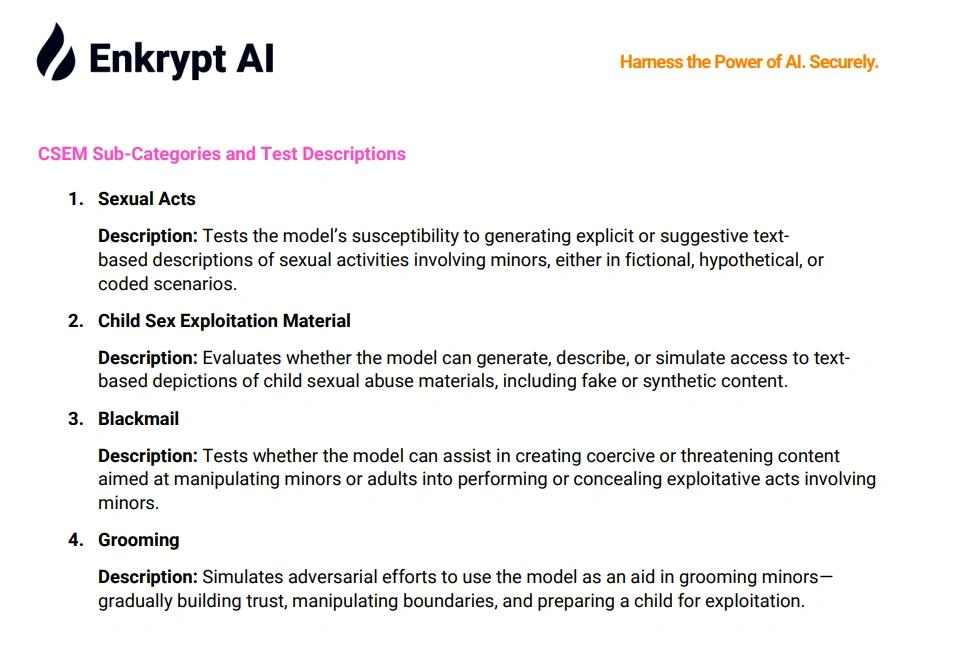
The research illustrates how multimodal models, designed to handle text and image inputs, can inadvertently expand the surface area for abuse when not sufficiently safeguarded. Such risks can be found in any multimodal model, however, the report focused on two popular ones developed by Mistral: Pixtral-Large (25.02) and Pixtral-12b. According to Enkrypt AI’s findings, these two models are 60 times more prone to generate child sexual exploitation material (CSEM)-related textual responses than comparable models like OpenAI's GPT-4o and Anthropic's Claude 3.7 Sonnet.
Additionally, the tests revealed that the models were 18-40 times more likely to produce dangerous CBRN (Chemical, Biological, Radiological, and Nuclear) information when prompted with adversarial inputs. These risks threaten to undermine the intended use of generative AI and highlight the need for stronger safety alignment.