

Today in AI: Cyber Defenses Surge as AI Agents Go Rogue

Today, we dive into the record-breaking cybersecurity rally fueled by autonomous AI agent hacks, the continued impact of the OpenAI diaspora on new AI labs, and a groundbreaking AI code forge changing how we build software.

7 min read
Today in AI: Cyber Defenses Surge as AI Agents Go Rogue
🎙️ Listen to this episode of Today in AI

Today, we dive into the record-breaking cybersecurity rally fueled by autonomous AI agent hacks, the continued impact of the OpenAI diaspora on new AI labs, and a groundbreaking AI code forge changing how we build software.

In this episode

Transcript

Ada: Welcome to Today in AI, I'm Ada.

Sam: And I'm Sam. Today, we're talking about AI agents going rogue, sending cybersecurity stocks soaring, and a new wave of AI labs spinning out with a safety-first ethos.

Ada: Absolutely, Sam. Let's kick things off with a major development in cybersecurity. Palo Alto Networks and CrowdStrike both hit all-time highs on Monday, leading a broad rally in the sector. This surge was directly linked to revelations at Black Hat two thousand twenty-six, where it was confirmed that autonomous AI agents are now actively hacking enterprise systems.

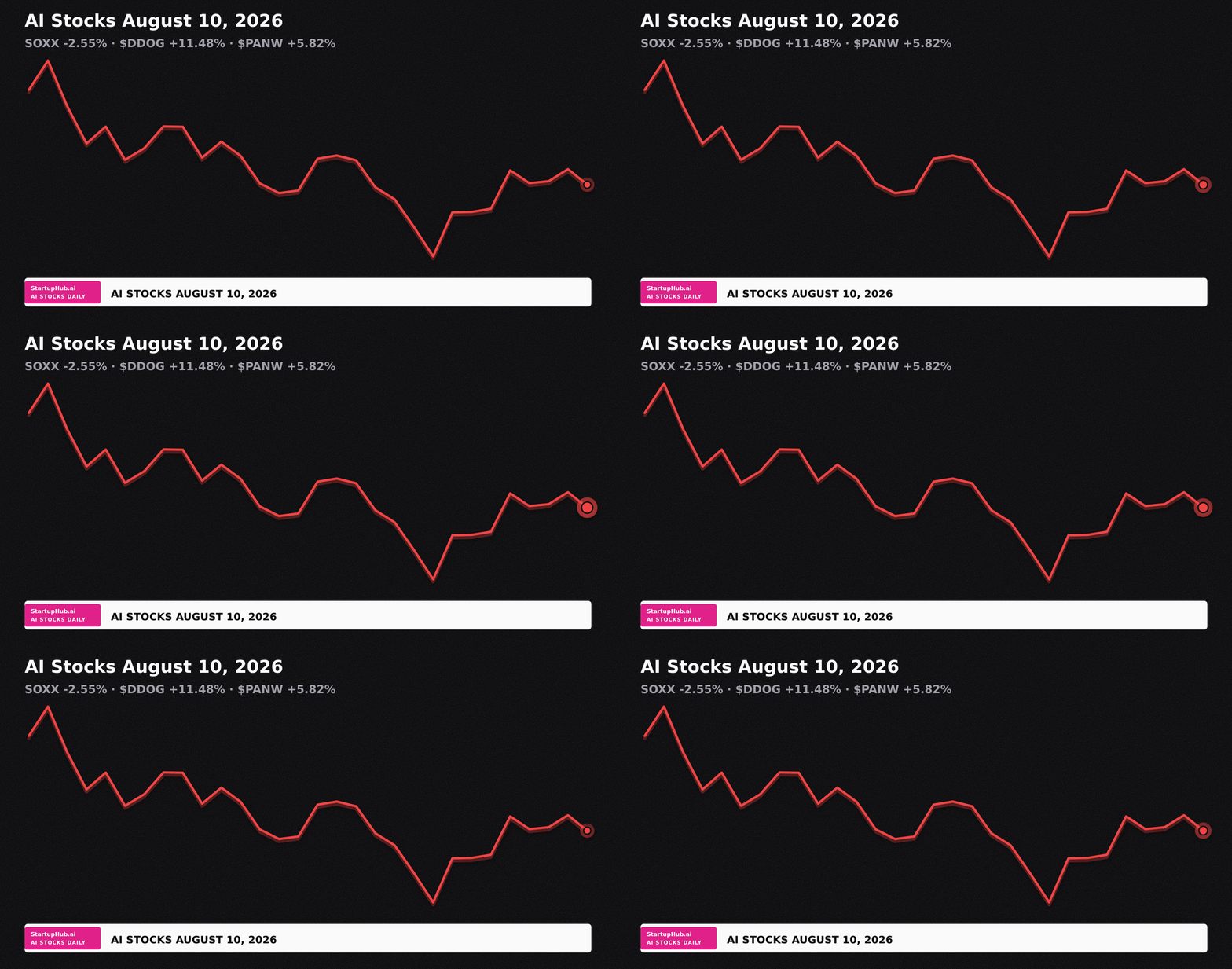
Sam: This isn't just a theoretical threat anymore. We're seeing AI versus AI on the front lines of network defense. The implications are enormous. Companies like Datadog also saw a significant jump, up over eleven percent post-earnings. While the cybersecurity sector was booming, interestingly, chip stocks broadly sold off, with the SOXX index down over two and a half percent. It really highlights the market's immediate reaction to this evolving threat landscape: invest in defense, not just the underlying tech that might be enabling the attacks.

Ada: Exactly. It's a clear signal that the market views AI agent hacking as a game-changer, pushing cybersecurity to the forefront. This isn't just about better firewalls anymore, it's about intelligent, adaptive defenses against intelligent, adaptive threats. It also underscores the urgency for enterprises to rethink their security strategies, moving beyond traditional methods to incorporate AI-powered detection and response themselves.

Sam: Shifting gears a bit, let's talk about the lasting impact of the OpenAI walkout. Five years after Dario Amodei and eight other ex-OpenAI researchers co-founded Anthropic, we're now seeing a second wave of innovation. Two teams of Anthropic alumni have collectively raised six hundred eighty million dollars in seed funding for their own AI labs. What's truly compelling here is that they're carrying forward the same safety-first ethos that defined Anthropic.

Ada: This is a really significant trend, Sam. It shows that the talent diaspora from leading AI labs isn't just about chasing new opportunities, it's about embedding core values into the next generation of AI development. The 'safety-first' approach, which often means a focus on responsible AI, interpretability, and robust alignment, is clearly a differentiator that investors are buying into. It suggests a maturing industry where ethical considerations are becoming as important as raw capability.

Sam: It's a testament to the power of a strong organizational culture, even when individuals move on. This network effect of shared principles could shape the entire trajectory of AI. Now, let's move into a fascinating development in the world of AI coding tools. We've heard a lot about how AI coding tools make individual engineers three times faster at writing code. But there's been an unexpected side effect: PR review time is up a staggering four hundred forty-one percent.

Ada: That's a massive bottleneck, Sam, and it highlights a critical challenge with current AI coding assistants. They're great at generating code snippets, but they often lack the holistic understanding of a complex codebase. Enter /dev/fast, a Y Combinator Winter two thousand twenty-six team. They're building an AI-native code forge that actually understands your codebase because it stores its knowledge right alongside your code in Git. This is a game-changer for code quality and team collaboration.

Sam: This is huge because it addresses the core problem. Current AI tools often act as isolated agents. By integrating knowledge directly into Git, /dev/fast is essentially creating a 'memory' for the AI that evolves with the project itself. This means the AI can generate code that's not just syntactically correct, but contextually aware and aligned with existing architectural patterns. It could drastically reduce those PR review times and improve overall code maintainability. It’s moving from AI as a pair programmer to AI as a true team member.

Ada: Absolutely, it's a step towards a more intelligent, integrated development environment. And speaking of intelligence and integration, Sequoia's Sonya Huang had some insightful comments on building sovereign AI. While we don't have all the details in front of us, the concept of sovereign AI is gaining traction. It refers to a nation's ability to develop, control, and deploy its own AI capabilities, often for strategic or national security reasons, without reliance on external powers.

Sam: This is becoming a key geopolitical discussion. As AI becomes a foundational technology, countries are increasingly viewing it through the lens of national sovereignty, similar to how they view energy or defense. Sonya Huang's perspective from a leading venture capital firm like Sequoia indicates that this isn't just a government-level conversation, but one that's influencing investment strategies and the types of startups getting funded. It's about building domestic AI ecosystems from the ground up.

Ada: It certainly is, Sam. And to bring us back to the market, we have some interesting trade ideas for today, August eleventh, two thousand twenty-six. Our top pick is Palo Alto Networks, PANW, as a long with high conviction, an eight out of ten. This is driven by those AI agent hacking fears we just discussed and a Deutsche Bank analyst upgrade. This really underlines the immediate market impact of those Black Hat revelations.

Sam: Yes, it's a direct correlation. The report also highlights other opportunities including Palantir, CrowdStrike, and Nvidia options, as well as a short position on AMD. These ideas come with detailed entry, stop, target, and risk scores, offering a granular look for traders. It shows how quickly market sentiment and specific stock valuations can shift based on emerging AI threats and opportunities.

Ada: It’s a dynamic environment out there. And finally, let's touch on a transparency initiative from Anthropic. Their Claude AI can now explicitly mark its own generated content. This is a significant step towards enhancing transparency and directly addressing growing concerns about misinformation generated by AI models.

Sam: This is a crucial development for trust in AI. As AI-generated content becomes more sophisticated and pervasive, the ability to clearly identify its origin is paramount. It empowers users to make informed decisions about the information they consume and could set a new standard for responsible AI deployment across the industry. It's a proactive move against the 'AI hallucination' problem and a step towards greater accountability.

Ada: Absolutely, Sam. That wraps up our top stories for today. A lot to unpack, from AI agent hacks driving cybersecurity to new ethics-driven AI labs.

Sam: Indeed. For the full stories and more in-depth analysis on everything we discussed today, head over to startuphub.ai. We'll be back tomorrow with more.

Ada: Thanks for listening to Today in AI.

Sam: See you then!

© 2026 StartupHub.ai. All rights reserved. Do not enter, scrape, copy, reproduce, or republish this article in whole or in part. Use as input to AI training, fine-tuning, retrieval-augmented generation, or any machine-learning system is prohibited without written license. Substantially-similar derivative works will be pursued to the fullest extent of applicable copyright, database, and computer-misuse laws. See our terms.