

Memory Chips Join AI Bottleneck

The AI boom has created a severe shortage and price surge for DRAM and NAND memory chips, impacting consumer electronics and benefiting memory manufacturers.

5 min read
Close-up of computer RAM modules with a glowing AI circuit pattern overlay
The global AI memory chip shortage is driving up prices and impacting the tech industry.· a16z Blog
Visual TL;DR
AI BoomDriver
insatiable appetite for artificial intelligence driving demand
HBM Crucial for AICore
From the article 2 mentionsThis surge isn't confined to High Bandwidth Memory (HBM), crucial for AI model training.
Memory Chip ShortageDriver
DRAM and NAND chips are now critical supply chain bottlenecks
From the article 5 mentionsMemory is now the most prominent addition to a list of shortages that already included power, skilled labor, and specialized chips like GPUs and CPUs.
DRAM & NAND Prices SurgeOutcome
DDR5, DDR4, and NAND prices skyrocketing since late last year
From the articleEven traditional NAND flash memory has seen significant price hikes, with DRAM contract prices more than tripling year-over-year as of March, while NAND prices doubled.
Consumer Electronics ImpactedOutcome
shortage and price surge affecting consumer electronics availability
From the articleHistorically, memory manufacturers competed solely on price, with success tied to the consumer electronics cycle.
AI Infrastructure BottleneckContext
memory joins power, processors, and GPUs as critical shortage
From the article 2 mentionsThe insatiable appetite for artificial intelligence has pushed memory chips into the spotlight, joining power and processors as critical supply chain bottlenecks.
Memory Manufacturers BenefitEffect
From the article 3 mentionsThe unprecedented demand has led to an extraordinary financial quarter for major memory manufacturers, including Samsung, SK Hynix, and Micron.
Contents(3)

The insatiable appetite for artificial intelligence has pushed memory chips into the spotlight, joining power and processors as critical supply chain bottlenecks. Prices for both DDR5 and DDR4 memory have skyrocketed since late last year, mirroring a broader inflationary trend in computer hardware.

This surge isn't confined to High Bandwidth Memory (HBM), crucial for AI model training. Even traditional NAND flash memory has seen significant price hikes, with DRAM contract prices more than tripling year-over-year as of March, while NAND prices doubled.

The demand shock, backed by substantial capital expenditures, has created an unprecedented situation across the AI infrastructure landscape. Memory is now the most prominent addition to a list of shortages that already included power, skilled labor, and specialized chips like GPUs and CPUs.

Memory Makers Ride the AI Wave

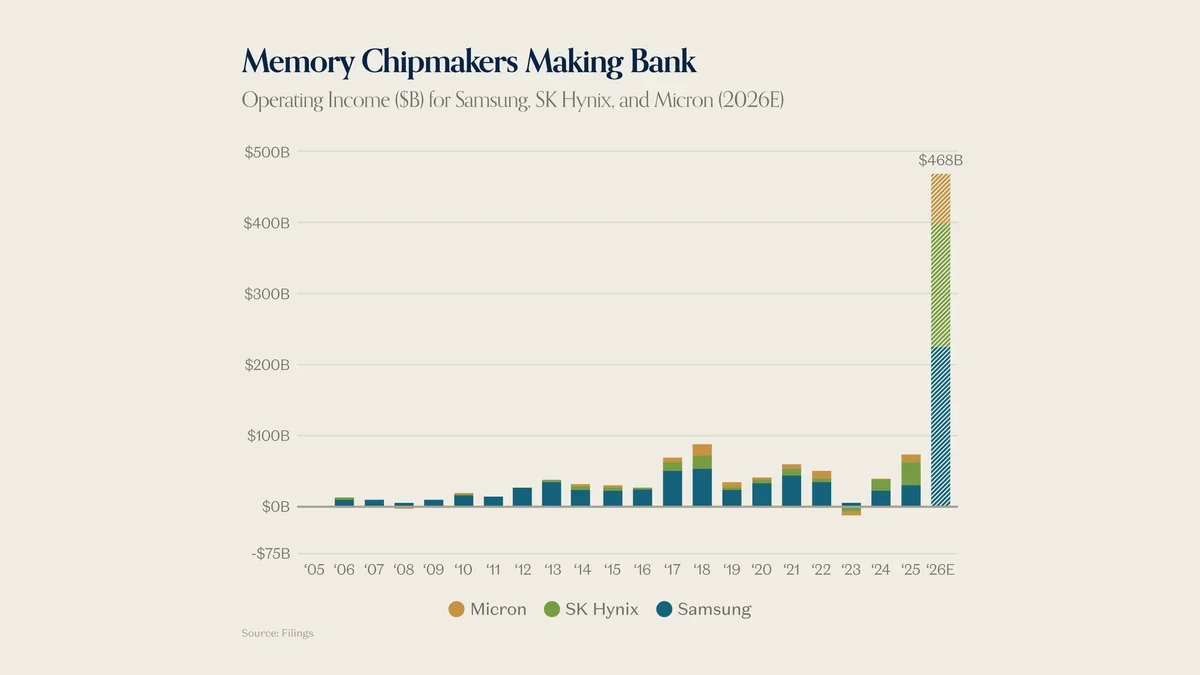
The unprecedented demand has led to an extraordinary financial quarter for major memory manufacturers, including Samsung, SK Hynix, and Micron. These companies are projected to see their operating income increase sixfold in 2026.

Micron, in particular, reported its first quarter earnings exceeding its total earnings for any single year prior to 2025. The net income gains for memory companies are so substantial that they've distorted typical supply chain winner charts.

From Commodity to Premium

Memory, once a highly commoditized segment of the chip market, has transformed. Historically, memory manufacturers competed solely on price, with success tied to the consumer electronics cycle.

However, the sheer volume and the increasing complexity of AI memory requirements, where power efficiency is paramount, have fundamentally altered the market dynamics. This shift has revitalized even previously low-margin players.

Addressing the Supply Crunch

The question of ending this memory run hinges on increasing production. However, bringing new manufacturing capacity online can take years.

Manufacturers are currently prioritizing higher-margin, silicon-intensive HBM, further straining the supply of consumer-grade memory chips. Hyperscalers are now securing supply with five-year agreements, a significant shift from the traditional one-year contracts, ensuring their position in the production queue.

This prioritization means even standard consumer memory chips are becoming more expensive, a cost likely to be passed on to consumers through higher prices for devices like smartphones and PCs, with estimates suggesting a 10-20% increase.

Yet, the cyclical nature of manufacturing suggests that shortages often breed gluts. Companies are historically hesitant to invest heavily in new capacity, fearing the consequences when demand inevitably cools.

Necessity, however, drives innovation. Rising costs are spurring efficiency improvements, evident in custom silicon solutions from tech giants aiming to reduce reliance on external GPU vendors. The ongoing High Bandwidth Memory demand is a key driver here.

The critical question remains whether this is a temporary surge or a fundamental step-change in computational demand. The answer carries multi-hundred billion dollar implications for the tech industry.

© 2026 StartupHub.ai. All rights reserved. Do not enter, scrape, copy, reproduce, or republish this article in whole or in part. Use as input to AI training, fine-tuning, retrieval-augmented generation, or any machine-learning system is prohibited without written license. Substantially-similar derivative works will be pursued to the fullest extent of applicable copyright, database, and computer-misuse laws. See our terms.