

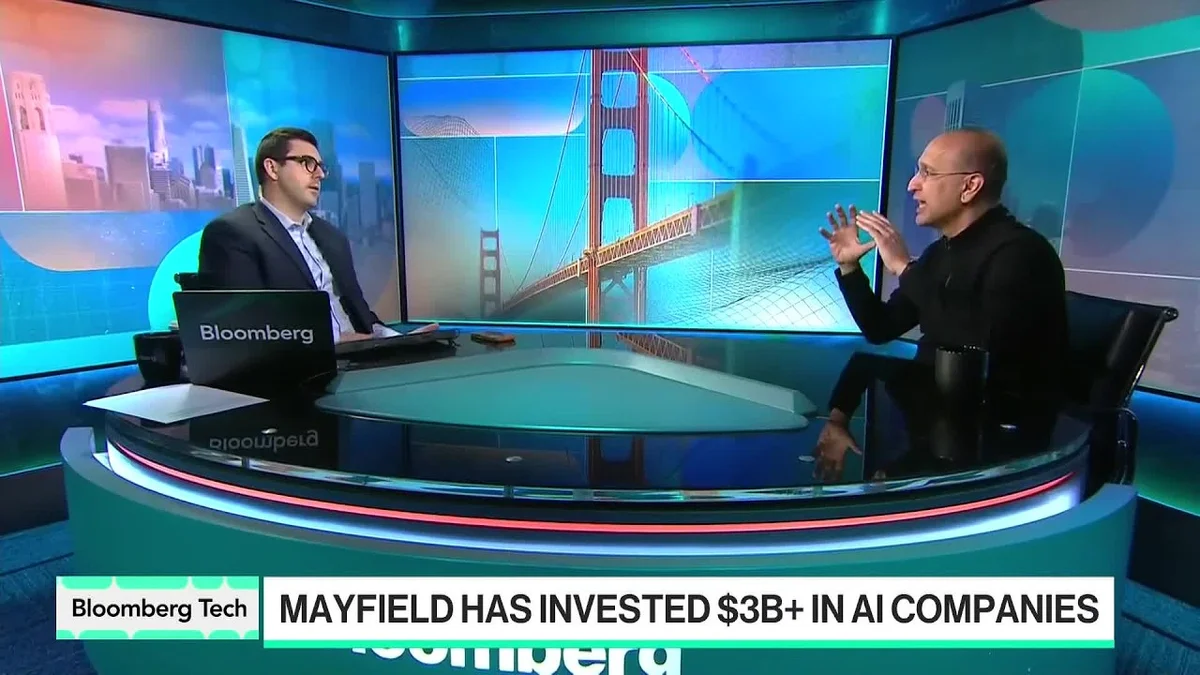
Mayfield Managing Partner: AI Fuels Startup Growth

Mayfield's Navin Chaddha discusses the AI startup boom, the firm's $3B+ investment strategy focusing on early-stage founders, and the importance of quality over quantity in venture capital.

Navin Chaddha, Managing Partner at Mayfield, speaks on a Bloomberg Tech panel.
Bloomberg Technology
Visual TL;DR
AI Fuels GrowthDriver
AI democratizes startup creation, demanding higher execution for success
From the articleThey plan to 'buck the trend way of raising growth funds,' prioritizing nimbleness and discipline.
Mayfield's AI ThesisCore
investing $3B+ in early-stage AI companies from 'paper and pencil ideas'
From the article 9 mentionsWith a track record of investing over $3 billion in AI companies, many at their inception, Mayfield managing partner Navin Chaddha shared his insights on the current AI investment climate and the firm's strategic approach.
Identify 'Inception' StartupsContext
focus on backing founders at the earliest stages, often pre-product
100x OpportunityOutcome
AI investments show significant returns, improving by factors of two to three
From the articleHe described the current AI opportunity as a '100x opportunity' and firmly believes that 'early stage is the place to play.'
Selective InvestingContext
prioritizing quality over quantity in venture capital investments
From the article 3 mentionsHe stressed the importance of a 'prepared mind' for VCs, advocating for investing in areas before they become mainstream and identifying promising entrepreneurs before they even start their companies.
Significant ReturnsEffect
AI companies are getting better, leading to substantial investment returns
From the article 4 mentions'With AI, they're only getting better and better by a factor of two to three x,' Chaddha stated, emphasizing the significant returns the firm has experienced.
Founder-First ApproachContext
Mayfield's core philosophy is backing exceptional founders from day one
From the article 2 mentionsMayfield's approach is to 'bet on the jockey and not the racetrack,' recognizing that many successful companies pivot from their initial ideas.
Strategic Fund FocusContext
Mayfield's fund strategy aligns with early-stage, high-potential AI ventures
From the articleLooking ahead, Chaddha revealed Mayfield's intention to maintain smaller fund sizes and continue their focus on early-stage investments.
Contents(6)

In the rapidly evolving AI sector, venture capital firm Mayfield is doubling down on early-stage investments, believing that artificial intelligence is democratizing startup creation while simultaneously demanding a higher caliber of execution for success. With a track record of investing over $3 billion in AI companies, many at their inception, Mayfield managing partner Navin Chaddha shared his insights on the current AI investment climate and the firm's strategic approach.

Mayfield's AI Investment Thesis

Chaddha highlighted that Mayfield's core business has always been identifying and backing companies from their earliest stages, often with just 'paper and pencil ideas.' This philosophy extends to their AI investments, where they see immense potential. 'With AI, they're only getting better and better by a factor of two to three x,' Chaddha stated, emphasizing the significant returns the firm has experienced. He described the current AI opportunity as a '100x opportunity' and firmly believes that 'early stage is the place to play.'

The full discussion can be found on Bloomberg Technology's YouTube channel.

Mayfield Bets on AI’s Earliest Founders - Bloomberg Technology
Mayfield Bets on AI’s Earliest Founders, from Bloomberg Technology

Identifying 'Inception' AI Startups

The conversation touched upon the geographical concentration of AI innovation, with a particular focus on San Francisco and Silicon Valley. However, Chaddha clarified that the type of founder Mayfield seeks depends on their position in the AI stack. For semiconductor companies, he noted, founders often have deep, years-long industry experience, not necessarily the stereotypical college dropout. In contrast, for AI models, expertise from researchers and professors is crucial. It's in the realm of 'agents and agentic applications' where Chaddha sees more of the younger, entrepreneurial talent emerging. He stressed the importance of a 'prepared mind' for VCs, advocating for investing in areas before they become mainstream and identifying promising entrepreneurs before they even start their companies.

The Art of Selective Investing

Addressing the pressure to deploy capital, Chaddha reiterated Mayfield's commitment to quality over quantity. 'Venture returns are driven by power law,' he explained, meaning that a few exceptional companies drive the majority of returns. Mayfield's strategy involves making 'selective investments, eight to 10 per year,' with the goal of finding 'one to two unicorns per year and one decacorn per year.' This focus on identifying truly disruptive companies is central to their investment philosophy.

Discussing exit strategies, Chaddha observed that the scale required for companies to go public has significantly increased, with trillion-dollar IPOs becoming more common. He anticipates a future dominated by these large exits, followed by a wave of mid-cap IPOs raising around a billion dollars. Alongside IPOs, strategic acquisitions, ranging from $1 billion to $50 billion, are also expected to provide significant liquidity. Chaddha acknowledged the trend of companies staying private longer but maintained that for those with strong fundamentals and clear paths to scale, an IPO remains a desirable outcome. He noted that the journey from $100 million to $1 billion in enterprise value is challenging, but once scale, repeatability, and network effects are achieved, reaching valuations of $10 billion to $100 billion is attainable for a select few.

The Founder-First Approach

When asked about the value attributed to founders, Chaddha emphasized the paramount importance of human capital. 'Our belief is human capital. Stage, we invest. It's all about the people because people build companies, people build products,' he said. Mayfield's approach is to 'bet on the jockey and not the racetrack,' recognizing that many successful companies pivot from their initial ideas. This founder-centric philosophy is why Mayfield is known as a 'founder first firm,' focusing on patient, long-term partnerships with entrepreneurs.

Mayfield's Fund Strategy

Looking ahead, Chaddha revealed Mayfield's intention to maintain smaller fund sizes and continue their focus on early-stage investments. They plan to 'buck the trend way of raising growth funds,' prioritizing nimbleness and discipline. 'We are wealth creators. Take small boxes of money for our LPs, make them bigger,' he concluded, underscoring the firm's commitment to delivering strong returns for its limited partners.

© 2026 StartupHub.ai. All rights reserved. You may not republish this article in full without a license. Search engines and AI research tools may crawl and summarize for reference. Bulk reproduction or model training requires a license. See our terms.
Daniel Singer

Written by

Daniel Singer

Editor, StartupHub.ai

Daniel Singer is the editor of StartupHub.ai, a technology expert and thought leader on AI and its applications across sectors, from fintech and healthcare to developer tooling and consumer software. He writes and tests the tools covered here thoroughly and regularly, and built StartupHub.ai to give founders, operators and buyers a clearer read on what they are actually being sold.