

AI Intelligence as Primitive, Apps as Diffusion

Analysis suggests AI's core intelligence is becoming a primitive, with applications forming the crucial diffusion layer for productization and value creation.

5 min read
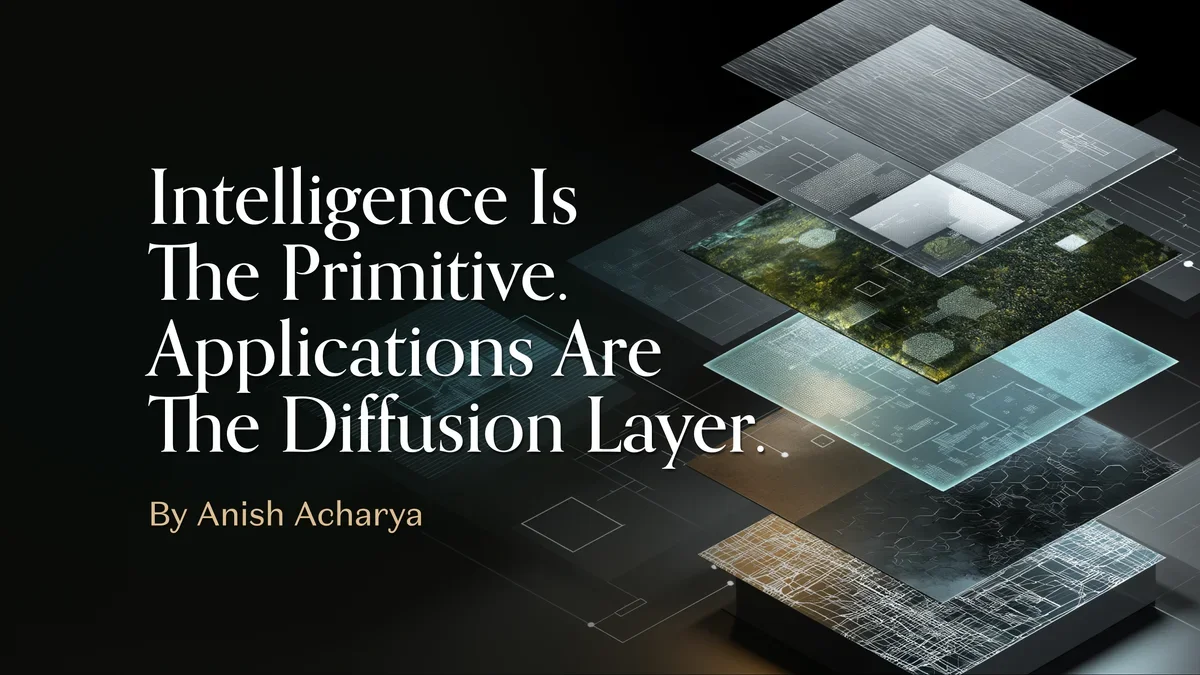
Conceptual graphic showing 'Intelligence' as a core primitive and 'Applications' as a diffusion layer.
a16z Blog
Visual TL;DR
AI core intelligenceCore
From the article 3 mentionsThe fundamental nature of artificial intelligence is shifting, with core intelligence models increasingly viewed as a foundational primitive, akin to electricity or cloud computing.
Diffusion layerCore
applications forming the crucial diffusion layer for productization and value creation
From the article 2 mentionsThis perspective, outlined in a recent analysis from a16z Blog, suggests that the real value creation will occur in the "diffusion layer", the applications that translate these powerful AI primitives into tangible user experiences and industry solutions.
Durable competitive advantageOutcome
From the articleThe article suggests that while AI models themselves might become commoditized, the durable competitive advantage will lie in the applications built atop them.
Value creation shiftEffect
From the articleThis perspective, outlined in a recent analysis from a16z Blog, suggests that the real value creation will occur in the "diffusion layer", the applications that translate these powerful AI primitives into tangible user experiences and industry solutions.
AI core intelligenceCore
From the article 3 mentionsThe fundamental nature of artificial intelligence is shifting, with core intelligence models increasingly viewed as a foundational primitive, akin to electricity or cloud computing.
Primitive, like electricityContext
From the articleThe fundamental nature of artificial intelligence is shifting, with core intelligence models increasingly viewed as a foundational primitive, akin to electricity or cloud computing.
AI models commoditizedDriver
From the article 5 mentionsThe article suggests that while AI models themselves might become commoditized, the durable competitive advantage will lie in the applications built atop them.
Diffusion layerCore
applications forming the crucial diffusion layer for productization and value creation
From the article 2 mentionsThis perspective, outlined in a recent analysis from a16z Blog, suggests that the real value creation will occur in the "diffusion layer", the applications that translate these powerful AI primitives into tangible user experiences and industry solutions.
Value creation shiftEffect
From the articleThis perspective, outlined in a recent analysis from a16z Blog, suggests that the real value creation will occur in the "diffusion layer", the applications that translate these powerful AI primitives into tangible user experiences and industry solutions.
Focus: pricing, packagingEffect
emphasis moving towards how gains are priced, packaged, and productized
From the articleThis requires a deep understanding of customer pain points and a strategic approach to pricing and packaging that reflects the value delivered, rather than just the cost of compute.
Durable competitive advantageOutcome
From the articleThe article suggests that while AI models themselves might become commoditized, the durable competitive advantage will lie in the applications built atop them.

The fundamental nature of artificial intelligence is shifting, with core intelligence models increasingly viewed as a foundational primitive, akin to electricity or cloud computing. This perspective, outlined in a recent analysis from a16z Blog, suggests that the real value creation will occur in the "diffusion layer", the applications that translate these powerful AI primitives into tangible user experiences and industry solutions.

This framing implies a significant change in how AI-native products are developed and commercialized. Instead of focusing solely on the underlying model advancements, the emphasis is moving towards how these gains are priced, packaged, and productized for specific industry needs.

The article suggests that while AI models themselves might become commoditized, the durable competitive advantage will lie in the applications built atop them. This is a familiar pattern in technology adoption; early computing power was a scarce resource, but software applications eventually drove mass adoption and defined market leaders.

Gary Michael Weiner, in a related discussion, posits that if intelligence becomes a primitive, then judgment might become the moat. Applications can be replicated, and features tend to converge over time. The scarcity, he suggests, will remain in knowing where to direct this intelligence effectively.

This perspective is particularly relevant for startups and established tech companies alike. For founders, it highlights the critical need to design applications that not only integrate AI capabilities but also offer unique value propositions and defensible business models. Investors, in turn, will likely scrutinize the application layer for signs of true product-market fit and long-term viability.

The challenge for businesses will be to translate the raw power of advanced AI models into accessible, user-friendly, and economically viable products. This requires a deep understanding of customer pain points and a strategic approach to pricing and packaging that reflects the value delivered, rather than just the cost of compute.

The evolution from raw AI capabilities to sophisticated applications represents a key phase in the AI market's maturation. Success will hinge on the ability to effectively diffuse AI's primitive power through well-designed, problem-solving applications.

© 2026 StartupHub.ai. All rights reserved. Do not enter, scrape, copy, reproduce, or republish this article in whole or in part. Use as input to AI training, fine-tuning, retrieval-augmented generation, or any machine-learning system is prohibited without written license. Substantially-similar derivative works will be pursued to the fullest extent of applicable copyright, database, and computer-misuse laws. See our terms.