

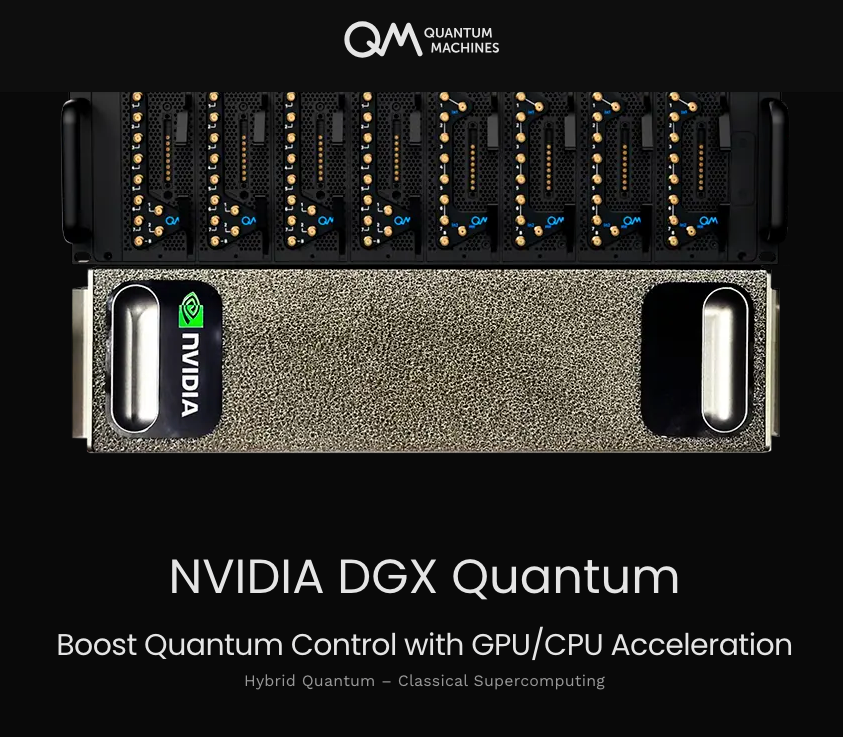
The Jülich Supercomputing Centre (JSC) recently announced a landmark deployment of the NVIDIA DGX Quantum system, featuring Quantum Machines’ OPX1000 hybrid quantum-classical controller. This strategic integration at Europe's fastest supercomputing facility significantly bolsters Quantum Machines funding prospects by validating its core technology in a real-world, high-performance computing environment. The collaboration positions Quantum Machines at the forefront of hybrid quantum-classical computing, attracting further investment and demonstrating market readiness.
This milestone at JSC, home to Europe's first exascale system, represents a significant leap. It integrates quantum computing capabilities into high-performance computing environments, providing researchers with unprecedented access to advanced resources. The deployment at this pioneering facility, a leader in European HPC innovation, underscores the operational maturity of Quantum Machines' solutions.
The DGX Quantum system combines NVIDIA's Grace Hopper Superchip with Quantum Machines’ OPX1000 controller. This powerful pairing enables seamless interaction between classical and quantum computing resources. It achieves round-trip data transfer with latency under 4 microseconds, a 1000-fold improvement over prior implementations.
The system incorporates Arque Systems' 5-qubit quantum processor. This processor utilizes electron shuttling to couple qubits, an approach designed for quantum error correction (QEC). The tightly integrated stack delivers microsecond-scale analog feedback, ensuring classical processing remains within qubit coherence times.
Quantum Machines' Strategic Investment in Hybrid Computing
Key aspects of this collaboration include accelerating qubit calibration routines and benchmarking quantum error correction performance. Researchers will also explore hybrid quantum-classical algorithm development within a high-performance computing environment. This integration enables microsecond-scale interaction between quantum control hardware and classical compute resources, making quantum operations a seamless part of the HPC workflow.