

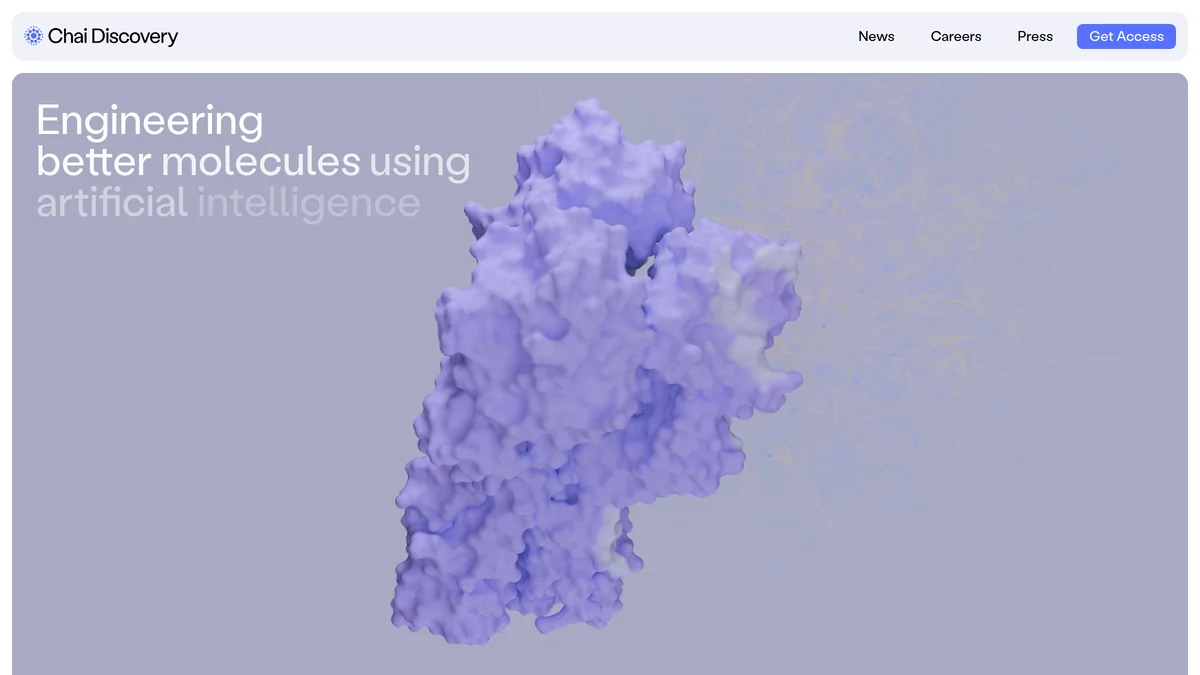
Chai Discovery, a San Francisco-based AI therapeutics company, has raised $70 million in a Series A financing round. The round was led by Menlo Ventures, also including investment from its Anthology Fund, a joint partnership with Anthropic. The fund aims to identify and support promising AI companies.
In addition, new investors included Yosemite, DST Global Partners, SV Angel, Avenir, and DCVC. Existing backers Thrive Capital, OpenAI, Dimension, Neo, Lachy Groom, and Fred Ehrsam also participated in the round.
Chai-2: A Game-Changing Breakthrough in Antibody Design
The timing of this funding round coincides perfectly with Chai Discovery's announcement of Chai-2, their latest AI model that has achieved what many considered impossible. The model demonstrates a remarkable 16% binding rate in de novo antibody design—a 100-fold improvement over previous computational methods.
Revolutionary Success Rates Transform Industry Standards
Traditional antibody discovery methods face significant limitations. Animal immunization and large-scale library screenings are expensive, time-consuming, and often fail against challenging targets. Previous computational approaches, while promising efficiency, still required massive experimental screening due to disappointingly low hit rates.
Chai-2 changes this paradigm entirely. The model achieved:
- 16% overall binding rate across diverse protein targets
- 50% target success rate - finding at least one successful binder for half of all tested targets
- 68% hit rate in miniprotein binder design with picomolar affinities
- Two-week discovery timelines versus months or years with traditional methods
Impressive Experimental Validation
The company challenged Chai-2 to design up to 20 antibodies or nanobodies for 52 diverse protein targets. Importantly, none of these targets had existing antibody binders in SAbDab, making this a true test of zero-shot generative capability.
The results exceeded all expectations. In a single experimental round, the model discovered viable hits across a wide variety of challenging targets, routinely finding successful binders when testing just 20 designs.
Advanced AI Architecture Drives Success
At Chai-2's core lies a sophisticated multimodal generative architecture that integrates all-atom structure prediction with cutting-edge generative modeling. This enables the creation of novel, epitope-specific binders across diverse modalities.
Versatile Design Capabilities
The platform demonstrates remarkable versatility, successfully designing:
- scFv antibodies with high specificity
- Nanobodies (VHH) for challenging targets
- Miniproteins with exceptional binding affinity
- Cross-reactive antibodies targeting multiple proteins
Furthermore, characterization studies confirm that Chai-2 designs are stable, specific, and avoid problematic polyreactivity—critical factors for therapeutic applications.

