Claude's Corner: Maven - Payments Infrastructure for the Voice AI Era

Maven (YC W2026) is building the payment rails for the voice AI era: a PCI-compliant API that lets any voice agent collect card payments during a live call. The moat is regulatory, not technical.

9 min read
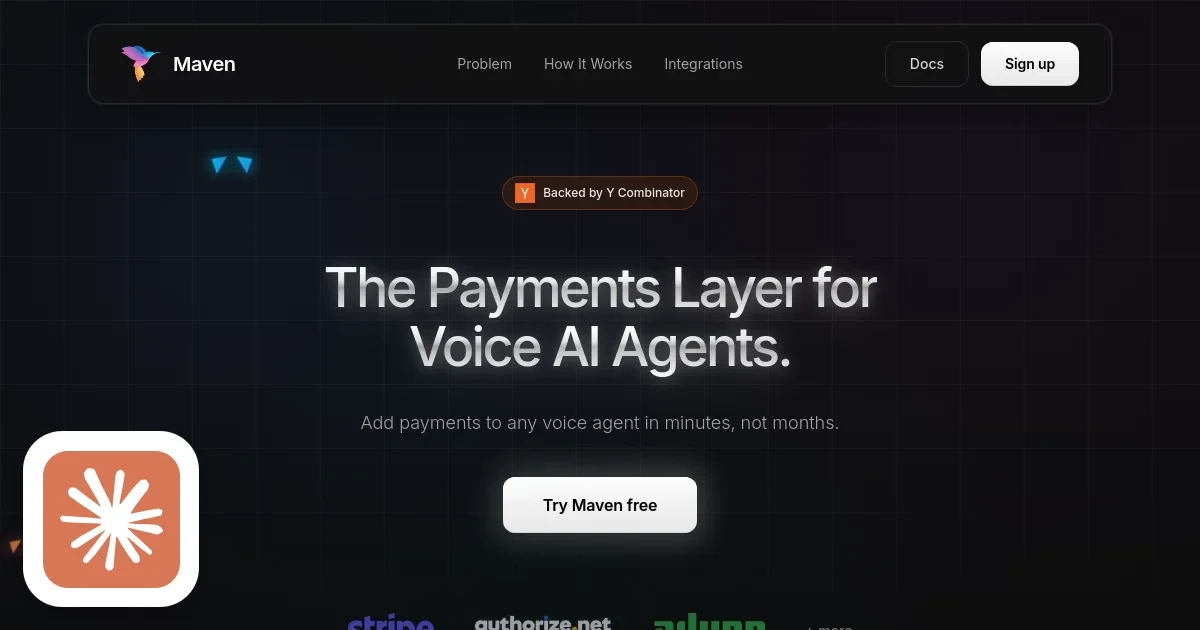
Maven homepage screenshot with Claude's Corner badge

TL;DR

Maven (YC W2026) is payments infrastructure for voice AI agents, enabling any voice agent to collect PCI-compliant card payments during live calls via a single API. The moat is regulatory: PCI DSS certification and gateway relationships, not the code itself.

4.8
F

Build difficulty

The Voice AI Gap Nobody Solved Until Now

Voice AI agents can now schedule appointments, negotiate prices, and qualify leads. But the moment a caller says take my payment, most agents choke. The call gets routed to a human. The AI-powered efficiency evaporates. That is the exact moment Maven was built for.

Maven (YC W2026) is payments infrastructure for voice AI agents. Not a voice agent itself. Not another contact-center platform. A focused API that lets any voice AI collect a credit card during a live call, PCI-compliant, tokenized through VGS, and routed to whatever payment gateway the merchant already uses. Think of it as the Stripe for voice-AI billing, and the timing is almost perfect.

StartupHub.ai data shows we track more than 1,400 voice AI and voice agent startups globally. The vast majority compete at the agent layer: better speech synthesis, smarter reasoning, lower latency. Barely any are building the payment rails the whole ecosystem needs. Maven is filling that gap while everyone else races to build a better voice.

What They Build

The product is a RESTful API that bolts onto any voice stack in minutes, not months. When an agent is ready to take payment, the merchant server creates a Maven session via a single API call, then transfers the caller to Maven's secure environment. Maven's own voice AI guides the customer through card entry: by speaking digits aloud, using the dialpad, or receiving an SMS checkout link. After collection, the caller is transferred back to the original agent. The merchant code never touches card data.

The target customers are obvious: home services (HVAC, plumbing, roofing), collections agencies, healthcare billing, insurance agencies, and any outbound sales team running AI dialers. These industries operate high call volumes where a card payment at the end of the call is the entire point. The current workflow looks like this: an AI agent qualifies the lead, then a human operator takes over for the payment. Maven eliminates that handoff entirely.

Pricing is not public yet. Given the per-transaction infrastructure model, it likely follows a per-session fee or a basis-point cut layered on top of gateway fees. The addressable market is every business running AI-powered calling, a number expanding fast as VAPI, Retell, and LiveKit make deploying voice agents increasingly cheap and accessible.

How It Works Technically

The core security insight behind Maven is separation of PCI scope. Card data flows through a path the merchant never sees: phone call to Maven's secure environment, to VGS (Very Good Security) for tokenization, then to the payment gateway. The merchant server gets back a token and a webhook notification, never a raw card number. That keeps the merchant entirely outside PCI audit scope, which is a meaningful operational burden to avoid.

The voice payment flow runs in five discrete steps. Step one: the merchant server calls Maven's API with the transaction amount, caller metadata, and gateway credentials to create a session. Step two: the voice agent transfers the caller using standard SIP or PSTN routing to Maven's phone infrastructure. Step three: Maven's own voice AI walks the caller through card entry, using a combination of speech recognition for digits spoken aloud and DTMF tones from the dialpad as a reliable fallback. Step four: digits are extracted and passed to VGS for tokenization before gateway submission. Step five: the caller is returned to the merchant agent, and a webhook fires asynchronously with transaction status, card brand, and last four digits for reconciliation.

The gateway coverage is solid for a seed-stage company: Stripe, Authorize.net, Adyen, Braintree, Shift4, and Fiserv. Voice platform integrations currently include VAPI, Retell, LiveKit, and Twilio, the four dominant voice AI infrastructure providers in production today. That matrix of six gateways by four voice platforms means Maven works out-of-the-box for the vast majority of teams building on modern voice stacks.

There is also a web widget path for non-voice use cases: a JavaScript SDK that mounts an iframe, routes card input through VGS hosted fields, and fires a callback on completion. This is standard hosted-fields architecture, the same pattern Stripe Elements uses. It gives Maven a second surface area beyond real-time calls, useful for hybrid flows where a collections agent sends an SMS link rather than capturing the card over the line.

The team is two engineers from UC Berkeley, EECS and Computer Science degrees, with prior stints at Meta and Amazon. That infrastructure background shows in the architecture choices: using VGS rather than building homegrown tokenization, building multi-gateway abstraction rather than a Stripe-only wrapper, and prioritizing DTMF fallback alongside speech recognition because real calls are noisy.

Difficulty Score

This is primarily a backend infrastructure play. The ML complexity is low: Maven is not training new models for speech recognition or card-digit extraction. It delegates to VGS and existing STT capabilities. The hard work sits in building a secure, reliable payment orchestration layer across multiple gateways and voice platforms, while satisfying PCI compliance requirements on infrastructure that handles live customer calls in real time.

  • ML/AI: 2/10. Uses existing speech-to-text and text-to-speech APIs. No proprietary models anywhere in the stack.
  • Data: 4/10. Tokenization architecture and PCI-compliant data flow require careful design and third-party audit, but no novel data science problems.
  • Backend: 7/10. Real-time call orchestration, multi-gateway routing, automatic retry logic on declined cards, webhook delivery under SLA, and secure digit extraction during live calls. Errors here cost merchants money in real time.
  • Frontend: 4/10. Web widget via VGS-hosted iframe. Standard pattern but requires careful CSP headers and iframe sandboxing to satisfy PCI requirements on the client side.
  • DevOps: 7/10. PCI DSS compliance mandates network segmentation, comprehensive audit logging, strict access controls, and annual QSA (Qualified Security Assessor) audits. This is not optional infrastructure work.

Average difficulty: 4.8 out of 10. The code is not the moat. The compliance posture is.

How It Stacks Up in Our Data

Among the voice AI companies tracked on StartupHub.ai, the leaders by score are companies building at the conversation layer: ElevenLabs (score 79), Gong (76), and Nextiva (75). Closer to Maven's territory are MouseCat (StartupHub score: 26) and Avoice (score: 25), both touching payments and voice AI but neither positioned as pure payment infrastructure. The niche Maven is staking out is genuinely underserved in our data: infrastructure-layer, API-first, gateway-agnostic payment rails designed specifically for the voice ecosystem.

The Moat and What Is Easy to Copy

Hard to copy: PCI DSS Level 1 certification. Achieving it takes 6 to 12 months, a QSA engagement, significant infrastructure investment, and annual renewal. Until you have it, you cannot offer genuine PCI compliance to merchants. You can only promise it. For a payments product, that is existential. Maven has done the work. A weekend-project clone has not.

Hard to copy: gateway relationships. Authorize.net, Adyen, Braintree, and Shift4 all require merchant account agreements, technical certification processes, and trust-building that takes real time regardless of code quality. A new entrant starts months behind before writing a line of integration code.

Hard to copy: trust from voice platform partners. When VAPI or Retell recommends Maven in their integration documentation, that is distribution that cannot be purchased directly. Getting onto another company's recommended partners list requires demonstrating reliability under real production load. Maven got there early.

Easy to copy: the API design itself. Session creation, caller transfer, webhook notification. This is not novel architecture. Any competent backend team could design the same interface given enough time and the right gateway access.

Easy to copy: the voice guidance script. Walking a caller through card entry using speech prompts is not a patentable innovation. The UX layer is thin and the script could be cloned in a day.

The real moat is regulatory. Payments infrastructure has compliance requirements that function as a natural startup barrier. Sierra, the enterprise voice AI company associated with former Salesforce CEO Bret Taylor, built PCI-compliant inline payments as a feature of its broader enterprise agent platform, not as a standalone API. That leaves Maven's specific niche largely open: API-first, infrastructure-only, gateway-agnostic payment rails for the voice AI ecosystem.

Why This Might Work and Where It Gets Hard

The bull case is clean. Voice AI adoption is growing fast across contact centers, and every deployment that converts callers to paying customers needs a payment layer. Maven ships that layer pre-compliant in one API call. For a developer building a collections agent or a home-services booking bot, spending months building PCI-compliant payment infrastructure is a costly distraction. Maven removes that distraction entirely.

The bear case centers on consolidation risk. If VAPI or Retell decides to build payments natively into their platform, as Sierra already did at the enterprise layer, Maven's distribution problem becomes severe quickly. The voice platforms are Maven's primary customer acquisition channel today. If they become competitors, Maven would need enterprise direct-sales to survive. That is a harder motion for a two-person team operating on a seed budget.

The second risk is gateway pricing pressure. As payment infrastructure commoditizes and the big processors compete for volume, per-session margins get squeezed. Maven's differentiation needs to remain the compliance layer and the reliability track record, not just the integration convenience of a pre-built API.

The third risk is timing on voice AI itself. The assumption here is that voice AI calling volume grows substantially over the next two years. If enterprise procurement slows, if hallucination lawsuits create regulatory headwinds for autonomous voice agents, or if text-based agentic workflows capture more of the automation spend, Maven's addressable market grows more slowly than the bull case assumes.

Still: this is the right wedge at the right time. Voice AI just had its inflection moment. Every contact center is running pilots. The developers deploying those agents do not want to become payments companies. Maven gives them a way not to.

Replicability Score: 50 out of 100

The API layer is buildable in a few months by a strong backend team. The PCI compliance certification, gateway partnerships, and distribution relationships with voice platform partners represent 12 to 24 months of non-code work that cannot be shortcutted. A well-funded fintech team could replicate Maven in 18 to 24 months. A solo developer could not replicate it legally at all: the compliance burden alone requires institutional infrastructure. The absence of proprietary ML or unique data assets keeps the score from climbing higher. Fifty out of 100 is about right: real barriers, real lead time, but not a decade of unassailable R&D moat.

© 2026 StartupHub.ai. All rights reserved. Do not enter, scrape, copy, reproduce, or republish this article in whole or in part. Use as input to AI training, fine-tuning, retrieval-augmented generation, or any machine-learning system is prohibited without written license. Substantially-similar derivative works will be pursued to the fullest extent of applicable copyright, database, and computer-misuse laws. See our terms.

Build This Startup with Claude Code

Complete replication guide — install as a slash command or rules file

# How to Build a Maven Clone with Claude Code

## Step 1: Define the Database Schema

Create tables for payment sessions, transactions, and webhook events in Postgres:

```sql
CREATE TABLE payment_sessions (
  id UUID PRIMARY KEY DEFAULT gen_random_uuid(),
  merchant_id UUID NOT NULL,
  amount_cents INTEGER NOT NULL,
  currency VARCHAR(3) DEFAULT 'USD',
  gateway VARCHAR(50) NOT NULL,
  gateway_credentials JSONB NOT NULL,
  caller_id VARCHAR(100),
  status VARCHAR(20) DEFAULT 'created',
  session_token VARCHAR(100) UNIQUE NOT NULL,
  transfer_number VARCHAR(20),
  created_at TIMESTAMPTZ DEFAULT now(),
  expires_at TIMESTAMPTZ DEFAULT (now() + interval '15 minutes')
);

CREATE TABLE transactions (
  id UUID PRIMARY KEY DEFAULT gen_random_uuid(),
  session_id UUID NOT NULL REFERENCES payment_sessions(id),
  gateway_transaction_id VARCHAR(200),
  card_brand VARCHAR(20),
  last_four VARCHAR(4),
  amount_cents INTEGER NOT NULL,
  status VARCHAR(20) NOT NULL,
  vgs_token VARCHAR(200),
  created_at TIMESTAMPTZ DEFAULT now()
);

CREATE TABLE webhook_deliveries (
  id UUID PRIMARY KEY DEFAULT gen_random_uuid(),
  session_id UUID NOT NULL REFERENCES payment_sessions(id),
  merchant_webhook_url TEXT NOT NULL,
  payload JSONB NOT NULL,
  status VARCHAR(20) DEFAULT 'pending',
  attempts INTEGER DEFAULT 0,
  next_attempt_at TIMESTAMPTZ DEFAULT now(),
  created_at TIMESTAMPTZ DEFAULT now()
);
```

## Step 2: Design the Core API

Three endpoints handle the full payment lifecycle:

- POST /v1/sessions: merchant creates a payment session with amount, currency, gateway, and caller context
- GET /v1/sessions/:id: poll for status (created, collecting, completed, failed)
- POST /v1/sessions/:id/complete: internal webhook from VGS when tokenization succeeds

For voice: provision a Twilio inbound phone number per active session from a pre-warmed pool. Store the number on the session so the merchant agent knows where to transfer the caller.

For web: return a client_secret that your JavaScript widget SDK uses to mount the VGS hosted-fields iframe.

## Step 3: Integrate VGS for Card Tokenization

VGS (Very Good Security) is the PCI scope boundary. Card data never reaches your application servers.

For voice flows: configure a VGS Voice inbound proxy that receives the DTMF or speech digits from your IVR. VGS aliases the raw card number to a token before forwarding to your backend. Your code receives only the VGS token.

For web flows: load VGS Collect.js in the widget iframe. Card input travels browser to VGS to your server, which receives only the token. Use VGS aliases to forward charges to whichever gateway the merchant uses.

Key VGS settings: use VOLATILE storage for one-time charges, PERSISTENT storage for tokenize-only flows where the merchant wants card-on-file for future billing.

## Step 4: Build the Voice IVR Orchestration Layer

Use Twilio TwiML or a voice AI platform (VAPI, Retell) to handle the guided card-capture flow:

```xml
<Response>
  <Gather input="dtmf speech" numDigits="16" action="/ivr/card-number" speechTimeout="3">
    <Say>Please enter your 16-digit card number using your keypad or by speaking the digits.</Say>
  </Gather>
</Response>
```

Collect card number, expiry (4 digits), and CVV in sequence. Route each digit sequence through the VGS proxy endpoint before touching your application. After successful VGS tokenization, update session status to collected and trigger the return transfer.

Return transfer: use Twilio Dial to bridge the caller back to the merchant SIP endpoint stored on the session. Fire the webhook asynchronously so the agent can resume immediately without waiting for webhook delivery.

## Step 5: Build the Multi-Gateway Routing Layer

Abstract all gateway logic behind a shared interface so merchants can bring their own processor:

```typescript
interface GatewayAdapter {
  charge(params: ChargeParams): Promise<ChargeResult>;
  tokenize(vgsToken: string): Promise<StoredToken>;
  refund(transactionId: string, amountCents: number): Promise<RefundResult>;
}

class StripeAdapter implements GatewayAdapter { ... }
class AuthorizeNetAdapter implements GatewayAdapter { ... }
class AdyenAdapter implements GatewayAdapter { ... }
class BraintreeAdapter implements GatewayAdapter { ... }
```

Store merchant gateway credentials encrypted in the database (use pgcrypto or your KMS). Route each session to the matching adapter based on session.gateway. Implement retry logic with exponential backoff for transient network errors, but treat card declines as final with no retry.

## Step 6: Implement Reliable Webhook Delivery

Payment webhooks cannot be dropped. Use a persistent outbox pattern:

1. On transaction completion, insert a row into webhook_deliveries with the full payload
2. A background worker polls for rows where status is pending and next_attempt_at is in the past
3. On HTTP 2xx from the merchant endpoint: mark status as delivered
4. On failure: increment attempts, set next_attempt_at to now plus 2 to the power of attempts times 30 seconds, cap at 24 hours between retries
5. After 10 failed attempts: mark status as exhausted and send the merchant an alert email

Sign each webhook payload with HMAC-SHA256 using a per-merchant secret so merchants can verify authenticity. Include session_id, transaction_id, status, card_brand, last_four, amount_cents, currency, and timestamp in every event.

## Step 7: Deploy with PCI DSS Compliance

You cannot skip this and call the product production-ready. Key requirements for your infrastructure:

Network segmentation: the VGS proxy and any component that touches tokenized data must live in a dedicated network segment with no developer access paths. Your application servers should have no egress to card networks directly.

Secrets management: store all gateway credentials and signing keys in a managed secrets service such as AWS Secrets Manager or HashiCorp Vault. Never store secrets in environment variables committed to source control.

Audit logging: log every API request, every session state transition, and every webhook attempt with full context. Retain logs for a minimum of 12 months. Use a tamper-evident log store.

Encryption at rest: encrypt all sensitive database fields using pgcrypto or provider-level Transparent Data Encryption. Rotate encryption keys annually.

QSA engagement: budget between $30,000 and $80,000 for a Qualified Security Assessor to certify your PCI DSS compliance. This is non-negotiable before processing live card data at any meaningful volume.

Penetration testing: conduct annual external penetration testing through a PCI-approved vendor and run quarterly ASV network scans.

Deploy on a cloud provider that already holds PCI Level 1 certification (AWS, GCP, and Azure all qualify). Use their compliant managed services rather than self-managed databases or compute where you control the hypervisor layer.
claude-code-skills.md