

Russia Sells Off Gold Reserves: A Warning Sign for the War Economy

Russia's recent sale of 44 tons of gold signals a shrinking financial cushion as the country faces a growing budget deficit and wartime economic strain.

7 min read
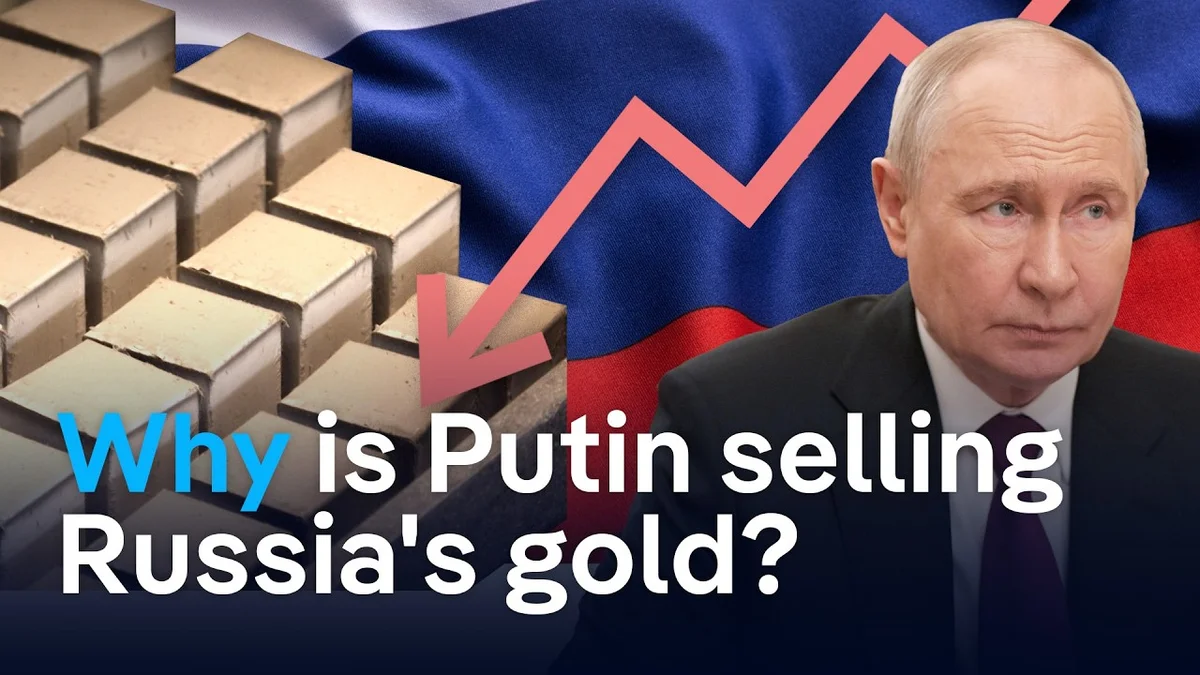
Gold bars stored in a vault, representing Russia's shrinking financial reserves.
Russia's official gold stocks are being tapped to cover widening budget deficits.· YouTube

Visual TL;DR. Russia Sells Gold to cover Finance Expenditures. Budget Deficit Grows drives need Finance Expenditures. Russia Sells Gold indicates Shift in Strategy. Finance Expenditures leads to War Economy Strain. Russia Sells Gold results in Reduced Financial Cushion. Shift in Strategy reflects War Economy Strain.

  1. Russia Sells Gold: 44 tons sold in H1 2026, signaling shrinking financial cushion
  2. Budget Deficit Grows: mounting pressure on the country's economy due to wartime strain
  3. Shift in Strategy: reversing years of gold accumulation as an insurance policy
  4. Finance Expenditures: exchanging gold assets for rubles to cover rising government costs
  5. War Economy Strain: critical indicator of mounting pressure on Russia's financial system
  6. Reduced Financial Cushion: tapping into strategic reserves, not immediate bankruptcy
Visual TL;DR
Visual TL;DR, startuphub.ai Russia Sells Gold to cover Finance Expenditures. Budget Deficit Grows drives need Finance Expenditures. Finance Expenditures leads to War Economy Strain to cover drives need leads to Russia Sells Gold Budget Deficit Grows Finance Expenditures War Economy Strain From startuphub.ai · The publishers behind this format
Visual TL;DR, startuphub.ai Russia Sells Gold to cover Finance Expenditures. Budget Deficit Grows drives need Finance Expenditures. Finance Expenditures leads to War Economy Strain to cover drives need leads to Russia Sells Gold Budget DeficitGrows FinanceExpenditures War EconomyStrain From startuphub.ai · The publishers behind this format
Visual TL;DR, startuphub.ai Russia Sells Gold to cover Finance Expenditures. Budget Deficit Grows drives need Finance Expenditures. Finance Expenditures leads to War Economy Strain to cover drives need leads to Russia Sells Gold 44 tons sold in H1 2026, signalingshrinking financial cushion Budget Deficit Grows mounting pressure on the country's economydue to wartime strain Finance Expenditures exchanging gold assets for rubles to coverrising government costs War Economy Strain critical indicator of mounting pressure onRussia's financial system From startuphub.ai · The publishers behind this format
Visual TL;DR, startuphub.ai Russia Sells Gold to cover Finance Expenditures. Budget Deficit Grows drives need Finance Expenditures. Finance Expenditures leads to War Economy Strain to cover drives need leads to Russia Sells Gold 44 tons sold in H12026, signalingshrinking financial… Budget DeficitGrows mounting pressureon the country'seconomy due to… FinanceExpenditures exchanging goldassets for rublesto cover rising… War EconomyStrain critical indicatorof mountingpressure on… From startuphub.ai · The publishers behind this format
Visual TL;DR, startuphub.ai Russia Sells Gold to cover Finance Expenditures. Budget Deficit Grows drives need Finance Expenditures. Russia Sells Gold indicates Shift in Strategy. Finance Expenditures leads to War Economy Strain. Russia Sells Gold results in Reduced Financial Cushion. Shift in Strategy reflects War Economy Strain to cover drives need indicates leads to results in reflects Russia Sells Gold 44 tons sold in H1 2026, signalingshrinking financial cushion Budget Deficit Grows mounting pressure on the country's economydue to wartime strain Shift in Strategy reversing years of gold accumulation as aninsurance policy Finance Expenditures exchanging gold assets for rubles to coverrising government costs War Economy Strain critical indicator of mounting pressure onRussia's financial system Reduced Financial Cushion tapping into strategic reserves, notimmediate bankruptcy From startuphub.ai · The publishers behind this format
Visual TL;DR, startuphub.ai Russia Sells Gold to cover Finance Expenditures. Budget Deficit Grows drives need Finance Expenditures. Russia Sells Gold indicates Shift in Strategy. Finance Expenditures leads to War Economy Strain. Russia Sells Gold results in Reduced Financial Cushion. Shift in Strategy reflects War Economy Strain to cover drives need indicates leads to results in reflects Russia Sells Gold 44 tons sold in H12026, signalingshrinking financial… Budget DeficitGrows mounting pressureon the country'seconomy due to… Shift in Strategy reversing years ofgold accumulationas an insurance… FinanceExpenditures exchanging goldassets for rublesto cover rising… War EconomyStrain critical indicatorof mountingpressure on… Reduced FinancialCushion tapping intostrategic reserves,not immediate… From startuphub.ai · The publishers behind this format

Russia has begun tapping into its strategic financial reserves, selling off 44 tons of gold during the first half of 2026. While this move does not signal immediate bankruptcy for the Kremlin, it serves as a critical indicator of the mounting pressure on the country's economy. The sale highlights a shift in strategy for a nation that previously treated its gold stock as an essential insurance policy against Western sanctions.

Russia Sells Off Gold Reserves: A Warning Sign for the War Economy - YouTube
Russia Sells Off Gold Reserves: A Warning Sign for the War Economy — from YouTube

The Shifting Financial Strategy

For years, Russia actively accumulated gold as a way to reduce reliance on the US dollar and build domestic control over its assets. Now, that trend has reversed. As Daniel Winter of DW Business points out, this move is not about funding a specific purchase of tanks or missiles, but rather a necessary step to finance a ballooning federal budget deficit. The government is essentially exchanging gold assets held by the Central Bank for rubles to cover rising expenditures.

The Reality of a War Economy

Elina Ribakova from the Kyiv School of Economics notes that the primary driver behind these sales is the urgent need to address a widening budget gap. The readily spendable portion of Russia's rainy day fund has decreased by roughly three quarters since the invasion of Ukraine. "The fact that they are selling gold means that they are running out of other more liquid assets in that fund," says Ribakova. This depletion leaves the state with fewer options to absorb economic shocks, such as a drop in oil prices or the imposition of new sanctions.

Limits on Long-Term Sustainability

The Russian economy is currently characterized by a stark divide. The state-dominated sector is bolstered by high military spending, while the private sector and small to medium-sized enterprises struggle to maintain viability. As Chris Weafer of Macro-Advisory observes, "The rest of the economy is a disaster. Small, medium-sized enterprises, the private sector, all struggling badly."

While the Kremlin can theoretically continue to borrow domestically, raise taxes, or accept higher inflation, these measures come with heavy costs. Investment is increasingly diverted away from civilian infrastructure like roads, schools, and hospitals toward defense production. Ultimately, the government can print more rubles, but it cannot instantly manufacture the skilled engineers, machine tools, or imported electronics required for a modern, functioning civilian sector. The war effort is continuing, but it is increasingly forcing the Russian economy to make difficult trade-offs between military survival and future economic stability.

© 2026 StartupHub.ai. All rights reserved. Do not enter, scrape, copy, reproduce, or republish this article in whole or in part. Use as input to AI training, fine-tuning, retrieval-augmented generation, or any machine-learning system is prohibited without written license. Substantially-similar derivative works will be pursued to the fullest extent of applicable copyright, database, and computer-misuse laws. See our terms.