

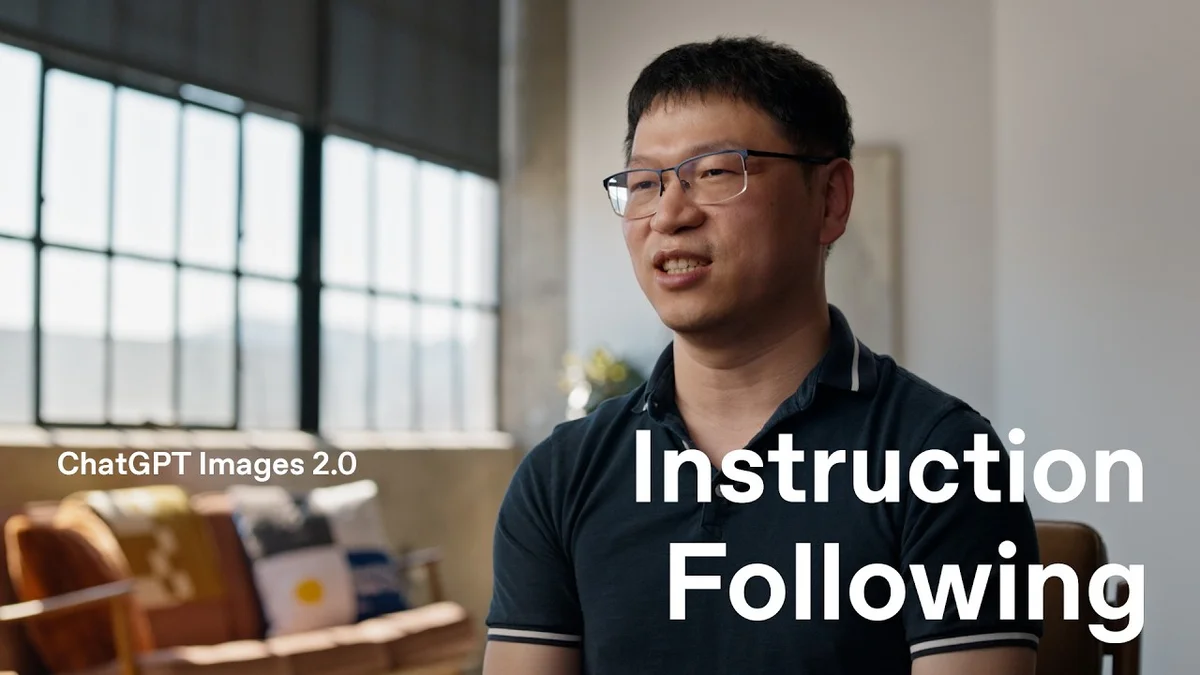
OpenAI's Jianfeng Gu on ChatGPT Images 2.0

OpenAI researcher Jianfeng Gu details how ChatGPT Images 2.0 dramatically improves instruction following for AI image generation, enabling precise control over object placement and scene composition.

4 min read
Jianfeng Gu from OpenAI discusses ChatGPT Images 2.0 capabilities on a laptop.
Image credit: OpenAI· OpenAI Youtube

Jianfeng Gu, a researcher at OpenAI, offers a deep dive into the advancements of ChatGPT Images 2.0, a significant leap forward in AI-powered image generation. Gu, who works on the research team focusing on image generation, explains how this latest iteration addresses key challenges in translating user prompts into accurate and contextually aware visuals. The video showcases the evolution from earlier models to the current capabilities, highlighting how the new version excels at understanding nuanced instructions.

Meet Jianfeng Gu

Jianfeng Gu is a researcher at OpenAI, a leading artificial intelligence research laboratory. His work is central to the development of generative AI models, particularly in the realm of image creation. Gu's contributions are vital in pushing the boundaries of what AI can achieve in terms of understanding and executing complex creative tasks, making him a key figure in the ongoing advancements of AI's visual capabilities.

The full discussion can be found on OpenAI Youtube's YouTube channel.
Related startups

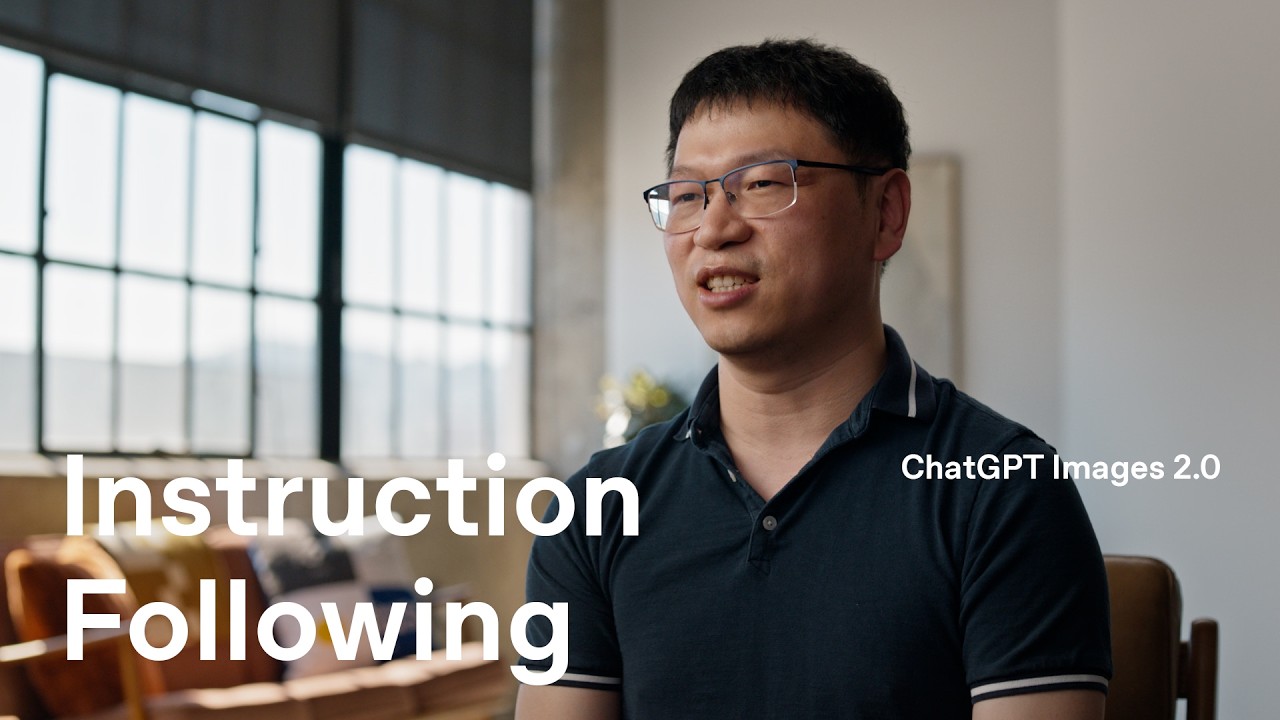
Instruction Following with ChatGPT Images 2.0 - OpenAI Youtube
Instruction Following with ChatGPT Images 2.0 — from OpenAI Youtube

ChatGPT Images 2.0: A New Era of Instruction Following

The core of Gu's presentation revolves around the enhanced instruction-following capabilities of ChatGPT Images 2.0. He explains that previous models often struggled with precise object placement, spatial relationships, and even interpreting subtle cues within a prompt. This new version, however, demonstrates a remarkable ability to grasp and implement detailed instructions, bringing AI-generated imagery closer to human intent.

Gu illustrates this with several examples. The first involves a prompt to create an image of a woman making magazine word art on a carpet floor. The prompt specifies the text on the art, that the woman is holding the word "words" in one hand and the word "few" in the other. The model successfully rendered this complex scene, demonstrating its improved understanding of textual elements within an image and their placement.

Another compelling demonstration focuses on clock rendering. Gu explains that older models might generate clocks with incorrect times or inconsistent styles. However, ChatGPT Images 2.0 can accurately render multiple clocks showing specific times. For instance, a prompt to generate four retro-looking clocks, with specific times like 2:25, 2:30, 9:10, and 7:45, was executed with precision. Gu notes, "The clock rendering is pretty amazing compared to the old model." This level of detail signifies a major step up in the AI's ability to handle precise numerical and visual information.

Spatial Reasoning and Object Placement Mastery

A significant breakthrough highlighted by Gu is the model's improved spatial reasoning. He presents a prompt to create an image with five specific objects on a white background: an apple in the center, a mug to its right, books above the mug, a camera to the left, and a basketball below the camera. The resulting image accurately reflects these spatial relationships, showcasing the model's ability to understand and manipulate objects in a three-dimensional space.

Gu elaborates on the challenges this presents for AI development. "The problem is… the model has to know something about the spatial layout." He emphasizes that for older models, accurately placing objects based on such detailed instructions was difficult. ChatGPT Images 2.0, however, shows a marked improvement, generating images that closely match the specified arrangements. This capability is crucial for applications requiring precise scene composition or the generation of complex visual narratives.

Bridging the Gap Between Intent and Output

The overarching theme of Gu's discussion is how ChatGPT Images 2.0 is closing the gap between what a user intends to create and what the AI actually produces. He states, "This is a huge improvement… it’s going to close the gap between your intent and the model’s response." This enhancement is not just about creating aesthetically pleasing images; it's about making AI a more reliable and intuitive tool for creative expression and practical applications.

The advancements in instruction following mean that users can communicate more complex ideas to the AI and expect more faithful visual representations. This improved accuracy and control empower creators, designers, and anyone looking to visualize their ideas with greater fidelity. The ability to precisely control elements within an image opens up new possibilities for storytelling, product visualization, and artistic exploration.

Future Implications

The progress demonstrated by ChatGPT Images 2.0 suggests a future where AI image generation is more versatile and user-friendly. As the models become better at understanding and executing instructions, they will likely become indispensable tools across various industries. From marketing and advertising to education and entertainment, the ability to generate highly specific and contextually accurate images on demand will drive new forms of creativity and efficiency.

© 2026 StartupHub.ai. All rights reserved. Do not enter, scrape, copy, reproduce, or republish this article in whole or in part. Use as input to AI training, fine-tuning, retrieval-augmented generation, or any machine-learning system is prohibited without written license. Substantially-similar derivative works will be pursued to the fullest extent of applicable copyright, database, and computer-misuse laws. See our terms.