Artificial Intelligence

Laurie Voss on Shipping Real Agents

Laurie Voss of Arize AI discusses the challenges and necessity of hands-on evaluation for shipping real-world AI agents.

StartupHub.ai Staff

By StartupHub.ai Staff, reviewed by Daniel Singer, Editor

4 min read

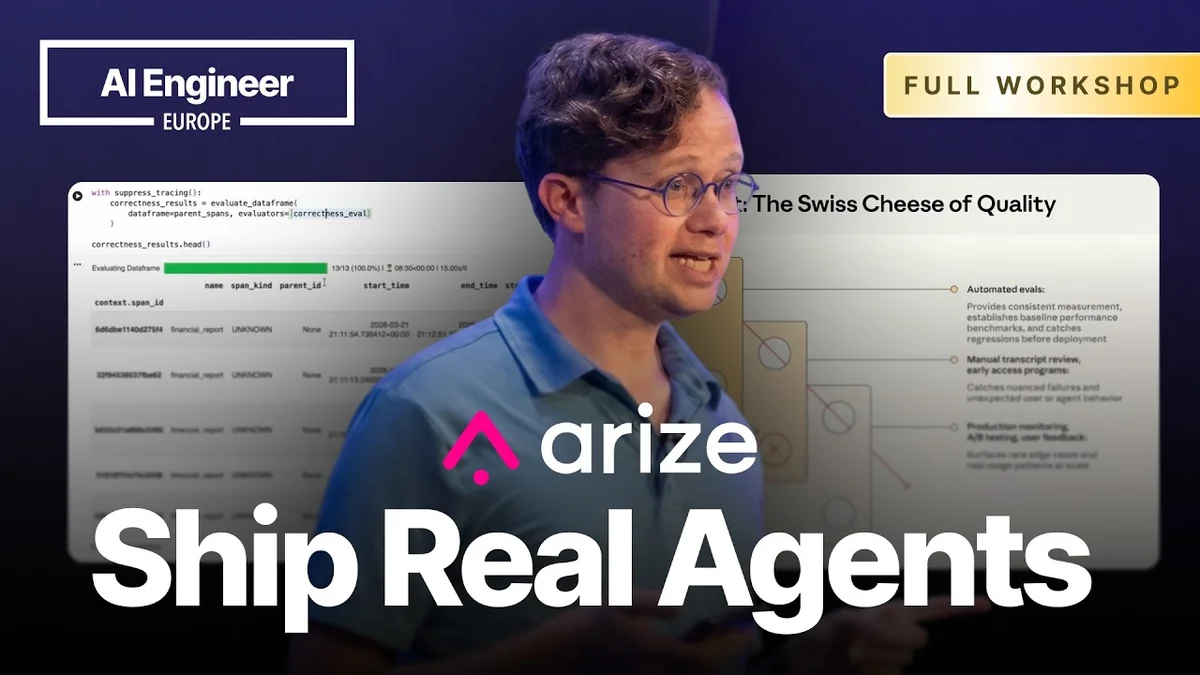
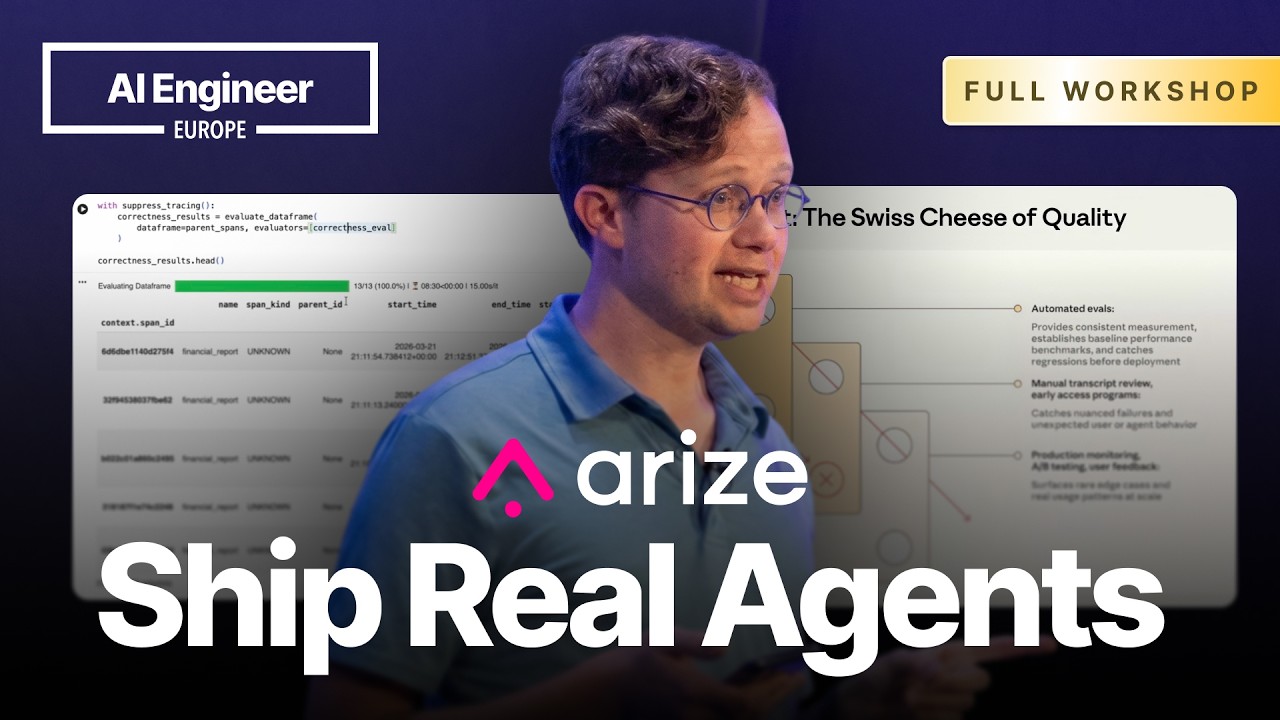
Laurie Voss speaking at an Arize AI event on AI agent evaluation
Image credit: StartupHub.aiCredit: AI Engineer
Visual TL;DR
Agentic AI ChallengesDriver
agents reason, plan, and act autonomously across operations
From the article 6 mentionsLaurie Voss, a prominent figure in the AI development space, recently shared insights into the critical challenges and best practices for deploying and evaluating agentic applications.
Beyond BenchmarksDriver
From the article 2 mentionsIn a discussion hosted by Arize AI, Voss underscored the necessity of moving beyond theoretical benchmarks to rigorous, hands-on evaluation for AI agents operating in real-world scenarios.
Hands-On EvaluationCore
rigorous testing under actual conditions for reliability and safety
From the article 8 mentionsHe stressed that developers must actively seek out and implement methods for direct, hands-on evaluation.
Key Performance MetricsCore
understanding how agents perform under actual conditions
From the articleWhen it comes to evaluating AI agents, Voss identified several critical metrics that go beyond standard AI performance indicators.
Shipping Real AgentsEffect
ensuring agents are reliable, safe, and efficient in production
From the articleVoss emphasized that shipping these real agents requires a deep understanding of their behavior in dynamic, unpredictable situations.
Observability ToolsContext
essential for understanding agent behavior and debugging issues
From the articleThe complexity of agentic systems demands advanced observability tools.
Contents(3)

Laurie Voss, a prominent figure in the AI development space, recently shared insights into the critical challenges and best practices for deploying and evaluating agentic applications. In a discussion hosted by Arize AI, Voss underscored the necessity of moving beyond theoretical benchmarks to rigorous, hands-on evaluation for AI agents operating in real-world scenarios. The focus is on understanding how these agents perform under actual conditions, ensuring they are not just capable in controlled environments but also reliable, safe, and efficient when interacting with users and complex systems.

Laurie Voss on Shipping Real Agents - AI Engineer
Laurie Voss on Shipping Real Agents, AI Engineer

The core of Voss's message centers on the unique difficulties presented by agentic applications. Unlike traditional machine learning models that often perform a single, well-defined task, AI agents are designed to reason, plan, and act autonomously across a sequence of operations. This inherent complexity means that their performance cannot be adequately captured by simple accuracy scores. Voss emphasized that shipping these real agents requires a deep understanding of their behavior in dynamic, unpredictable situations.

The Imperative of Hands-On Evaluation

Voss articulated that the true test of an AI agent lies in its ability to function effectively in the wild. Synthetic evaluations, while useful for initial development, often fail to replicate the nuances of real-world data, user interactions, and emergent behaviors. He stressed that developers must actively seek out and implement methods for direct, hands-on evaluation. This involves deploying agents, observing their actions, and collecting data on their performance in live environments. This iterative process is crucial for identifying unexpected failures, biases, or inefficiencies that might go unnoticed in simulated testing.

The speaker highlighted that agentic systems are not static; they learn and adapt. This dynamic nature makes continuous evaluation a non-negotiable aspect of their lifecycle. Without ongoing assessment, agents can drift in performance, potentially leading to degraded user experiences or even harmful outcomes. Voss suggested that this evaluation needs to be as sophisticated as the agents themselves, requiring dedicated tooling and methodologies.

Key Metrics for Agentic Performance

When it comes to evaluating AI agents, Voss identified several critical metrics that go beyond standard AI performance indicators. Task completion rate is fundamental, but it’s only the starting point. He also pointed to efficiency, which encompasses the speed at which an agent completes a task and the resources it consumes. For agents that interact with costly APIs or consume significant compute power, efficiency directly translates to operational cost and scalability.

Safety and reliability are paramount, especially for agents handling sensitive information or performing critical actions. Voss discussed the need to evaluate agents for their propensity to generate harmful content, make incorrect decisions, or exhibit undesirable behaviors. This involves establishing clear safety guardrails and continuously monitoring for violations.

Furthermore, the cost associated with running these agents is a significant factor for commercial viability. Agents often interact with large language models (LLMs) or other services that incur per-token or per-call fees. Voss argued that evaluation frameworks must incorporate cost analysis to ensure that deployed agents are economically sustainable. He stated, "We need to understand the full cost of operation, not just the perceived accuracy."

Observability and the Future of Agent Evaluation

The complexity of agentic systems demands advanced observability tools. Voss explained that to effectively evaluate agents, developers need deep visibility into their decision-making processes, intermediate steps, and the data they are processing. This allows for detailed debugging and performance analysis. He suggested that traditional logging mechanisms are often insufficient for the intricate workflows of AI agents.

Voss pointed towards the development of specialized evaluation platforms that can handle the unique challenges of agentic AI. These platforms should facilitate the collection, annotation, and analysis of agent behavior, enabling developers to identify patterns, root causes of failure, and areas for improvement. The goal is to create a feedback loop that continuously refines agent performance and safety.

The future of agent evaluation, according to Voss, lies in creating sophisticated, automated systems that can continuously monitor, test, and report on agent performance in real-time. This will be essential for scaling agentic applications and ensuring their trustworthiness in a wide range of applications.

Mentioned in this story

TopicsAI ResearchArtificial IntelligenceArize AI

StartupHub.ai StaffDaniel SingerWritten by StartupHub.ai Staff, Editorial teamReviewed by Daniel Singer, EditorAbout

StartupHub.ai Staff, Editorial team

The staff writers of StartupHub.ai, ranging from investment analysts to avid AI tool users, early adopters and critical enthusiasts. Backgrounds span engineering, business and the arts. We hold every piece to rigorous standards of research and review.

Daniel Singer, Editor

Daniel Singer is an AI expert who has been writing about, covering and building AI technology since 2018.

More from Daniel Singer

Get the free daily brief every morning

Every morning the day's AI news, new AI startups and new funding rounds. Free and takes a few minutes to read, unsubscribe at any time.

Join 64,000 other subscribers.

Test your Agent Readiness now

Paste your website. How well ChatGPT, Claude and the other agents can read and use a site, in about a minute.

The videos behind the news, one flip at a time

The feed mixes the videos from our articles with startup demos and you flip through them like TV channels for free with no signup.