Intercom's AI Leap: Doubling Engineering Throughput

Brian Scanlan of Intercom discusses how AI adoption can double engineering throughput, sharing insights from Intercom's AI-first transformation.

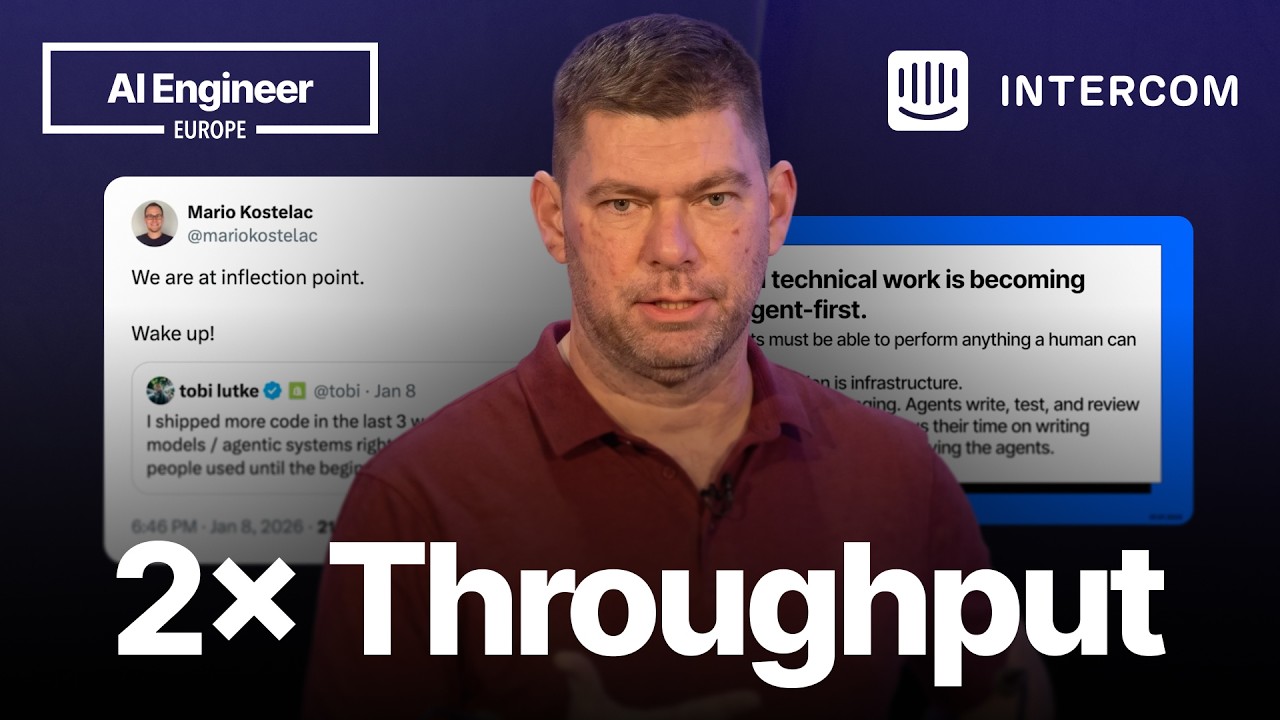
Brian Scanlan speaking at AI Engineer Europe about building with AI.
Image credit: AI Engineer Europe· AI Engineer
Visual TL;DR
AI adoption insightsCore
Brian Scanlan shares Intercom's AI journey and strategies
From the article 5 mentionsScanlan's insights offer a practical roadmap for organizations seeking to harness the power of AI to double their engineering output.
AI-first transformationDriver
Intercom pivots to AI-focused entity after 15 years
From the article 2 mentionsSpeaking at AI Engineer Europe, Scanlan detailed Intercom's transition to an AI-first company and the strategies employed to achieve remarkable gains in productivity.
Accelerated by new modelsCore
ChatGPT and similar models significantly boost AI capabilities
From the article 3 mentionsThe recent surge in AI capabilities, particularly with the advent of models like ChatGPT, has accelerated this transformation.
Key principles adoptedContext
Focus on transforming how engineering work is approached
From the articleThis initiative is underpinned by several key principles.
Doubled engineering throughputEffect
Remarkable gains in productivity achieved through AI adoption
From the article 2 mentionsBrian Scanlan, a senior principal engineer at Intercom, recently shared insights on how embracing AI can significantly boost an engineering team's throughput.
Metrics and maturityContext
Tracking progress and readiness for AI integration
From the article 3 mentionsScanlan also highlighted Intercom's AI maturity model, which spans from manual code responses to agents autonomously writing and reviewing code.
Future of engineeringEffect
AI integration reshaping the engineering landscape
From the article 7 mentionsThe presentation concluded with a look at the future of engineering, where AI agents are expected to play an increasingly central role.
Contents(5)

Brian Scanlan, a senior principal engineer at Intercom, recently shared insights on how embracing AI can significantly boost an engineering team's throughput. Speaking at AI Engineer Europe, Scanlan detailed Intercom's transition to an AI-first company and the strategies employed to achieve remarkable gains in productivity. He emphasized that the adoption of AI is not merely about adding new tools but fundamentally transforming how engineering work is approached and executed.

Intercom's AI Leap: Doubling Engineering Throughput - AI Engineer
Intercom's AI Leap: Doubling Engineering Throughput, AI Engineer

Intercom's AI Transformation

Scanlan outlined Intercom's journey, noting that the company has been integrating AI features since 2018. The recent surge in AI capabilities, particularly with the advent of models like ChatGPT, has accelerated this transformation. Intercom, a 15-year-old B2B SaaS company with a global presence, has pivoted to become an AI-focused entity. This strategic shift was driven by a foresight into the evolving technological landscape, where companies failing to adapt to AI risk becoming obsolete.

The '2x' Initiative and Key Principles

Intercom launched an internal initiative, dubbed '2x', with the ambitious goal of doubling engineering productivity within a year without increasing headcount. This initiative is underpinned by several key principles. Firstly, standardizing on a single, skill-driven AI platform that all of R&D can leverage is paramount. This platform must provide access to all Intercom tools and the necessary skills to use them effectively. Secondly, the company believes in giving agents problems, not just tasks, empowering them to figure out solutions independently and to proactively fill in knowledge gaps.

The approach involves a continuous improvement cycle for AI guidance, combining human curation with automated processes. This ensures that the AI models are not only effective but also constantly learning and refining their capabilities. Intercom's strategy emphasizes building robust, testable, and reliable AI components that deliver tangible value to customers.

Metrics and AI Maturity

To track progress, Intercom monitors several key metrics. The adoption of AI is measured through the number of skill invocations, code reviews, and automated approval rates. The company has observed a significant increase in these metrics, particularly in the latter half of the year, indicating a successful integration of AI into their workflows. The adoption of AI tools like Claude Code, which are used by nearly 1000 weekly users across Intercom, demonstrates a broad embrace of these new technologies.

Scanlan also highlighted Intercom's AI maturity model, which spans from manual code responses to agents autonomously writing and reviewing code. The current stage sees agents actively writing code, with engineers focusing on higher-level tasks such as writing specifications, validation, and improving the agents themselves. This shift allows engineers to move from being mere coders to becoming product builders, focusing on strategy and innovation.

Key Takeaways for AI Adoption

Scanlan shared several key lessons for companies looking to adopt AI to boost engineering productivity:

  • Update Job Descriptions and Expectations: Roles and responsibilities need to evolve to reflect the new AI-augmented workflows.
  • Communicate Urgency: Continuously emphasize the importance of adopting AI to drive organizational change.
  • Reward and Recognize: Financially and socially reward engineers who excel in leveraging AI tools.
  • Provide Support and Space: Allow engineers the time and resources to learn, experiment, and adapt to new AI tools.
  • Be Specific: Clearly define desired outcomes and how AI should be applied to achieve them.

The company's platform strategy centers on standardizing on a single, skill-driven AI platform that can be leveraged by all of R&D. This approach aims to streamline development, enhance collaboration, and ultimately drive faster, more efficient delivery of high-quality products.

The Future of Engineering with AI

The presentation concluded with a look at the future of engineering, where AI agents are expected to play an increasingly central role. Intercom's experience shows that by embracing AI, engineering teams can significantly increase their throughput, improve code quality, and foster a more innovative and productive environment. Scanlan's insights offer a practical roadmap for organizations seeking to harness the power of AI to double their engineering output.

© 2026 StartupHub.ai. All rights reserved. You may not republish this article in full without a license. Search engines and AI research tools may crawl and summarize for reference. Bulk reproduction or model training requires a license. See our terms.

Watch

The videos behind the news, one flip at a time

The feed mixes the videos from our articles with startup demos and you flip through them like TV channels for free with no signup.

Daniel Singer

Written by

Daniel Singer

Editor, StartupHub.ai

Daniel Singer is the editor of StartupHub.ai, a technology expert and thought leader on AI and its applications across sectors, from fintech and healthcare to developer tooling and consumer software. He writes and tests the tools covered here thoroughly and regularly, and built StartupHub.ai to give founders, operators and buyers a clearer read on what they are actually being sold.