

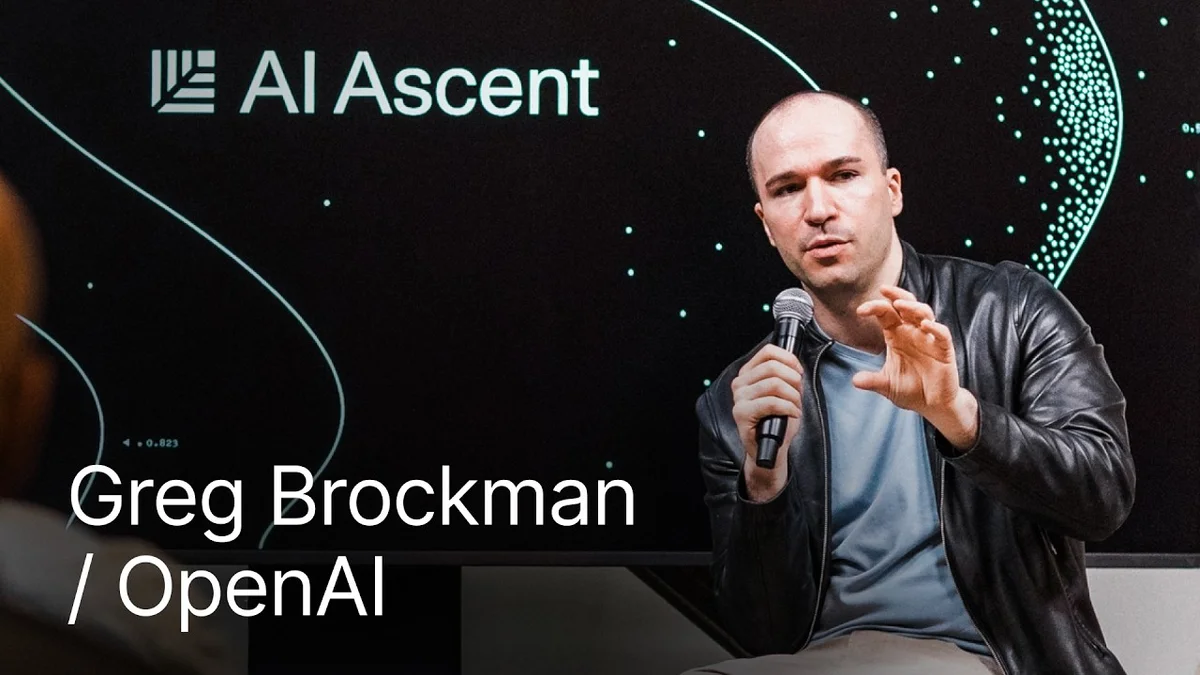
In a recent fireside chat hosted by AI Ascent, Greg Brockman, President and Chief Technology Officer of OpenAI, shared insights into the company's mission and approach to developing advanced artificial intelligence. Brockman, a pivotal figure in the AI research community, discussed the rapid evolution of AI capabilities and the strategic considerations behind OpenAI's work.
Greg Brockman's Role at OpenAI
Brockman highlighted his dual role at OpenAI as both a co-founder and the chief builder, emphasizing his hands-on involvement in shaping the company's technological direction. He noted the significant progress OpenAI has made, particularly in scaling AI models and making them more accessible and useful.
The Scaling Laws of AI
A key theme of the discussion was the concept of scaling laws in AI, which Brockman described as a fundamental truth in the field. He explained that as models are trained on more data and with more computational power, their capabilities tend to increase predictably. This principle underpins OpenAI's strategy to develop increasingly sophisticated AI systems.
Brockman drew parallels to fundamental scientific discoveries, suggesting that the underlying principles of AI scaling are akin to understanding the laws of physics. He emphasized that while the precise mechanisms are not always fully understood, the empirical evidence for scaling laws is strong, driving continuous progress.
The Importance of Compute and Data
The conversation also touched upon the critical role of compute power and vast datasets in advancing AI. Brockman acknowledged OpenAI's aggressive strategy in securing compute resources, stating, "We want to scale compute as much as possible." He linked this directly to the company's ability to train larger, more capable models that can tackle increasingly complex problems.