
Context Layer: The Missing Piece for Production AI Agents

Prukalpa Sankar of Atlan explains why context is the missing piece for production AI agents and introduces the concept of a context layer.

9 min read
Prukalpa Sankar, Founder & Co-CEO of Atlan, speaking on stage about AI context layers.
AI Engineer

Visual TL;DR. AI Models Smart but still AI Agents Fail. AI Agents Fail due to Missing Context. Missing Context solution is Context Layer. Context Layer requires Architectural Needs. Context Layer enables Production Viability. Atlan's Role contributes to Context Layer.

  1. AI Models Smart: models now rank in the top 1% of test scorers, showing raw intelligence
  2. AI Agents Fail: deployed agents falter with simple business questions, leading to abandonment
  3. Missing Context: the critical disconnect is a deficit in understanding real-world business problems
  4. Context Layer: Prukalpa Sankar introduces this architectural need for contextual intelligence
  5. Architectural Needs: outlines specific requirements for building a robust context layer for agents
  6. Production Viability: enables AI agents to move beyond demos and solve real-world business problems
  7. Atlan's Role: Atlan is involved in context engineering, addressing the contextual gap
Visual TL;DR
Visual TL;DR, startuphub.ai AI Agents Fail due to Missing Context. Missing Context solution is Context Layer. Context Layer enables Production Viability due to solution is enables AI Agents Fail Missing Context Context Layer Production Viability From startuphub.ai · The publishers behind this format
Visual TL;DR, startuphub.ai AI Agents Fail due to Missing Context. Missing Context solution is Context Layer. Context Layer enables Production Viability due to solution is enables AI Agents Fail Missing Context Context Layer ProductionViability From startuphub.ai · The publishers behind this format
Visual TL;DR, startuphub.ai AI Agents Fail due to Missing Context. Missing Context solution is Context Layer. Context Layer enables Production Viability due to solution is enables AI Agents Fail deployed agents falter with simplebusiness questions, leading to abandonment Missing Context the critical disconnect is a deficit inunderstanding real-world business problems Context Layer Prukalpa Sankar introduces thisarchitectural need for contextualintelligence Production Viability enables AI agents to move beyond demos andsolve real-world business problems From startuphub.ai · The publishers behind this format
Visual TL;DR, startuphub.ai AI Agents Fail due to Missing Context. Missing Context solution is Context Layer. Context Layer enables Production Viability due to solution is enables AI Agents Fail deployed agentsfalter with simplebusiness questions,… Missing Context the criticaldisconnect is adeficit in… Context Layer Prukalpa Sankarintroduces thisarchitectural need… ProductionViability enables AI agentsto move beyonddemos and solve… From startuphub.ai · The publishers behind this format
Visual TL;DR, startuphub.ai AI Models Smart but still AI Agents Fail. AI Agents Fail due to Missing Context. Missing Context solution is Context Layer. Context Layer requires Architectural Needs. Context Layer enables Production Viability. Atlan's Role contributes to Context Layer but still due to solution is requires enables contributes to AI Models Smart models now rank in the top 1% of testscorers, showing raw intelligence AI Agents Fail deployed agents falter with simplebusiness questions, leading to abandonment Missing Context the critical disconnect is a deficit inunderstanding real-world business problems Context Layer Prukalpa Sankar introduces thisarchitectural need for contextualintelligence Architectural Needs outlines specific requirements forbuilding a robust context layer for agents Production Viability enables AI agents to move beyond demos andsolve real-world business problems Atlan's Role Atlan is involved in context engineering,addressing the contextual gap From startuphub.ai · The publishers behind this format
Visual TL;DR, startuphub.ai AI Models Smart but still AI Agents Fail. AI Agents Fail due to Missing Context. Missing Context solution is Context Layer. Context Layer requires Architectural Needs. Context Layer enables Production Viability. Atlan's Role contributes to Context Layer but still due to solution is requires enables contributes to AI Models Smart models now rank inthe top 1% of testscorers, showing… AI Agents Fail deployed agentsfalter with simplebusiness questions,… Missing Context the criticaldisconnect is adeficit in… Context Layer Prukalpa Sankarintroduces thisarchitectural need… ArchitecturalNeeds outlines specificrequirements forbuilding a robust… ProductionViability enables AI agentsto move beyonddemos and solve… Atlan's Role Atlan is involvedin contextengineering,… From startuphub.ai · The publishers behind this format

In the rapidly evolving AI landscape, a critical disconnect persists: while models have achieved remarkable leaps in raw intelligence, their ability to solve real-world business problems remains stubbornly constrained. Prukalpa Sankar, Founder & Co-CEO of Atlan, argues that the missing ingredient is context. Speaking at a recent event, Sankar outlined the architectural needs for giving AI agents the contextual intelligence required to move beyond impressive demos and achieve production viability.
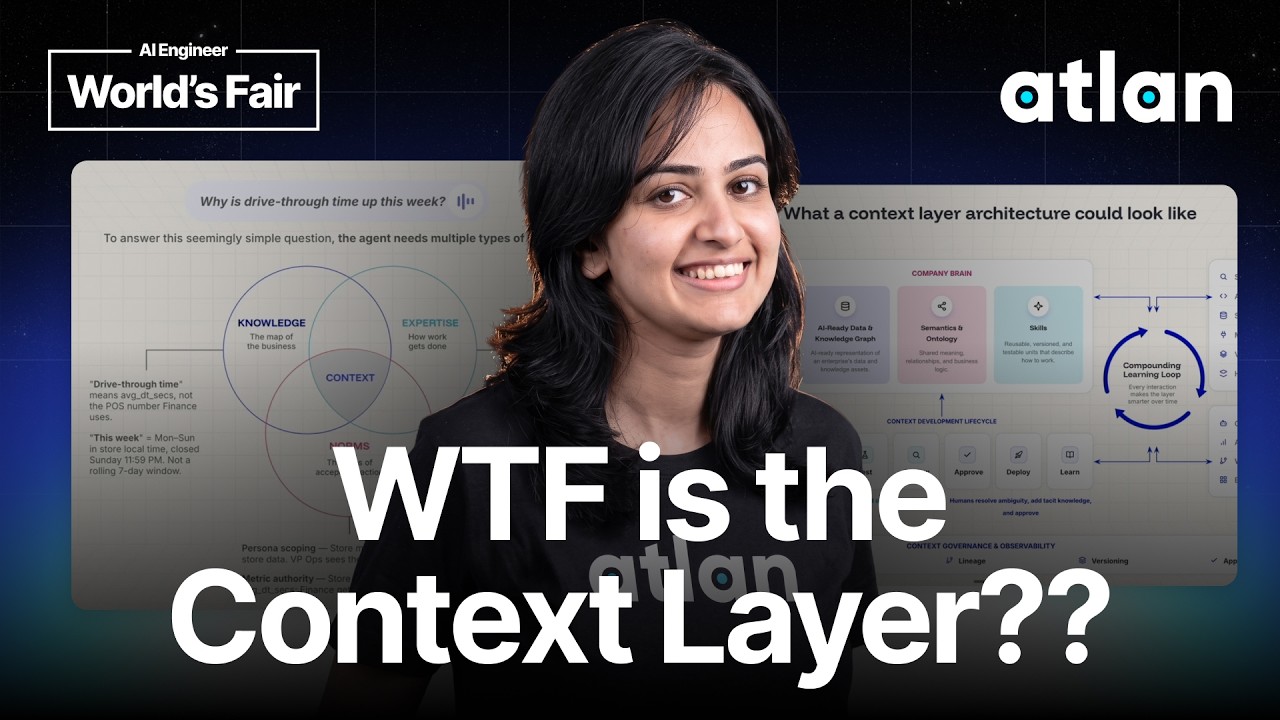
Context Layer: The Missing Piece for Production AI Agents - AI Engineer
Context Layer: The Missing Piece for Production AI Agents — from AI Engineer

The current state of AI agents presents a common frustration for businesses. Two years ago, AI models struggled with basic professional exams. Today, they rank in the top 1% of test scorers. Yet, most deployed agents still falter when faced with simple business questions. This leads to a cycle where a functional demo is shipped, only for the business to abandon it within a month. Sankar identifies this failure point not as a limitation of model intelligence, but as a deficit in understanding the nuances of business operations.

The Contextual Gap in AI Deployment

Sankar emphasizes that the value human experts bring to a business is not solely their analytical prowess, but their deep understanding of business definitions, procedural knowledge, and operational norms. These are the implicit, often unarticulated, rules and understandings that govern how work gets done. AI models, trained on vast datasets, often lack this specific, operational context. This leads to agents that can process information but cannot effectively act upon it within a specific business environment.

The problem is compounded by the fact that traditional methods like fine-tuning and simple prompting struggle to imbue AI agents with this deep contextual understanding. Fine-tuning can be costly and difficult to scale, while prompting offers only a surface-level interaction with the model's knowledge. Sankar proposes a more fundamental architectural shift: a dedicated 'context layer' designed to provide AI agents with the necessary business intelligence.

Architecture of a Context Layer

Drawing from hundreds of production deployments, Sankar detailed the components and principles of an effective context layer. This layer acts as a bridge between raw data and AI agent execution, translating business logic and operational knowledge into a format AI can utilize. Key elements include:

  • Versioned, Testable, Portable Context Repositories: Just like code repositories, context needs to be managed, versioned, and tested. This ensures that the context applied to an AI agent is reliable, auditable, and can be easily shared and updated across different deployments and frameworks.
  • Simulation Environments: Before deploying an agent into a live business environment, simulation plays a critical role. These environments allow for the testing of agent behavior against real-world scenarios, catching potential failures and unexpected outcomes related to context before they impact operations.
  • Agent Traces for Contextual Compounding: The interactions and outcomes of AI agents in production can provide valuable feedback. By tracing agent behavior and feeding these insights back into the context layer, the system can learn and adapt, compounding shared context over time and improving future agent performance.

This approach, Sankar argues, is essential for scaling AI solutions beyond the demo phase. Context engineering, as opposed to solely relying on model training or prompt engineering, provides a more sustainable and effective path to production-ready AI agents.

Openness and Portability: The MCP Mandate

A crucial aspect of Sankar's vision for the context layer is its openness and portability. The context should not be locked into a specific AI framework or proprietary system. Instead, it should adhere to open standards, such as the Metadata, Compute, and Portability (MCP) framework, and integrate with data infrastructure like Apache Iceberg. This allows for context to be deployed across any framework and any cloud environment, preventing vendor lock-in and maximizing flexibility.

When context is not open and portable, it leads to fragmented systems and significant re-engineering efforts for each new AI initiative. Sankar highlighted the consequences of non-open context: increased costs, slower deployment cycles, and a reduced ability to adapt to changing business needs. The goal is to create a reusable and universally applicable layer of business intelligence that powers all AI agents within an organization.

Atlan's Role in Context Engineering

Prukalpa Sankar, as the Founder & Co-CEO of Atlan, is at the forefront of this movement. Atlan positions itself as the context layer for AI, aiming to provide enterprises with the necessary infrastructure to imbue their AI agents with operational intelligence. The company's work in metadata management and data governance has positioned it as a leader, serving over 300 enterprises including major financial institutions and automotive giants. Atlan's success in attracting significant funding, including over $200 million from prominent venture capital firms, underscores the growing recognition of context's importance in the AI era.

Before Atlan, Sankar co-founded SocialCops, a venture that built the world's largest government data lake to support the UN's Sustainable Development Goals. This prior experience likely informed her understanding of how data, context, and practical application intersect to drive real-world impact.

© 2026 StartupHub.ai. All rights reserved. Do not enter, scrape, copy, reproduce, or republish this article in whole or in part. Use as input to AI training, fine-tuning, retrieval-augmented generation, or any machine-learning system is prohibited without written license. Substantially-similar derivative works will be pursued to the fullest extent of applicable copyright, database, and computer-misuse laws. See our terms.