

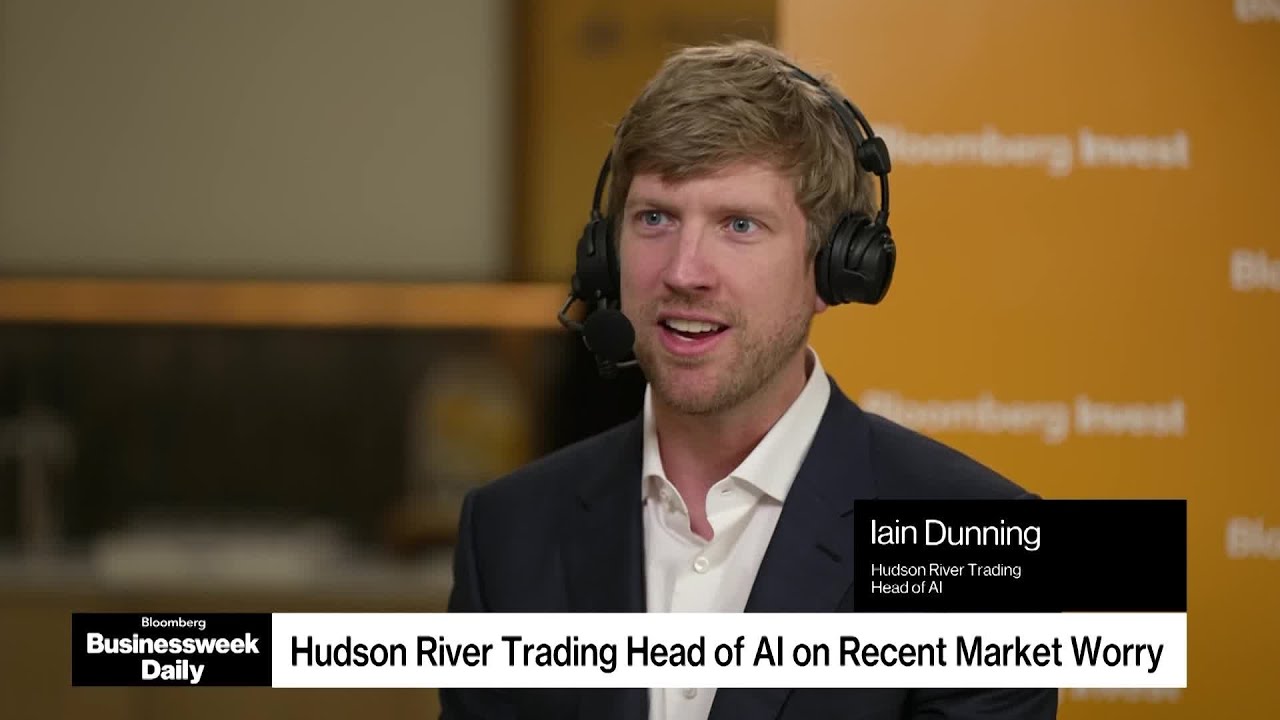
In a recent segment from Bloomberg Businessweek Live at Bloomberg Invest, Iain Dunning, Head of AI at Hudson River Trading, shared insights into the firm's sophisticated use of artificial intelligence for market prediction and analysis. Dunning elaborated on how AI tools are not only enhancing productivity but also providing a competitive edge in the fast-paced world of financial markets.
Iain Dunning: AI Leader at Hudson River Trading
Iain Dunning leads the artificial intelligence initiatives at Hudson River Trading, a quantitative trading firm known for its sophisticated technological infrastructure and data-driven approach. His role involves leveraging advanced AI and machine learning techniques to develop predictive models and optimize trading strategies. Dunning's perspective is highly valued in the industry due to the firm's success in navigating complex market conditions.
AI-Driven Productivity Gains
Dunning highlighted the tangible benefits Hudson River Trading has experienced by integrating AI into its operations. He noted that these tools have led to a significant increase in productivity, estimating a double-digit percentage boost. This improvement stems from AI's ability to automate complex tasks and enhance the efficiency of the firm's human capital.
The full discussion can be found on Bloomberg Podcast's YouTube channel.
Regarding the conversion of interns to full-time employees, Dunning confirmed that the company continues to hire and convert talent. He stated, "We embrace AI tooling very heavily to amplify every role at the company." This approach allows the firm to scale its AI capabilities and integrate new talent effectively.
The Value of AI in Volatile Markets
Dunning emphasized that in the current market environment, AI is not just about incremental gains but about fundamental improvements. He explained that their AI tools are designed to provide a significant productivity boost, "maybe a double-digit percentage productivity boost for sub-percent productivity gains." While these gains might seem small on an individual basis, their cumulative effect across numerous operations is substantial.
He further elaborated on the iterative nature of AI development, stating, "The progress of tooling is what really keeps us, you know, constantly moving forward, and you know, constantly re-evaluating." This continuous refinement process is crucial for staying ahead in the competitive financial landscape.
Proprietary AI vs. Open Source
When questioned about the specific AI models used, Dunning differentiated between proprietary and open-source solutions. He mentioned that while they leverage various tools, their core predictive models for market forecasting are proprietary. "We evaluate all of the different providers and, you know, try to stay agnostic to the provider as much as possible. But Claude is my current, you know, personal favorite, and that's what it sort of accelerates my work."
Dunning also touched upon the advantage of proprietary AI in certain contexts, especially for financial firms. He explained that while open-source models like Claude are valuable, proprietary models offer a distinct edge. "We invest massively in our proprietary AI and our peers are developing... what we can do is try to stay ahead of the curve."
AI for Market Prediction and Analysis
Dunning clarified the distinction between AI for market prediction and AI for productivity assistance. He stated, "We have two classes of AI. One is the AI that uses to predict markets, and that's something that we develop internally and that's proprietary." This internal development allows for tailored solutions optimized for the firm's specific needs and data sets.
The second class of AI is for productivity assistance. Dunning noted, "And then the AI that we use to, you know, help us do our job better with AI assistance." He elaborated on the rapid evolution in this area, mentioning that even models that were considered state-of-the-art six months ago are now being surpassed. "The rate of change in the tooling and progress of tooling is what really keeps us, you know, constantly moving forward and you know, constantly re-evaluating."
The Evolving Landscape of AI in Finance
Dunning expressed that the ability to leverage AI effectively is becoming a significant differentiator. He noted that while many firms are adopting AI, the sophistication and application of these tools vary greatly. "I think that the competitive advantage comes from how you integrate these tools, how you fine-tune them, and how you use them to generate edge."
He further explained that the effectiveness of AI can be measured by its ability to predict market movements with greater accuracy than random chance. "What we can do is systematically, you know, make better than random predictions... And so, you know, it's a constantly moving target." Dunning acknowledged the challenge of staying ahead, as the pace of AI development means that today's cutting-edge tools could be surpassed quickly.
The Role of Data in AI Success
Dunning stressed the critical role of data in the success of AI models. He stated, "Our primary data set is market data itself... that we've been paying for and diligently collecting over decades." This extensive historical data is essential for training and validating predictive models. He also highlighted the importance of data quality and relevance for effective AI implementation.
He elaborated on the continuous process of model evaluation and refinement, stating, "We have to constantly be evaluating what's working and what's not working, and adapting our models accordingly." This iterative approach ensures that the firm's AI capabilities remain sharp and effective in capturing market opportunities.


