
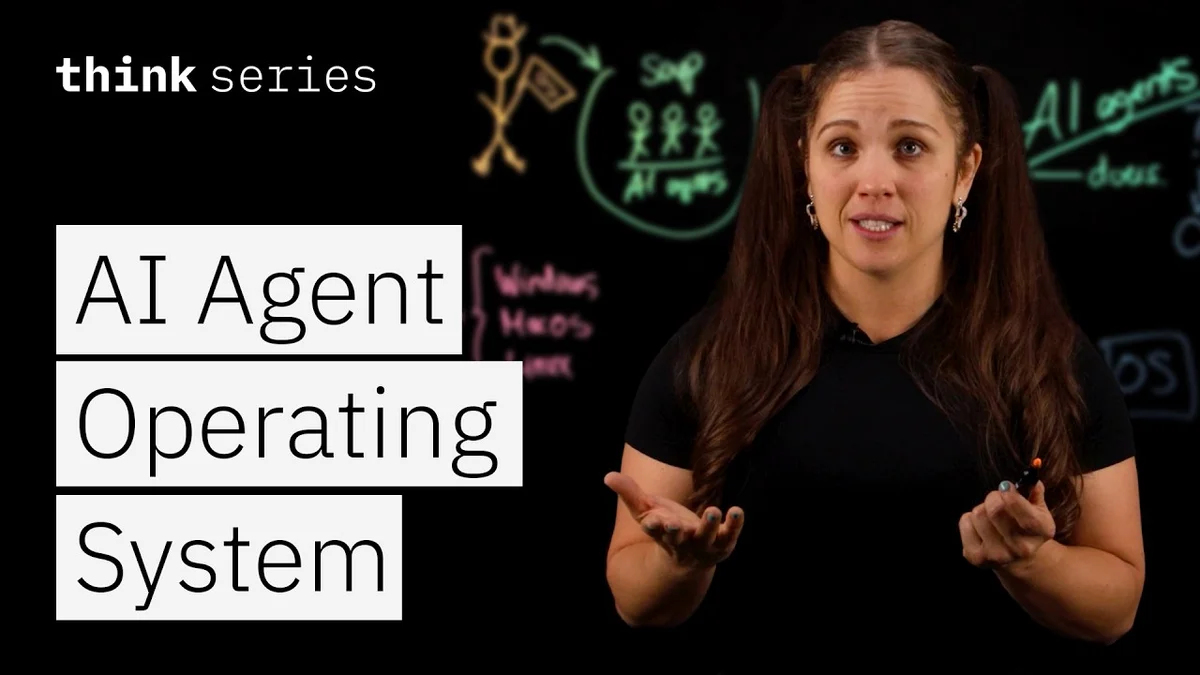
In the rapidly evolving world of artificial intelligence, the concept of AI agents is gaining significant traction. These agents, capable of performing a wide range of tasks from booking flights to writing code, are currently operating in a somewhat chaotic environment. Bri Kopecki, an AI Engineer at IBM, explains why these agents desperately need a unified operating system to manage their complex functionalities and ensure reliable, safe execution.
Kopecki likens the current state of AI agents to a group of unsupervised toddlers. Without a guiding structure, they can perform tasks but lack the ability to recall past actions, manage resources effectively, or even understand the consequences of their operations. This often leads to agents forgetting what they did minutes ago, highlighting a critical need for a more organized approach.
The Analogy of an Operating System
Drawing a parallel to traditional computing, Kopecki explains that just as an operating system (OS) on a laptop manages processes, memory, and applications, an AI agent operating system (AI OS) is essential for the sophisticated AI agents of today and tomorrow. This AI OS acts as the central nervous system, coordinating the actions of multiple agents and ensuring they work together harmoniously.
The full discussion can be found on IBM's YouTube channel.
The Core Components of an AI OS
Kopecki breaks down the essential components that would constitute a robust AI OS:
- Scheduler/Orchestrator: This component decides which agent gets to use the AI's processing power and when. It prioritizes tasks, ensuring that the most critical or time-sensitive operations are handled first, preventing agents from interfering with each other or wasting resources.
- Memory Manager: Just as a computer's OS manages RAM, an AI OS needs to manage the memory of AI agents. This includes tracking short-term memory for ongoing tasks and long-term memory for learned information, ensuring agents can recall past actions and outcomes.
- Tool Manager: AI agents often rely on external tools to perform their tasks, such as accessing databases, sending emails, or browsing the web. The tool manager keeps track of available tools, their functionalities, and who is authorized to use them, preventing misuse or conflicts.
- Identity Manager: This component is crucial for security and accountability. It manages the identities of agents, ensuring that each agent acts within its defined permissions and that its actions can be traced back to it.
Why the Infrastructure Matters
Kopecki emphasizes that these components work together to provide a structured environment for AI agents. The scheduler ensures efficient task execution, the memory manager allows for learning and context retention, the tool manager grants access to necessary functionalities, and the identity manager enforces security and accountability. Without this foundational infrastructure, AI agents operate in a state of chaos, similar to how a computer without an OS would be merely a collection of inert hardware.
The Current State of AI Agents
Currently, many AI agents are deployed without these essential OS-like functionalities. This means they lack the ability to manage their tasks effectively, learn from past mistakes, or even remember their actions. Kopecki illustrates this with the analogy of a system without traffic lights, leading to gridlock and inefficiency. An AI OS would bring order to this digital chaos.
The Importance of Trust and Reliability
The absence of a proper AI OS leads to agents that are unreliable and untrustworthy. For instance, an agent might approve a refund it shouldn't, or repeatedly fail at a task due to a lack of memory. An AI OS, with its built-in guardrails and governance, ensures that agents operate within defined boundaries, learn from their experiences, and execute tasks reliably. This is critical for building trust in AI systems, especially as they become more integrated into critical business processes and daily life.
In essence, Kopecki argues that an AI OS is not just a technical nicety but a fundamental requirement for the scalable, reliable, and safe deployment of AI agents. It transforms agents from chaotic toddlers into disciplined, efficient digital workers.



