
Agentic Search & Context Engineering with Elastic

Leonie Monigatti of Elastic discusses agentic search and context engineering, exploring how AI agents can enhance data retrieval and action.

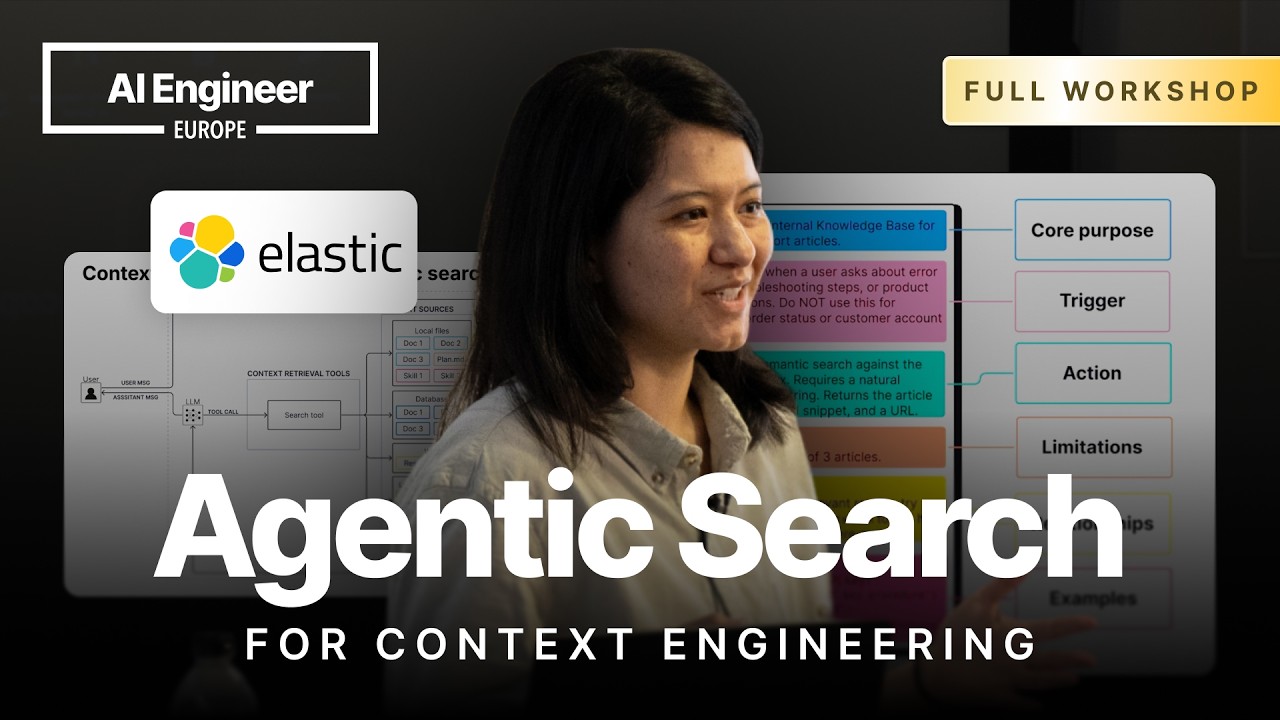
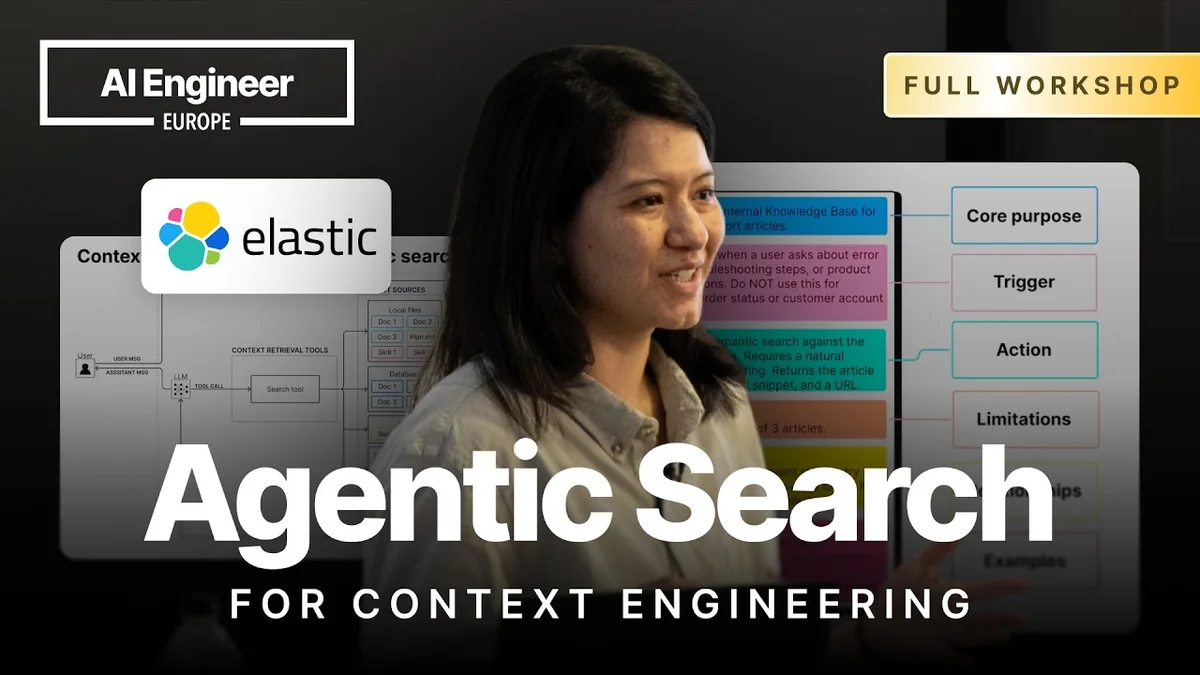
Leonie Monigatti speaking about agentic search and context engineering
Image credit: StartupHub.ai· AI Engineer

Leonie Monigatti from Elastic recently presented on the evolving field of agentic search and its implications for context engineering. The session, titled "Agentic Search for Context Engineering," delves into how artificial intelligence agents can move beyond simple keyword matching to understand and act upon complex user intent. This approach promises to transform how we interact with data, making information retrieval more intuitive and effective.

Agentic Search & Context Engineering with Elastic - AI Engineer
Agentic Search & Context Engineering with Elastic — from AI Engineer

Understanding Agentic Search

Agentic search represents a significant leap from traditional search methods. Instead of merely returning documents that match keywords, agentic search employs AI agents that can reason, plan, and execute tasks. These agents are designed to understand the nuances of a query, infer underlying needs, and actively seek out information to fulfill those needs. This shift moves search from a passive retrieval system to an active assistant.

Related startups

The Role of Context Engineering

Central to the success of agentic search is context engineering. This discipline focuses on providing AI agents with the necessary background information, constraints, and goals to perform their tasks effectively. Without proper context, an agent might misinterpret a query or generate irrelevant results. Monigatti highlighted that effective context engineering ensures that agents can navigate vast datasets, filter noise, and deliver precise, actionable intelligence. It's about shaping the agent's understanding of the world and the specific problem it needs to solve.

This involves several key elements:

  • Defining the agent's objectives and desired outcomes.
  • Supplying relevant domain-specific knowledge.
  • Establishing operational boundaries and ethical guidelines.
  • Enabling the agent to learn and adapt from its interactions.

Elastic's Vision for Agentic Search

Elastic, a company known for its search and analytics solutions, is actively exploring the potential of agentic search. Monigatti's presentation suggests that the company sees this as a natural evolution for its platform, which already handles large volumes of complex data. By integrating agentic capabilities, Elastic aims to enhance its offerings in areas like observability, security analytics, and enterprise search. The goal is to enable users to ask more complex questions and receive more intelligent, context-aware answers.

The integration of agentic search into platforms like Elastic's could unlock new possibilities for data-driven decision-making. Imagine an IT operations team using an agentic search to not only identify an anomaly in system logs but also to suggest and even initiate remediation steps based on historical data and best practices. This level of automation and intelligence is what agentic search, powered by robust context engineering, promises to deliver.

© 2026 StartupHub.ai. All rights reserved. Do not enter, scrape, copy, reproduce, or republish this article in whole or in part. Use as input to AI training, fine-tuning, retrieval-augmented generation, or any machine-learning system is prohibited without written license. Substantially-similar derivative works will be pursued to the fullest extent of applicable copyright, database, and computer-misuse laws. See our terms.