

Agent-Led Growth: The New B2B Frontier

Agent-led growth is the next B2B frontier, where AI agents research, evaluate, and purchase on behalf of buyers, fundamentally altering market dynamics.

Mar 14 at 1:28 PM5 min read
Abstract visualization of AI agents interacting with digital networks and data streams.

The enterprise software playbook is undergoing a seismic shift, and the next dominant go-to-market (GTM) motion is already here. Just as companies that embraced Product-Led Growth (PLG) or Account-Based Experience (ABX) early captured significant market advantages, a new paradigm is emerging. This evolution is fueled by advancements in AI infrastructure, leading to what Insight Partners terms 'Agent-led growth' (ALG).

Historically, new GTM motions have followed a clear pattern: enabling infrastructure emerges, early adopters build around it, and later entrants attempt to replicate their success. Sales-led growth scaled with CRMs like Salesforce, PLG became measurable with product analytics tools, and Account-Based Experience (ABX) was crystallized by intent data platforms. Now, a new infrastructure stack is paving the way for ALG.

Defining Agent-Led Growth: Demand vs. Supply

The term 'Agent-led growth' is currently used to describe two distinct concepts. ChatGPT and Gemini often define it from the supply side: AI agents deployed by companies to enhance sales efficiency, such as AI-powered SDRs or automated pipeline management. While valuable for optimizing existing funnels, this is an efficiency gain, not a fundamental market restructuring.

The true structural shift lies in demand-side ALG. This is where AI agents actively work for the buyer, researching vendors, comparing features, evaluating capabilities, and even initiating purchases autonomously. Demand-side ALG fundamentally changes who controls the funnel, presenting both significant opportunities and risks.

This shift is most apparent in the developer ecosystem, where AI agents have been granted considerable autonomy. The market is rapidly establishing default tools and platforms, not through traditional sales and marketing, but through agent selection.

Early Wins in the Developer Ecosystem

Clear proof points for ALG are emerging among developer tools. AI coding assistants like Cursor and Claude Code don't just write code; they make infrastructure decisions for developers. Platforms like Supabase have become default backends for many AI coding environments, not through business development efforts, but because agents preferentially select them. Supabase saw its developer base surge from 1 million to 4.5 million in under 12 months, with its CEO crediting tools like Bolt and Cursor directly for a doubled sign-up rate.

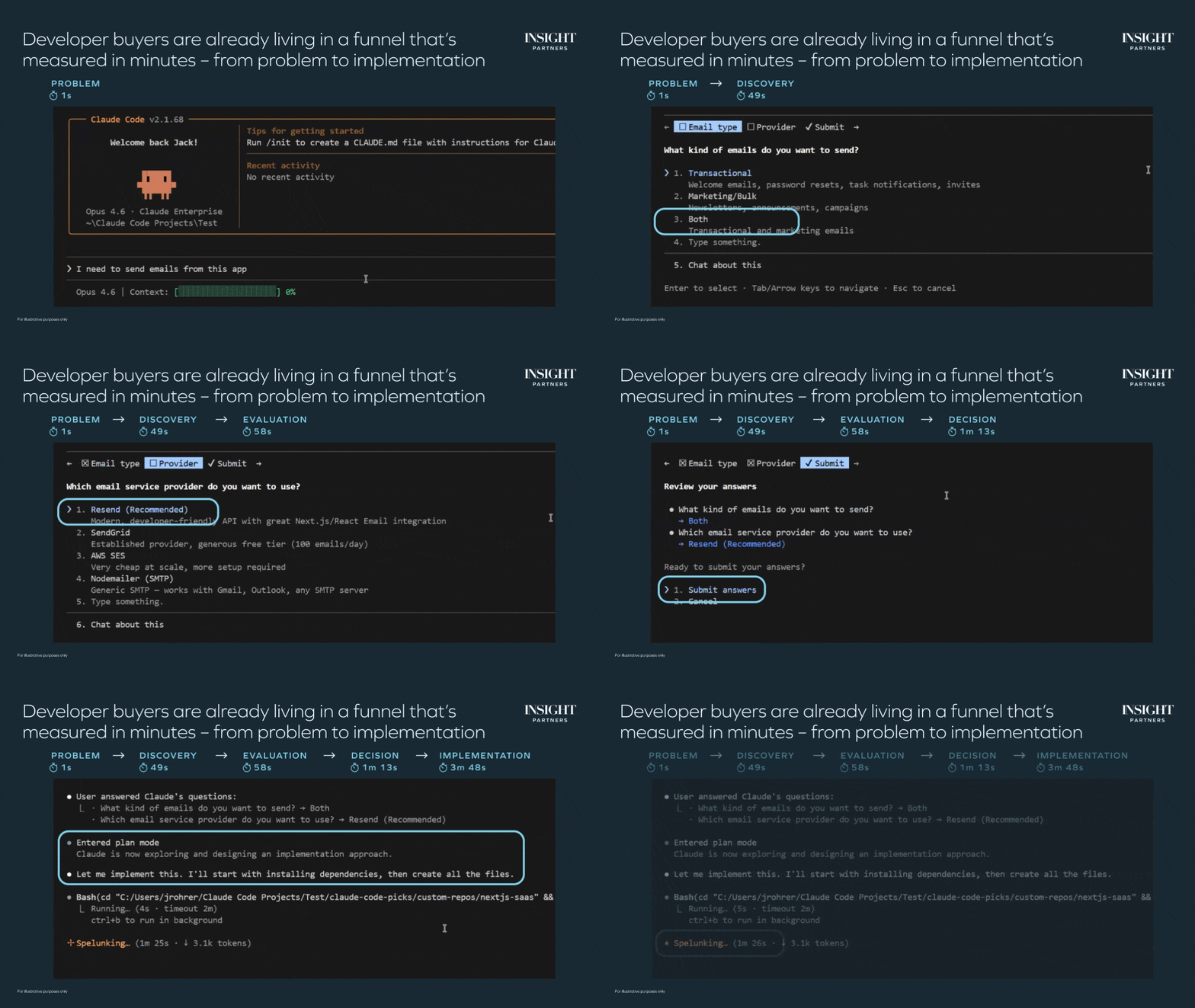
Similarly, Resend, a transactional email provider, launched in 2023 and quickly reached 400,000 users. When agents are tasked with adding email functionality, they choose Resend 63% of the time, far surpassing larger competitors like SendGrid. This preferential placement is driven by the ease with which agents can evaluate and implement these solutions.

Why do agents favor these products? They typically feature extensive, machine-readable documentation, offer free tiers that bypass budget approvals, and provide clean, predictable APIs. This minimizes the 'token-to-value' – the computational effort required for an agent to identify a solution and implement it. The less work an agent needs to do, the more likely a product becomes a default choice.

The Full Funnel is Shifting

While much of the AI and GTM conversation focuses on discovery—Generative Engine Optimization (GEO) and Answer Engine Optimization (AEO)—ALG extends much deeper into the buyer journey. At the evaluation stage, agents can autonomously compile feature matrices and test capabilities, often forming a preliminary purchase decision before human sales teams engage. Research indicates 77% of buyers purchase from their AI-informed preliminary favorite.

The seller's role shifts from demand creation to confirming or combating a pre-formed preference. At the purchase stage, agent-initiated transactions are becoming a reality. The speed is remarkable; developers can move from problem awareness to production integration in minutes, with tools like Resend requiring a single command for implementation. The funnel doesn't disappear; it accelerates.

WebMCP: The Infrastructure for ALG

Just as CRMs powered SLG and product analytics powered PLG, ALG requires its own enabling infrastructure. Protocols like Anthropic's Model Context Protocol (MCP) and Google's Agent-to-Agent protocol (A2A) are forming the backend. However, a critical gap existed in enabling agents to interact with the web's visual interface.

The recent introduction of Google and Microsoft's Web Model Context Protocol (WebMCP), now integrated into Chrome 146, closes this gap. By adding simple HTML attributes, websites can become 'agent-ready,' allowing AI agents to programmatically interact with forms, test products, and even initiate transactions directly. This transforms the buyer journey from a series of human steps to a streamlined, agent-mediated process.

This creates a compounding effect, similar to brand trust in the human world. Agents that find tools reliable will preferentially recommend them, building a 'machine trust' moat. Companies need to become 'Findable, Evaluable, and Actionable' to machines.

The Playbook for Agent-Led Growth

Winning in an agent-mediated world requires optimizing for machine evaluation and action. Companies should invest in GEO and AEO to be discoverable by agents. Documentation must be treated as a primary GTM asset, answering the questions agents will ask, thereby minimizing token-to-value. Integrating with WebMCP allows for seamless agent-initiated actions, like trial sign-ups or purchases, especially when paired with free tiers or usage-based pricing.

This doesn't replace human marketers and sellers but elevates their role. Consistency across marketing, documentation, and sales messaging is crucial. Human interaction becomes more valuable, focused on reinforcing agent-driven decisions or addressing remediation. The infrastructure for AI Agents in B2B is rapidly being built; companies that make themselves easy for machines to evaluate and act upon will secure durable advantages. The question is not if ALG will reshape B2B distribution, but which categories will adapt first.