

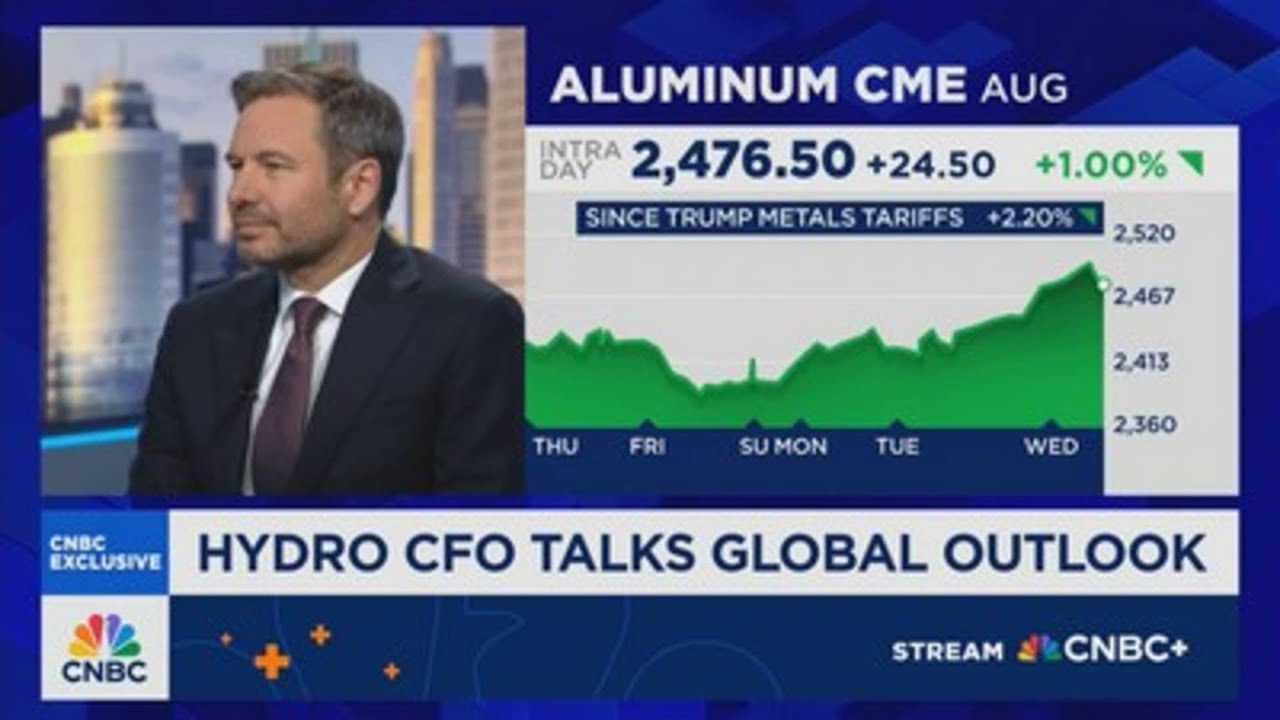
In an era where geopolitical tremors send ripples across global supply chains, the imperative for agile, AI-driven strategies has never been clearer. While traditional market forces still dictate much, the volatility introduced by shifting trade policies is fundamentally reshaping how industries operate, demanding a new level of foresight and adaptability. This complex landscape was recently illuminated by Trond Olaf Christophersen, CFO and Executive Vice President of Hydro, one of the world's largest aluminum producers, who spoke with CNBC about the profound impact of metal tariffs on his global business and the broader economy.
Christophersen's insights painted a vivid picture of an industry grappling with constant flux. For a company like Hydro, which operates in 40 countries and boasts over 32,000 employees, stability is paramount. Yet, the current environment is anything but. He articulated the core challenge succinctly: "it's mostly all the uncertainty and the changes that is the main concern for us." This sentiment resonates deeply within the startup ecosystem, where founders and VCs are increasingly aware that technological innovation alone is insufficient without robust, adaptable operational frameworks. The unpredictability of trade relations, far more than the tariffs themselves, creates an environment where long-term investment planning becomes a high-stakes gamble.
One of the most significant consequences of these tariff changes, Christophersen noted, is a fundamental restructuring of global production. The imposition of duties, such as the 50% tariff announced on Mexican aluminum a few days prior to the interview, forces companies to re-evaluate their entire manufacturing footprint. This isn't merely about adjusting prices; it's about a "reshuffling of the production capacity globally to optimize around the tariffs that is creating uncertainty and also a lot of changes to the global supply chains." For startups looking to scale, this means that traditional offshoring models may need critical re-evaluation, favoring regionalization or nearshoring strategies that mitigate tariff exposure and enhance supply chain resilience. This seismic shift creates opportunities for AI and automation to identify optimal new locations, streamline new production setups, and manage the complex logistics of a fragmented global landscape.
While Hydro, as a primary aluminum producer, can largely pass on increased metal prices to its customers, the downstream effects are a significant concern. Christophersen confirmed that "the metal price is a pass-through cost going through to our customers," indicating that the burden ultimately falls on the end consumer. This ripple effect has already manifested as softening demand in key sectors. The automotive industry, a critical customer segment for Hydro, is experiencing a global slowdown. "We have seen a slowing demand from the automotive industry going into this year compared to last year," Christophersen observed, noting this trend across all three major continents: North America, Europe, and China. This demand softening, exacerbated by the trade war, highlights the interconnectedness of global markets and the vulnerability of even diversified businesses to macro-economic headwinds.