

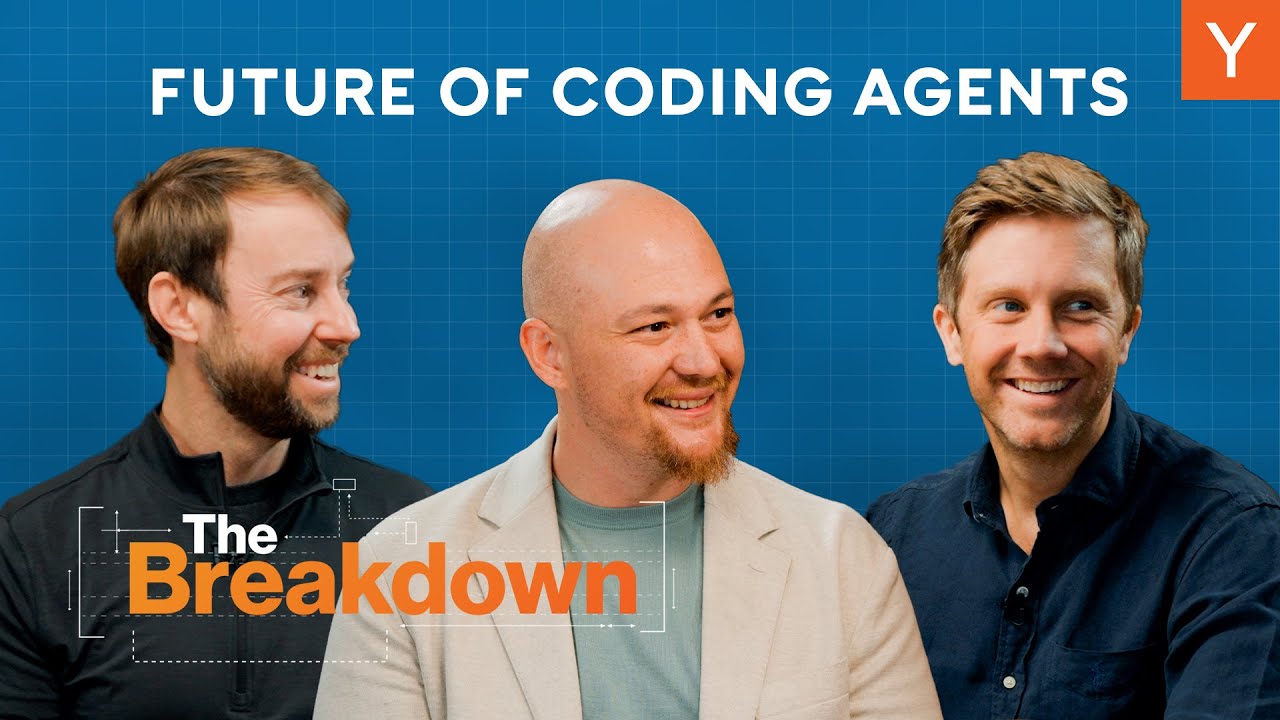
Amjad Masad, CEO of Replit, asserts that the latest advancements in large language models have transformed AI from mere autocomplete into an agent capable of autonomous problem-solving. This shift, he explains, has been so profound that Replit made the strategic decision to "bet the company on agents," moving beyond its initial mission to teach a billion people to code. The vision has evolved to empower anyone to build software, fundamentally altering the landscape of development.
Masad spoke with Tom and Dave on The Breakdown, discussing Replit's journey from its foundational role in accessible programming to its current position at the vanguard of AI-assisted software creation. The conversation traversed the evolving nature of programming, the future of work, and the next generation of human-computer collaboration. A pivotal moment, Masad noted, was the leap in AI autonomy, particularly between Claude 3 and its 4.0 iteration. He observed, "It just went from being a smart autocomplete... to having a lot of autonomy and being able to solve problems end-to-end." This qualitative jump signifies AI's capacity to tackle complex tasks with minimal human intervention.

This newfound AI autonomy addresses what Masad terms "the last mile" problem in computer use, where non-technical users often struggle to translate their ideas into functional software. Replit aims to bridge this gap, enabling individuals without deep coding knowledge to ship applications. The platform achieves reliability through an innovative sampling and branching method, running multiple AI agents in parallel and selecting the optimal solution, then branching from there for robust outcomes.
The implication is a future where the distinction between engineers and non-engineers blurs. Masad envisions a world where "it's about letting anyone build software, not just engineers." This democratisation extends beyond simple no-code solutions, positioning Replit as a middle ground where users still interact with code, but AI handles the heavy lifting. This paradigm shift suggests that future software development might involve guiding AI agents rather than meticulously crafting every line of syntax.
For those contemplating the relevance of traditional coding education, Masad offers clarity. While the rote memorization of syntax may diminish, the core skill of problem-solving remains paramount. "It's more about problem solving and less about syntax," he clarified, emphasizing that understanding logic and breaking down complex challenges will be the enduring competencies. Replit's trajectory illustrates a future where AI agents empower small teams and even individuals to develop sophisticated SaaS products, ushering in an era of unprecedented software creation accessibility.