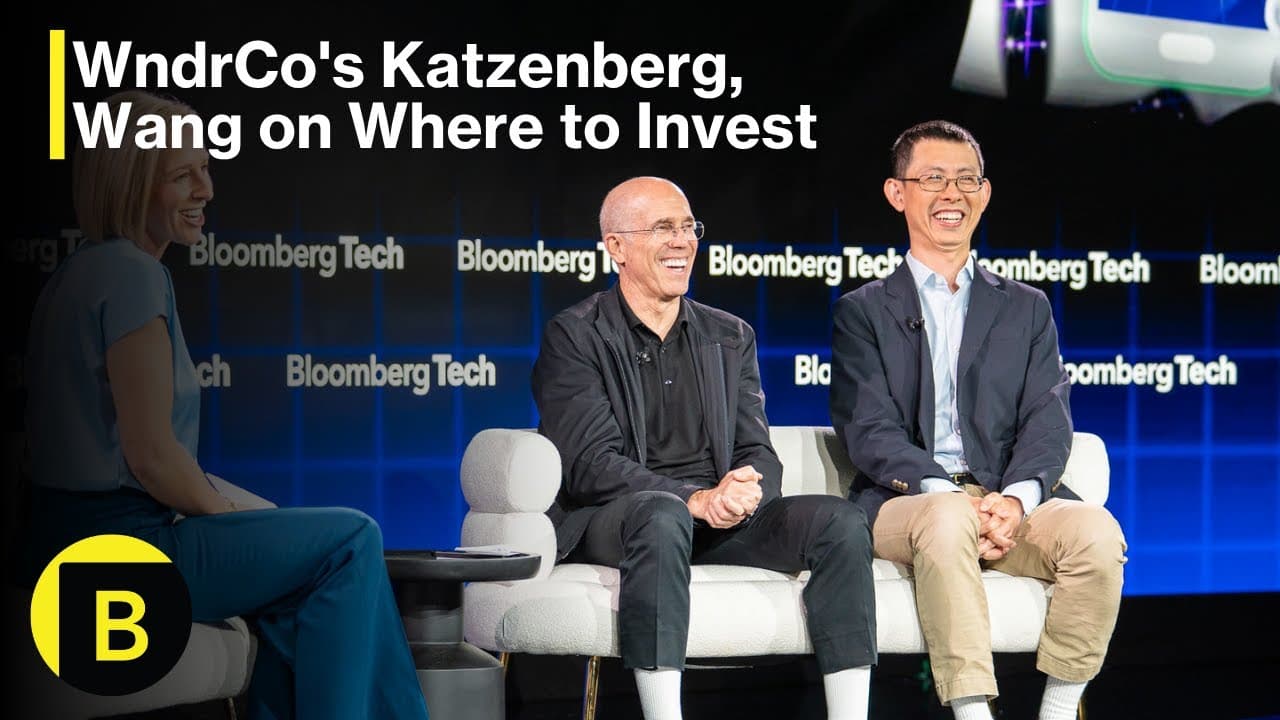
“The world changed... in November 2022, where the possibilities were unleashed in a way that is really just hard to imagine how much has changed in just these whatever it is 16, 18 months.” So declared Jeffrey Katzenberg, Founding Partner at WndrCo, speaking with Bloomberg Television's Caroline Hyde and his General Partner, ChenLi Wang, at the recent Bloomberg Tech conference. Their conversation, a masterclass in discerning genuine opportunity from fleeting hype, peeled back the layers of the current AI frenzy, offering seasoned insights for founders, venture capitalists, and tech leaders grappling with this transformative era.
Katzenberg, a titan of entertainment and now a shrewd investor, wasted no time in framing the current moment as an "incredibly exciting time." He pointed to WndrCo's investment in Creatify, an AI-powered advertising platform, as a prime example of how generative AI is not just about efficiency, but about an unprecedented "quality escalation" in creative fields. ChenLi Wang further elaborated on this, explaining that companies like Creatify are leveraging AI to "push the boundaries of human creativity," empowering individuals to generate more engaging content and spend less time on "the mundane-ness of it." This vision suggests AI isn't here to replace human ingenuity, but to augment it, leading to an explosion of higher-quality output across industries, particularly in digital marketing.
However, the path forward isn't without its anxieties. The common fear is that AI will render human creatives redundant. But Katzenberg, drawing from his extensive experience in animation, dismissed this notion with a powerful historical parallel. He recounted the advent of CGI animation, pioneered by John Lasseter and Pixar, which initially sparked fears of job losses in traditional 2D animation. Yet, he noted, "It didn't... it changed the jobs, it didn't eliminate them," and today, "by a factor, there are more people working in animation today than there were then." This is a crucial insight: successful adaptation to technological shifts hinges on embracing change, not fearing it. "As uncomfortable as change is," Katzenberg warned, "irrelevance is going to be way more difficult to deal with." This "boiled frog" analogy serves as a stark reminder for founders and established enterprises alike: adapt or face obsolescence.
The discussion then pivoted to the human element at the heart of successful ventures in this dynamic landscape. What makes a founder stand out when technology is so readily available? ChenLi Wang emphasized a "maniacal obsession" with solving a specific problem and building a "magical product experience." He cited Dropbox's Drew Houston, who was driven by a deep fascination with synchronization and user experience, rather than just market opportunity. Katzenberg added that successful venture capitalists, and by extension, the founders they back, must possess two seemingly contradictory qualities: the ability to "see a dream" and "be a bit of a dreamer yourself," coupled with a "degree of skepticism" and being "somewhat cynical." This delicate balance allows for audacious vision tempered by pragmatic realism, crucial for navigating the inevitable challenges of innovation.
This blend of dreaming and realism becomes particularly vital when considering the "dark side" of technological advancement. Katzenberg highlighted the increasing vulnerability of individuals to online crime, citing a startling statistic: online theft ($15 billion) far surpasses traditional home burglaries ($4 billion). He pointed to WndrCo's investment in Aura, a digital safety product, as a mission-driven venture born from a founder's personal experience with their child falling victim to online dangers. This underscores another core insight: while technology opens doors to incredible opportunities, it also creates new threats. Investing in solutions that protect individuals and society from these evolving risks is not just a noble pursuit but a burgeoning market. The best founders are often driven by a genuine problem they've experienced or observed, transforming personal pain into a powerful mission.
Ultimately, the message from WndrCo is clear: the AI revolution is not merely a technological wave but a profound shift demanding both audacity and prudence. For founders, it's about identifying real problems, cultivating a near-obsessive drive to solve them, and maintaining a clear-eyed vision that balances boundless optimism with a healthy dose of skepticism. For investors, it's about backing these rare individuals who can not only see the future but also build the tools to navigate its complexities and mitigate its risks. As Katzenberg concluded, encapsulating his career-long mantra, "Never let your memories be greater than your dreams." In the age of AI, success will come to those who not only dream big but also consistently "exceed expectations" in every facet of their pursuit.