


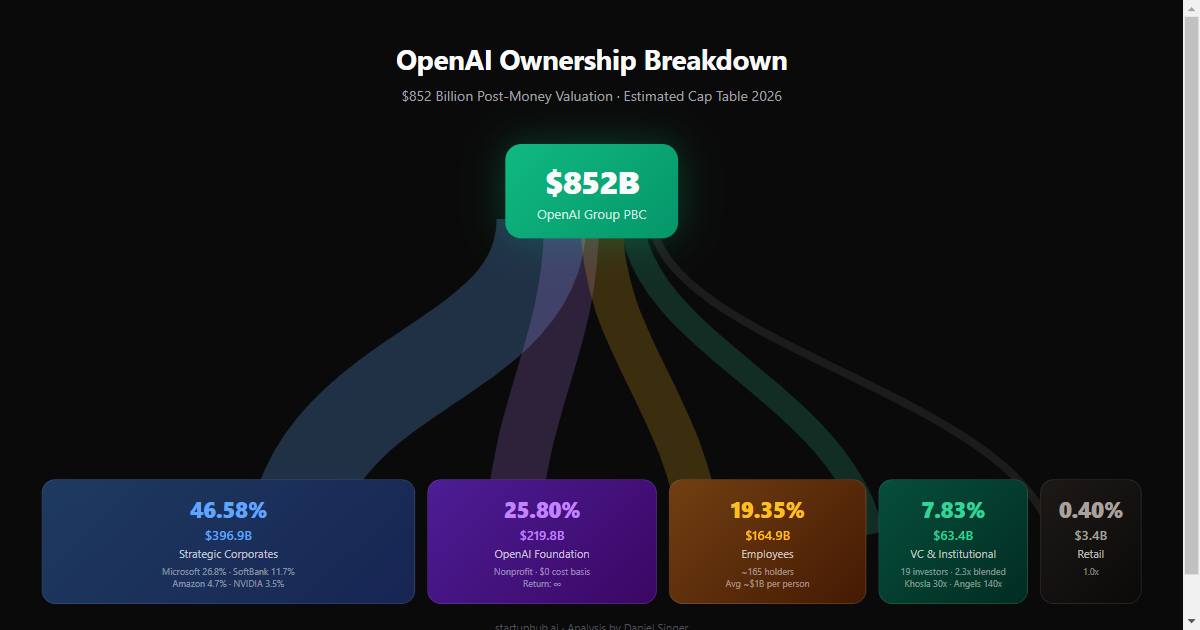
Somewhere on Sand Hill Road this week, a spreadsheet is making the rounds. Twenty-nine lines. Five columns of numbers. It is, by any reasonable measure, the most extraordinary document in the history of venture capital. A reconstructed cap table showing who owns OpenAI at its $852 billion post-money valuation, what they paid, and what their stakes are worth today.
The numbers are staggering. A nonprofit foundation holding $219.8 billion in paper value. A single corporate partner sitting on $215 billion in unrealized gains. Early angel investors, including Reid Hoffman and Peter Thiel, who wrote checks when "artificial general intelligence" was still a punchline, watching their $10 million turn into $1.4 billion. That is a 140x return. It may be the most lucrative angel bet in history.
But beyond the spectacle, this cap table tells a deeper story. It tells us about the structural evolution of AI from research curiosity to geopolitical asset. About the compressed timelines of wealth creation in the age of foundation models. And about what happens when the most transformative technology since the internet concentrates in a single entity valued at nearly a trillion dollars.
This is the definitive breakdown.
I. The Nonprofit Foundation: 25.80% ($219.8 Billion)
Start at the top of the ledger. The OpenAI Foundation, the original nonprofit entity from which the for-profit arm was spun out, still controls 25.80% of OpenAI Group PBC. That stake is worth $219.8 billion at the current valuation. The cost basis is zero. The return multiple is, mathematically, infinite.