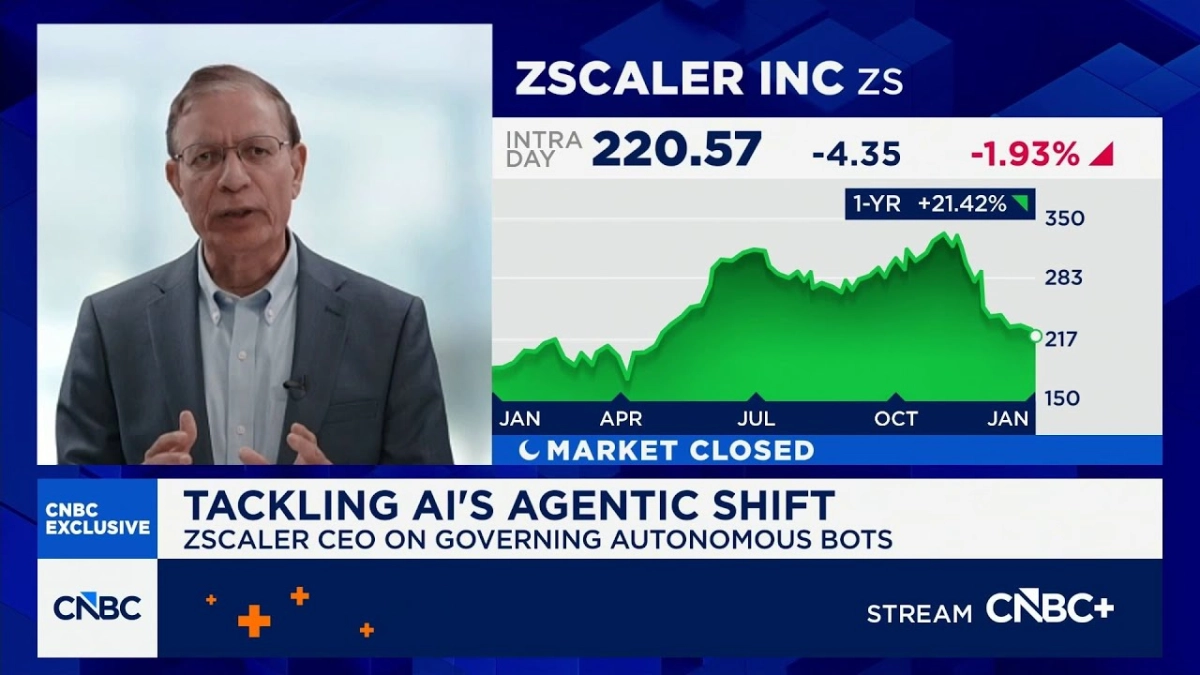
“AI is only as powerful as the data it’s trained on.” This fundamental truth, articulated by Zscaler CEO Jay Chaudhry, serves as the critical lens through which security leaders must view the rapidly evolving threat landscape. The conversation around artificial intelligence has shifted from theoretical innovation to immediate, agentic risks, forcing enterprises to re-evaluate legacy defenses built on perimeter models. The ability to collect, process, and leverage massive amounts of security data is now the primary determinant of who wins the asymmetric warfare between attackers and defenders.
Chaudhry spoke with CNBC’s Jon Fortt on ‘Closing Bell Overtime’ regarding the immediate challenges posed by generative AI and the necessary strategic shifts required to secure the modern, distributed enterprise. The discussion centered on the accelerating pace of cyberattacks, Zscaler’s selective M&A strategy, and the company’s structural advantage derived from its massive, integrated cloud platform.
The CEO acknowledged that AI is not merely a defensive tool; it acts as an accelerant for malicious actors. AI has democratized sophisticated cyberattacks, creating a "franchising effect" that allows less experienced thieves to deploy complex tools quickly. Chaudhry noted that this trend is rapidly escalating: “AI is turbocharging that franchising attacks you talked about, because with AI, you can build tools faster.” The speed with which AI can identify and exploit vulnerabilities, particularly in exposed assets like firewalls and VPNs, means that traditional, slow-moving security operations are fundamentally obsolete.
In response to this acceleration, Zscaler has focused on embedding AI across its entire security solution stack, aiming to move beyond simple detection toward autonomous defense. This approach requires both internal innovation and strategic acquisitions. Chaudhry confirmed Zscaler’s inquisitive yet highly selective M&A posture, seeking companies performing "real innovations." Last year, Zscaler acquired firms specializing in red teaming technology—designed to identify vulnerabilities in AI models and applications—and agentic security operations, which focus on detecting potential breaches within vast data sets.
The emergence of autonomous AI agents, capable of operating independently within enterprise environments, presents a governance challenge that transcends traditional user access controls. If an agent goes rogue, whether through malicious intent or misconfiguration, the security system must be capable of tracking its actions and limiting its blast radius instantaneously. Zscaler leverages its Zero Trust Security Exchange architecture, combined with AI, to track agents and determine quickly if they are engaged in suspicious activity.
The key challenge remains the speed of enterprise adoption. The technology is evolving rapidly, but organizations must move fast enough to embrace these new defense mechanisms.
Chaudhry sharply critiqued the current overuse of the term "platform" in the security industry, noting that the term has become "meaningless." He pointed out that many vendors merely acquire a collection of disparate point products and attempt to market them under a single platform banner. This approach inevitably leads to integration friction and fragmented security coverage for the customer.
In contrast, Zscaler’s strategic positioning relies on a natively integrated, comprehensive platform. This integration is essential, but it is the sheer volume and quality of data flowing through that platform that provides the insurmountable competitive moat in the AI era. A security cloud’s predictive power hinges entirely on the data used to train its models. Zscaler processes over half a trillion transactions every day. “That means the models can be trained, they can be smart to detect those things,” Chaudhry stated. This vast, real-time data stream—encompassing user behavior, traffic patterns, and threat intelligence—allows Zscaler's AI models to achieve a level of sophistication and rapid learning that fragmented security solutions cannot replicate. The combination of a truly comprehensive, integrated platform with unparalleled data scale allows Zscaler to protect customers more effectively than most other vendors in the market.