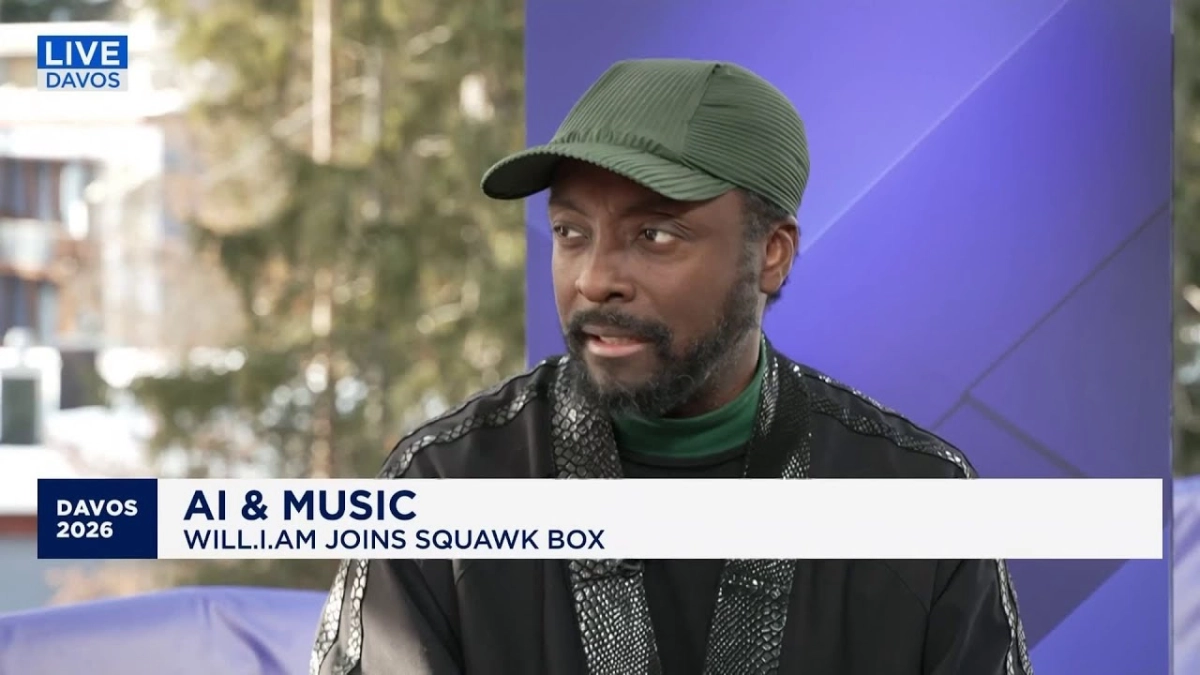
The music industry’s panic over generative AI is largely misplaced, according to Will.i.am, who argues the true disruptive force—a truly autonomous AI—has not yet arrived. The immediate concern, he suggests, is not creative destruction, but intellectual property infrastructure and the devaluation of human artistry in a fragmented consumption landscape.
The musician, philanthropist, and now professor at Arizona State University, Will.i.am, spoke with CNBC’s Squawk Box panel in Davos, addressing the sweeping changes AI is bringing to artistic creation, consumption, and compensation. His perspective balances the fear of obsolescence with the recognition that technology has always driven new forms of creativity, even if that means navigating a period of "AI slop." He views the current state of generative music creation as rudimentary, noting that the truly advanced, self-sufficient systems are still on the horizon. As he put it: "The AI that we’re concerned about is not here yet."

Will.i.am views AI as the latest iteration of technological disruption, drawing a pointed historical parallel. When asked if AI-generated music is "real," he recounted the backlash against sampling in the 1970s. Jazz musicians, he observed, might have criticized early hip-hop for simply "sampling our stuff that we did back in the past, man," questioning if that constituted "music, man." Yet, sampling became the foundation of hip-hop—a collage music form. The current generative models, similarly, are tools used by developers who are artists in their own right, and their algorithmic contribution should not be dismissed. He acknowledges the complexity of training models on existing human work, asserting that the original creators "should be paid for... when you train on that." This is where the core tension lies: recognizing the artistic merit of the tool while ensuring equitable compensation for the data used to train it.
Looking ahead, Will.i.am predicts an evolution beyond simple prompt-based systems. He anticipates a future where systems are "promptless," becoming increasingly intelligent and autonomous. This technological leap necessitates a corresponding infrastructural shift in how individuals manage their digital identities and data. He stresses the urgent need for individuals to possess their own personal AI agent, powered by localized computing resources, rather than relying solely on centralized corporate models. The current environment, he analogized, is like the "Wild Wild West" where everyone is "Milli Vanilli," singing over tracks they didn't fully create, and nobody is truly accountable.
The real challenge facing artists today is not AI’s ability to generate content, but the attention economy itself. Will.i.am lamented the loss of communal consumption—the shared experience of listening to MTV or the same radio station—in favor of fragmented, short-lived "TikTok relevance." He noted that today’s trends are short-lived, unlike the sustained hits of previous eras. This fragmentation is compounded by the economic reality of streaming services (DSPs), which have fundamentally devalued music. "Music is not worth the way it was when Lionel Richie got rich," he stated bluntly, referencing the massive shift from selling vinyl and CDs to micro-payouts per stream.
In this hyper-fragmented and devalued landscape, the future value of human artistry will shift toward verifiable authenticity and live performance. Will.i.am believes that as AI music becomes indistinguishable from human music—like distinguishing between organic oranges and regular oranges—the demand for live, human-made experiences will surge. "Live is the place to be," he predicted, noting that audiences will prioritize genuine, improvised performances that cannot be replicated or faked. This pushes artists to focus on true improvisation and performance skills, skills that have arguably atrophied in the age of studio perfection and auto-tune.
This philosophy underpins his work at Arizona State University, where he teaches students to build their own AI agents through a course called Agentic Self. He emphasizes that just as a bank account is essential for a job, a personal, self-owned AI agent will soon be a prerequisite for economic participation. The ability to own and control the data that defines one's likeness, voice, and creative output—rather than letting large corporations scrape and monetize it—is the essential safeguard against deepfake misuse and the erosion of intellectual property. When asked about the threat of an AI version of himself singing songs long after he's gone, he offered the ultimate caveat: "The reason why that’s a bad thing now is because you don’t own your agent." The future of creativity, for Will.i.am, hinges on individual digital sovereignty.