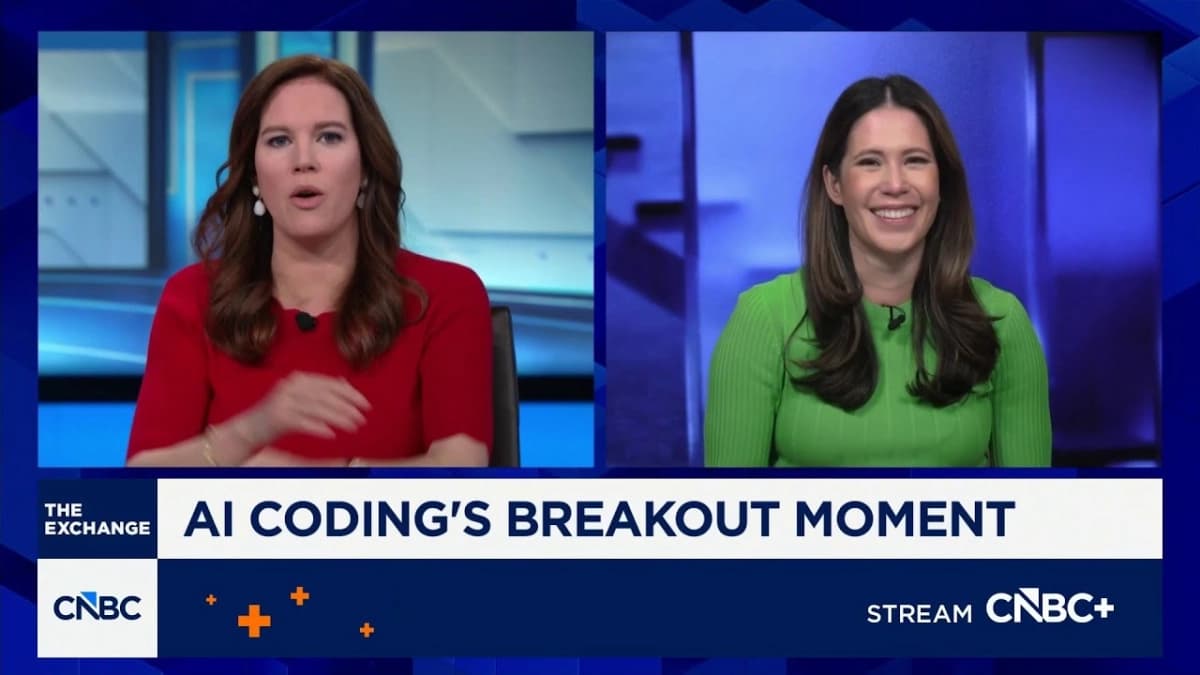
The true inflection point in generative AI may not be measured by lines of code generated, but by the complexity of the application built by a non-engineer. CNBC’s Deirdre Bosa demonstrated this seismic shift during a segment focused on the surging adoption of Anthropic’s models, noting an 85% spike in usage for Claude Opus 4.5 this week, driven largely by its advanced coding capabilities. The conversation quickly moved beyond standard efficiency gains to the concept of “vibe-coding”—the ability to translate vague, high-level intent into fully functional software.
Deirdre Bosa, CNBC’s TechCheck Anchor, spoke about her experimentation with Anthropic’s new Claude Co-Work product, highlighting a tool she built herself despite having “zero technical experience.” The resulting application, dubbed the “Evade-o-Meter,” is designed to automate a reporter’s “gut check” during corporate earnings calls. It ingests raw earnings call transcripts, uses natural language processing to mathematically quantify how direct or evasive an executive is being, and transforms this slippery language into hard data.
The Evade-o-Meter prototype is a surprisingly complex, interactive dashboard. It ranks the Magnificent 7 companies based on executive evasiveness, identifying specific signals like “Hedge Words,” “Vague Quantifiers,” and “Deflection.” Bosa noted that Meta and Mark Zuckerberg scored highest, registering as “Moderately Evasive,” while Microsoft came in lowest, categorized as “Relatively Direct.” The power of this tool lies in its ability to handle nuanced, subjective analysis and output a professional-grade financial dashboard, all built using a few descriptive prompts rather than traditional coding. Bosa called this a “ChatGPT-like inflection moment for software and investors.” This capability signifies a profound democratization of software creation, moving the bottleneck from technical execution to conceptual clarity.
The shift Bosa demonstrated—from requiring specialized coding skills to merely needing a strong prompt and a clear vision—is rapidly redefining the value proposition for developers and the structure of software companies. Amjad Masad, CEO of Replit, a platform specializing in this new paradigm of AI-assisted coding, emphasized the existential stakes for the industry. He argued that the era of AI Agents is here, capable of executing complex tasks autonomously. The companies that fail to integrate this agent-centric workflow will be left behind.
Masad provided a stark warning and a clear mandate for modern software organizations: “The companies that become embrace agents and become platforms to for agents and app vibe-coding apps like Replit can build on top of and automate, will survive and thrive.” Conversely, he suggested, those companies that refuse to open their APIs and systems to be leveraged by these powerful AI agents will inevitably “go away.” This is a fundamental paradigm shift from building closed, proprietary systems to creating open, extensible platforms that allow AI agents to act as architects and integrators, automating vast swaths of development and deployment.
The true revolutionary impact of vibe-coding is the instantaneous collapse of the development cycle. In a further demonstration of the technology’s accessibility, Bosa revealed a secondary, whimsical app she created in minutes: the "Chow Jones," a real-time dinner stock market allowing her children to "buy or short the menu." While humorous, the application illustrates that AI is now capable of full-stack development—handling the frontend interface, the backend logic, and the deployment—based solely on a user’s creative or business intent. This speed radically accelerates the idea-to-market timeline, effectively turning anyone with a clear idea into a potential software builder.
For founders and VCs, this change demands a reassessment of investment strategies. Capital efficiency in software development is skyrocketing. Where a Series A startup once needed a team of engineers and months of runway to build a functional prototype like the Evade-o-Meter, a single product manager can now achieve similar results in an afternoon. The competitive advantage is shifting away from who can hire the most expensive engineers toward who can conceive the most valuable, well-prompted agents and platforms. The focus moves from how to build to what to build, fundamentally altering the economics of software creation.