The race for AI dominance is increasingly being fought not just in the labs and on the stock market, but in the backyards of American communities. The sheer computational hunger of generative AI models demands an unprecedented buildout of data center infrastructure, which, in turn, consumes vast amounts of electricity and water, driving up local utility costs and generating significant political friction. This friction, often manifesting as localized opposition to new facilities, threatens to slow the pace of technological expansion.
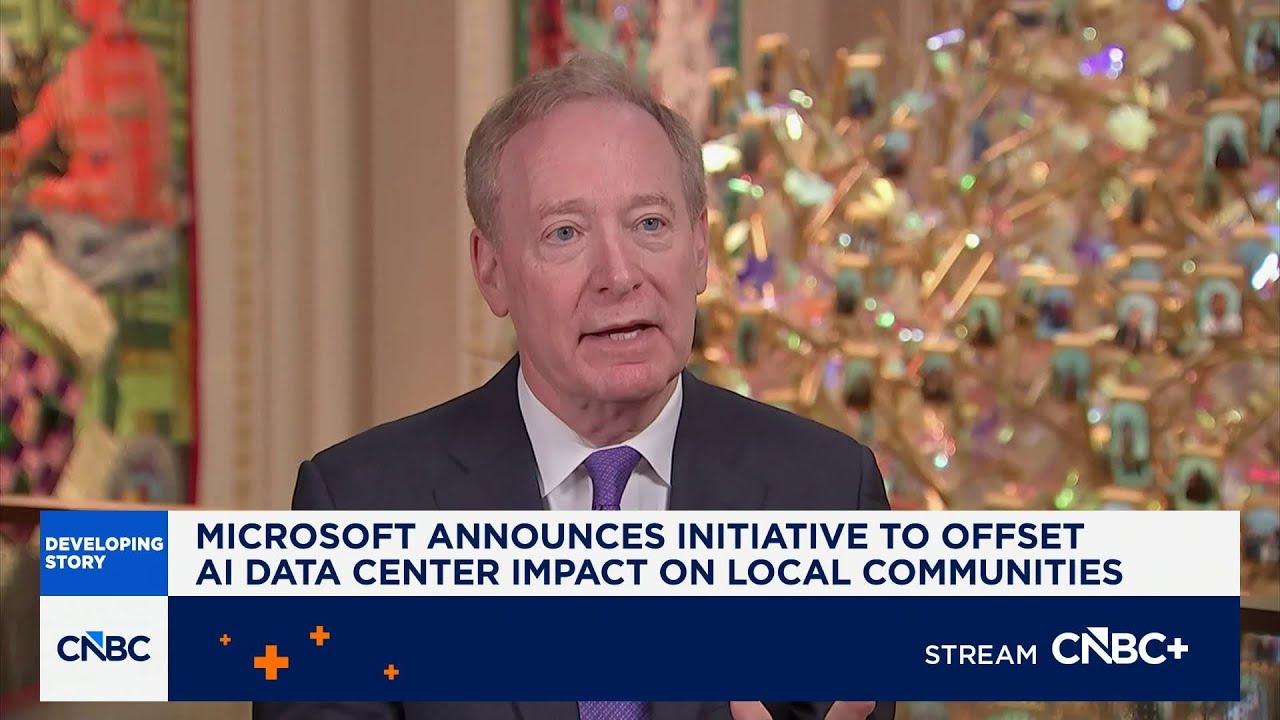
It is against this backdrop of rising community angst that Microsoft, a key leader in the AI and cloud space, unveiled a new set of five core principles aimed at mitigating the local impacts of its data center construction. CNBC’s Eamon Javers reported on the announcement, interviewing Microsoft President Brad Smith in Washington, D.C., about the company’s efforts to ensure that their massive infrastructure expansion remains politically and environmentally sustainable. Smith articulated the necessity of this pivot, acknowledging that "AI and cloud leadership today requires many things. One of them is sustaining the confidence of local communities so we can buy land, build data centers, and operate them." This statement underscores a critical insight for the entire AI ecosystem: unchecked growth is unsustainable if it erodes the social license to operate.
The necessity of this proactive measure reflects a core political reality, as Javers noted, which is that the data centers are "provoking political controversies in the local communities where they are." These controversies stem from tangible impacts: increased electricity demand straining grids, soaring water consumption in drought-prone regions, and the sheer noise and physical footprint of industrial facilities adjacent to residential areas. For founders and investors betting on the relentless scaling of AI capabilities, this local resistance represents a new, high-stakes variable in the CapEx equation. If a company cannot secure the right to build and power its infrastructure, the technological roadmap stalls.
Microsoft’s five principles directly address the primary sources of community concern. The first commitment targets utility costs: “We’ll pay our way to ensure our datacenters don’t increase your electricity prices.” This is a direct attempt to decouple the corporate resource consumption from the residential burden, signaling that the company is willing to internalize the cost of its energy needs rather than externalizing it onto local ratepayers.
The second principle tackles the acute issue of water scarcity, a major flashpoint in arid regions where data centers are proliferating. Microsoft pledges to “minimize our water use and replenish more of your water than we use.” While the specifics of how this net-positive water goal is achieved (often through restoration projects outside the data center footprint) require close scrutiny, the commitment itself acknowledges the moral and operational imperative of responsible resource management. The energy and water footprints of large language models are no longer abstract metrics; they are material constraints on growth.