• StartupHub.ai
    StartupHub.aiAI Intelligence
Discover
  • Home
  • Search
  • Trending
  • News
Intelligence
  • Market Analysis
  • Comparison
  • Market Map
Workspace
  • Email Validator
  • Pricing
Company
  • About
  • Editorial
  • Terms
  • Privacy
  • v1.0.0
  1. Home
  2. News
  3. The Massive Capability Overhang Openais Cfo On The Enterprise Pivot And Consumer Trust
Back to News

The Massive Capability Overhang: OpenAI’s CFO on the Enterprise Pivot and Consumer Trust

S
StartupHub Team
Jan 21 at 2:54 PM4 min read
The Massive Capability Overhang: OpenAI’s CFO on the Enterprise Pivot and Consumer Trust

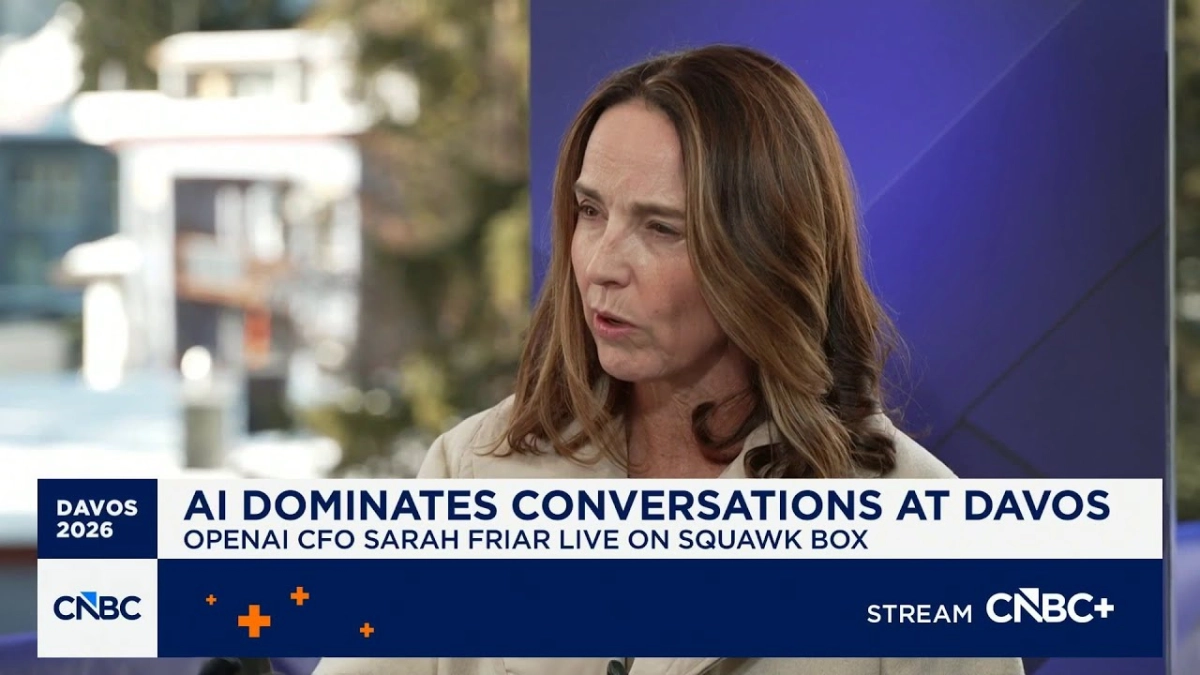
“There is a massive ‘capability overhang’ that’s occurring.” This statement, delivered by OpenAI CFO Sarah Friar during a conversation with CNBC’s Squawk Box at the World Economic Forum in Davos, captures the central dynamic defining the current artificial intelligence market. Friar’s insight suggests that the actual, profound utility of advanced models far outstrips the current, often simplistic ways the average user—consumer or business—is engaging with them. The race in AI is no longer solely about building the most powerful foundation model, but about successfully bridging this chasm between raw capability and transformative application.

Friar spoke with Andrew Ross Sorkin and other CNBC anchors about the state of the generative AI market, the competitive landscape including Google's Gemini, and the strategic shift in OpenAI’s business mix toward deeply integrated enterprise solutions. A year ago, conversations at Davos centered on the novelty of AI agents capable of performing simple tasks. Today, the focus has shifted entirely to the transformation of the enterprise, driven by "power users" who are extracting immense value from the platform. These users, often technical professionals, are utilizing the models for tasks like coding and deep research, employing the technology "seven times more than just the average user." This disparity highlights the immediate monetization opportunity: targeting users who understand how to deploy AI for high-leverage, complex tasks.


The strategic imperative for OpenAI, according to Friar, is balancing the explosive growth of its consumer base with the high-value potential of enterprise adoption. The company’s trajectory shows a clear pivot. At the end of last year, the business mix was approximately 70% consumer and 30% enterprise. Today, that ratio has shifted to 60/40, and Friar projects that the company will end the year closer to a 50/50 split. This movement underscores a deliberate effort to institutionalize AI within global corporations, moving beyond simple API calls or basic chatbot deployment into fundamental workflow redesign.

This enterprise momentum is rooted in deep integration, not surface-level engagement. Friar cited the example of BBVA, a major global bank, which has seen transformative results by deploying OpenAI solutions into its core operations, including call centers and credit screening processes. This transition represents a shift from a "Chat-GPT, wall-to-wall deployment into big transformations." The CEO of BBVA confirmed that OpenAI helped them scale their deployment from 10,000 deployed seats to over 120,000, demonstrating that the technology is "truly transforming the bank." For enterprise leaders and VCs evaluating the long-term defensibility of AI platforms, these deep integrations—which embed the models into mission-critical, multilingual, and geographically diverse operations—are far more important than broad consumer reach alone.

The discussion naturally turned to the recent competitive developments, specifically the news that Apple chose Google's Gemini to power the next generation of Siri. Friar remained unconcerned, framing Apple and other hardware manufacturers as "amazing distribution partners" rather than existential threats. Her confidence stems from the overwhelming direct consumer adoption of ChatGPT itself. She noted that the platform has grown to 800 million users, more than tripling its user base in just one year. This organic growth means ChatGPT has become "the noun and the verb" for generative AI, establishing a brand trust that transcends the underlying operating system wars. Users are seeking out the most capable model directly, regardless of default integrations built into their devices.

This direct user engagement, whether consumer or enterprise, is where true moat building occurs. Friar dismissed the idea of "lock-in" in favor of "value," arguing that if a product delivers undeniable value, loyalty naturally follows. This is particularly evident in highly regulated and complex verticals. Friar pointed to healthcare as an area of immense opportunity and immediate impact, noting that 66% of US physicians report using ChatGPT daily in their work. This is not casual use; it involves leveraging the model for critical functions like reviewing biopsies or providing guidance in medically underserved areas ("health deserts"). Such adoption signifies that AI is moving past novelty and becoming an indispensable "task worker," driving real productivity gains and societal benefits in sectors where the capability overhang is rapidly closing due to urgent demand. The focus remains squarely on scaling these deep, high-value applications across the global enterprise landscape.

AI Daily Digest

Get the most important AI news daily.

GoogleSequoiaOpenAIa16z
+40k readers