While American AI behemoths like OpenAI and Anthropic remain cloistered behind multi-billion-dollar private valuations, China is experiencing a veritable flood of AI Initial Public Offerings. This divergence is more than a market anomaly; it highlights fundamental differences in capital formation, risk tolerance, and national AI strategy between the two technological superpowers. The eagerness of Chinese AI firms to tap public markets, contrasted with the protracted privacy of US foundational models, creates a significant visibility gap for global investors seeking direct exposure to the sector’s explosive growth.
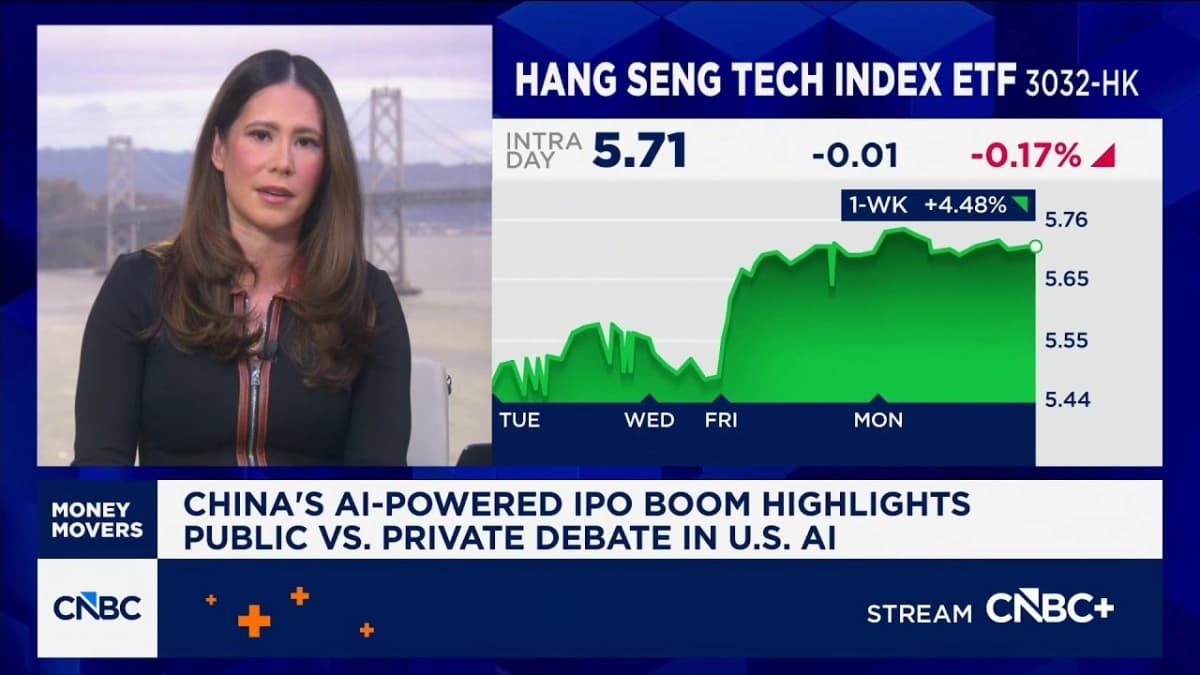
CNBC's Deirdre Bosa reported on the China-driven IPO revival, analyzing how foundational model builders and chipmakers are moving to the public markets early, challenging the established narrative of protracted private growth seen in Silicon Valley. The speed of this public migration is remarkable, driven by companies seeking capital and validation earlier in their lifecycle than their US counterparts. This trend has already yielded spectacular debuts. Just in the last few weeks, China has witnessed notable public market successes, including chipmaker Moore Threads, which surged 500% on its debut, and MetaX, which soared nearly 700%.
The pipeline is now moving aggressively from chips to models, with companies like MiniMax and Zhipu AI anticipated to list soon in Hong Kong. This willingness to go public early is quantifiable: the average age of the six Chinese AI companies recently mentioned in connection with IPOs is just six years. This phenomenon is driven, in part, by the fact that China’s late-stage private capital pool is relatively smaller compared to the massive funds available to US giants, making IPOs one of the few avenues to “raise real money over there.”
The US market presents a completely different picture. American foundational model builders are aging rapidly while remaining private. OpenAI, founded in 2016, and Databricks, founded in 2013, still command massive private valuations that public investors can only access indirectly. Public markets don't just provide capital; they force price discovery. Deirdre Bosa noted that public markets offer “real-time feedback on how much risk investors are willing to underwrite.”
This essential feedback loop is missing in the US AI sector. OpenAI is now one of the most valuable private companies on earth, but investors are left trading around it, forced to speculate on the value of related public entities like Nvidia and Microsoft. They must attempt to guess how much of OpenAI’s private value is durable, already priced into existing stocks, or simply “circulating between the same few balance sheets.” This lack of direct public exposure may be restraining the broader US AI trade, leaving investors without a pure-play option.
The relative valuation discrepancy also highlights the lingering impact of geopolitical risk. The recent acquisition of Manas AI by Meta, which saw the Chinese-native company shift its operations to Singapore, underscores the high valuation premium available when companies decouple from mainland Chinese political influence. While Chinese AI firms are proving robust in performance, Bosa observed that “the valuations are a lot lower relative to American AI startups.”
Beijing’s strategic support for domestic chipmakers and model builders is clear. This governmental backing, while providing resources, also creates operational constraints that affect international investment appeal.
The irony of this global AI race is pronounced: Chinese AI model builders and chipmakers, despite operating within a centrally controlled economy, are paradoxically “offering more visibility to markets.” This public transparency provides a crucial gauge of investor risk appetite and growth expectations—a tool currently denied to public investors seeking direct exposure to the most highly valued foundational AI companies in the United States. This public-versus-private disparity defines the current schism in global AI investment.