


• StartupHub.ai
    StartupHub.aiAI Intelligence
Discover
  • Home
  • Search
  • Trending
  • News
Intelligence
  • Market Analysis
  • Comparison
  • Market Map
Workspace
  • Email Validator
  • Pricing
Company
  • About
  • Editorial
  • Terms
  • Privacy
  • v1.0.0
  1. Home
  2. News
  3. The Elasticity Of Demand How Ai Creates New Jobs While Automating Old Ones
Back to News
Ai video

The Elasticity of Demand: How AI Creates New Jobs While Automating Old Ones

S
StartupHub Team
Jan 23 at 4:23 PM5 min read
The Elasticity of Demand: How AI Creates New Jobs While Automating Old Ones

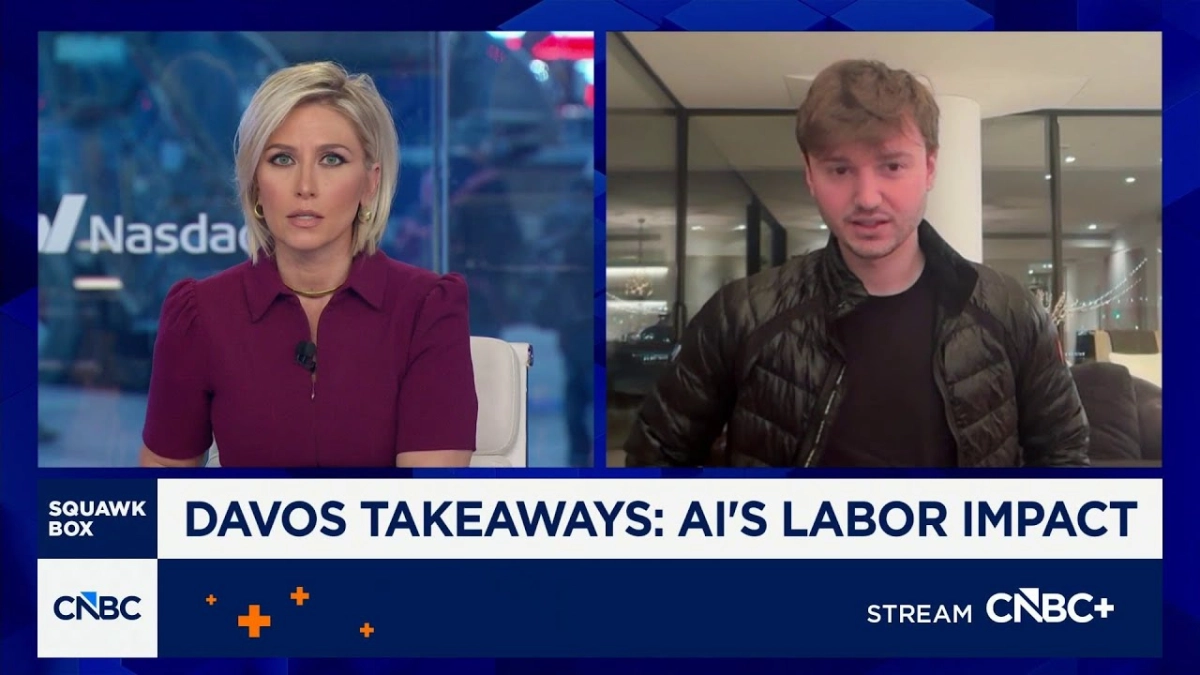
The impact of artificial intelligence on the global workforce is perhaps the most significant economic conversation of this decade. During a recent segment on CNBC’s Squawk Box, the discussion moved beyond the typical binary of job destruction versus creation, focusing instead on the nuance of productivity gains and market elasticity. Brendan Foody, Co-founder and CEO of Mercor, an AI recruiting platform, joined the program to offer his perspective, following commentary from tech titans Amazon CEO Andy Jassy and Microsoft Co-founder Bill Gates, who both predicted near-term contraction but long-term growth driven by AI. Foody’s core insight centered on the elasticity of demand for various job categories—a concept critical for founders and investors navigating this massive technological inflection point.

Amazon’s Andy Jassy set the stage by acknowledging the natural displacement that occurs during technological shifts, noting, “I do think that you won’t need as many people in all those jobs that we’ve thrown humans at for the last 20 years.” However, he quickly pivoted to the upside, emphasizing the creation of new roles in burgeoning areas like AI, robotics, healthcare, and space technology. Jassy, speaking from Davos, highlighted that whenever the industry undergoes a major technological transformation, “you find new jobs.” Bill Gates echoed this sentiment, focusing on the inevitable productivity boost: “Productivity will go up and we get to decide, do we do new things, do we reduce work week, do we let people retire earlier? Eventually society is better off.” These high-level predictions from industry veterans underscore a shared understanding that while the transition will be turbulent, the net effect is positive, driven by the expansion of possibilities that AI enables.

Foody expanded on this framework by introducing the concept of demand elasticity. His analysis suggests that the fate of any given job category depends heavily on whether the demand for that output is elastic or inelastic. In roles where demand is highly elastic, such as software engineering, AI-driven productivity gains will likely lead to more hiring, not less. As Foody articulated, “I believe that we can build ten times as much software or a hundred times as much software. So when we make software engineers ten times more productive, we’ll hire many more people.” This is a powerful insight for founders: if your business output is constrained by human labor but has high demand elasticity, AI serves as a force multiplier, necessitating more skilled workers to meet expanded market opportunities.

Conversely, Foody pointed out that certain job categories are inelastic, such as legal redlines or routine accounting tasks, where the market only requires a finite amount of output. In these sectors, AI-driven productivity gains—where "virtual co-workers" handle the bulk of the work—will lead to displacement. The human workers freed from these monotonous and redundant workflows must then transition to other roles. This duality is the true challenge of the AI era: managing the displacement in inelastic sectors while capitalizing on the massive hiring potential in elastic sectors.

Mercor’s CEO pointed to the fastest new job category in history—the hiring of experts to train AI agents at leading labs—as a direct example of AI creating immediate, high-growth demand. This rapid scaling, exemplified by Mercor’s own growth in this area, requires humans with domain expertise to guide and refine AI models. The skills required for this new cohort of workers are less about rote knowledge and more about high-level strategic application and management of AI tools. Foody stressed that the key skill for navigating the AI-driven workplace is the ability to handle ambiguity, create structure, and manage processes alongside these virtual co-workers. “People that are good at taking ambiguity, building structure, creating management processes as they sort of manage this team of virtual co-workers are going to gain a lot of benefits,” he stated. This shifts the value proposition of human labor from execution to orchestration.

The conversation also touched on the limitations of current AI models, which remain highly relevant for technology leaders. While AI capabilities are improving rapidly, Foody noted that they still struggle with two critical areas: the ability to effectively use external tools (like Google Workspace or complex internal software) and the capacity to handle “very long horizon tasks” that require sustained, multi-step planning and execution over many hours. These shortcomings define the current boundaries where human expertise remains indispensable. For startups and enterprises developing AI solutions, focusing on augmenting human capability in these areas—bridging the gap between a powerful language model and its effective application in complex, real-world workflows—represents a massive opportunity.

Ultimately, the consensus among these leaders is that the scale of AI’s impact will be far more profound than previous technological revolutions. For the working professional, particularly those in their 30s and 40s, the advice is clear: embrace the technology. Foody cautioned against being "Luddites about this technology and try to stop the productivity gains." Instead, individuals must aggressively adopt and apply AI tools, transforming their roles from executors to managers of virtual workforces. For government and policy makers, the role is not to impede progress, but to incentivize the growth of these new job categories and manage the societal transition, recognizing that the dramatic productivity gains are a net benefit that should be maximized. The revolution is not just coming; it is here, and preparedness hinges on understanding the elasticity of labor demand and mastering the art of AI orchestration.

#AI
#Artificial Intelligence
#Mercor CEO on
#Technology

AI Daily Digest

Get the most important AI news daily.

GoogleSequoiaOpenAIa16z
+40k readers