


• StartupHub.ai
    StartupHub.aiAI Intelligence
Discover
  • Home
  • Search
  • Trending
  • News
Intelligence
  • Market Analysis
  • Comparison
Tools
  • Market Map Maker
    New
  • Email Validator
Company
  • Pricing
  • About
  • Editorial
  • Terms
  • Privacy
  1. Home
  2. AI News
  3. The Databricks Blueprint How Laude Institute Is Replicating Research Breakthroughs Into Trillion Dollar Companies
  1. Home
  2. AI News
  3. AI Video
  4. The Databricks Blueprint: How Laude Institute is Replicating Research Breakthroughs into Trillion-Dollar Companies
Ai video

The Databricks Blueprint: How Laude Institute is Replicating Research Breakthroughs into Trillion-Dollar Companies

Startuphub.ai Staff
Startuphub.ai Staff
Jan 3 at 8:24 PM4 min read
The Databricks Blueprint: How Laude Institute is Replicating Research Breakthroughs into Trillion-Dollar Companies

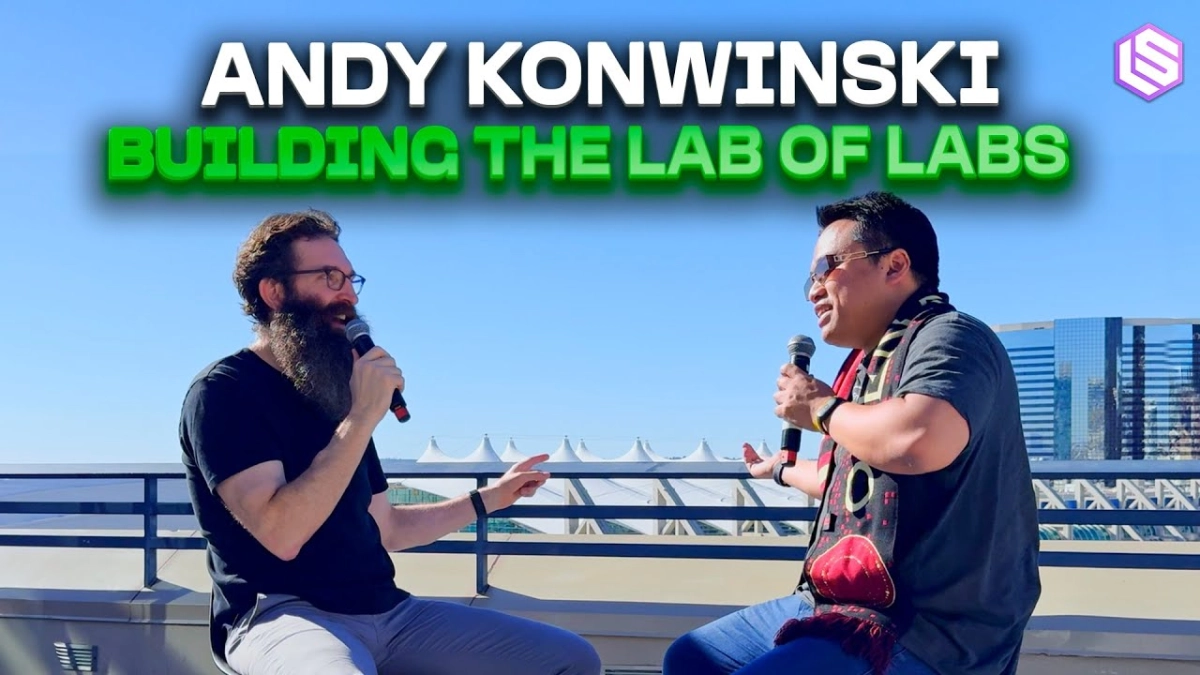
The most consequential companies in the history of modern technology—from Google to Databricks—did not emerge from a vacuum of capital and talent, but rather from a deep, collaborative foundation of open academic research. This is the central thesis underpinning the Laude Institute, a hybrid venture fund and nonprofit founded by Databricks and Perplexity AI co-founder Andy Konwinski, which seeks to formalize and accelerate the path from research breakthrough to market breakout. Konwinski, speaking live at NeurIPS 2025, detailed Laude’s mission: to provide the “right resource, right researcher, right time” to unlock the next generation of world-changing companies.

Konwinski’s experience co-founding two multi-billion dollar companies rooted in university research—Databricks evolving from the Berkeley AMPLab and Perplexity emerging from generative AI research—has shaped his view that the academic-to-startup pipeline is not an anomaly, but the new gold standard. He argues that the large, cohesive founding teams common in these spinouts—like the eight co-founders of Databricks—are inherently de-risked. These teams have already navigated years of deep collaboration, understanding each other’s strengths and weaknesses, thereby mitigating the catastrophic "founder divorce risk" that plagues smaller, less established teams. This established trust and shared intellectual property provide a robust platform for scaling paradigm-shifting ideas.

Laude Institute addresses the systemic issues hindering open research by operating a two-sided structure. The venture arm provides funding for researchers post-incorporation, backing technical founders with capital and expertise drawn from a highly specialized LP base, including Jeff Dean and top faculty from Berkeley and Stanford. Crucially, the nonprofit Institute side offers "no-strings-attached grants" to fund open research before incorporation, creating an upstream funnel that feeds the next wave of disruptive companies.

The sheer scale of capital required for frontier AI research has eclipsed traditional funding mechanisms. Konwinski is quick to stress that the National Science Foundation (NSF) is not "broken," but rather dramatically insufficient for the current demands of frontier AI development. The allocation of roughly $1 billion annually for computer science research falls far short of the $10 to $100 billion required to maintain global leadership. Laude complements this by applying the high-velocity, selective "picker model" characteristic of Silicon Valley venture capital directly to academic grant-making.

This funding is strategically directed toward the next layer of innovation in AI. Konwinski identifies the current focus shifting above the foundational models (pre-training and post-training) to what he terms the "post-post-training" layer. This involves compound systems, context management, Retrieval-Augmented Generation (RAG), memory curation, and advanced prompt optimization. Projects funded through Laude’s Slingshot program, such as DSPy—a "reverse compiler" that takes code and compiles natural language—and JEPA-style evolutionary prompt optimization research, exemplify this focus on building highly leveraged abstractions atop existing large language models. These tools are designed to maximize the utility and reliability of current models, democratizing access to powerful AI capabilities without requiring massive, proprietary foundational training runs.

Laude’s reach extends beyond the traditional Bay Area strongholds. Konwinski noted that while the West Coast institutions remain vital, the majority of their grants and funded projects are intentionally non-Berkeley/Stanford, spanning universities like MIT, CMU, UI Urbana-Champaign, Caltech, and international centers in Toronto and Waterloo. This focus is reinforced by the growth of PhD entrepreneurship clubs across these campuses—like Agent at the University of Washington and Saplings at Stanford—which Laude supports to cultivate a broader, geographically distributed pipeline of research-driven founders eager to translate their academic work into commercial products.

The need for robust open research funding is underscored by the current geopolitical dynamics. Konwinski pointed out that Chinese labs like Moonshot and DeepSeek are now publishing twice as many interesting open papers as their American counterparts, largely because frontier labs in the U.S., including OpenAI, have ceased public disclosure of key findings. To combat this "open research crisis," Laude is launching Open Frontiers, a live-streamed conference designed to unify the ecosystem by bringing together the 100 most influential open researchers—including Yann LeCun, François Chollet, and Jan Leike—to share roadmaps and foster collaboration. This initiative aims to reclaim the U.S. leadership position in open AI research, ensuring that foundational scientific progress remains a shared global asset rather than proprietary corporate IP. The ultimate goal of Laude is to serve as the critical bridge, ensuring that groundbreaking, open research translates efficiently into products that drive world-changing impact and create massive economic value.

#[State of Research
#AI
#Artificial Intelligence
#Technology

AI Daily Digest

Get the most important AI news daily.

GoogleSequoiaOpenAIa16z
+40k readers