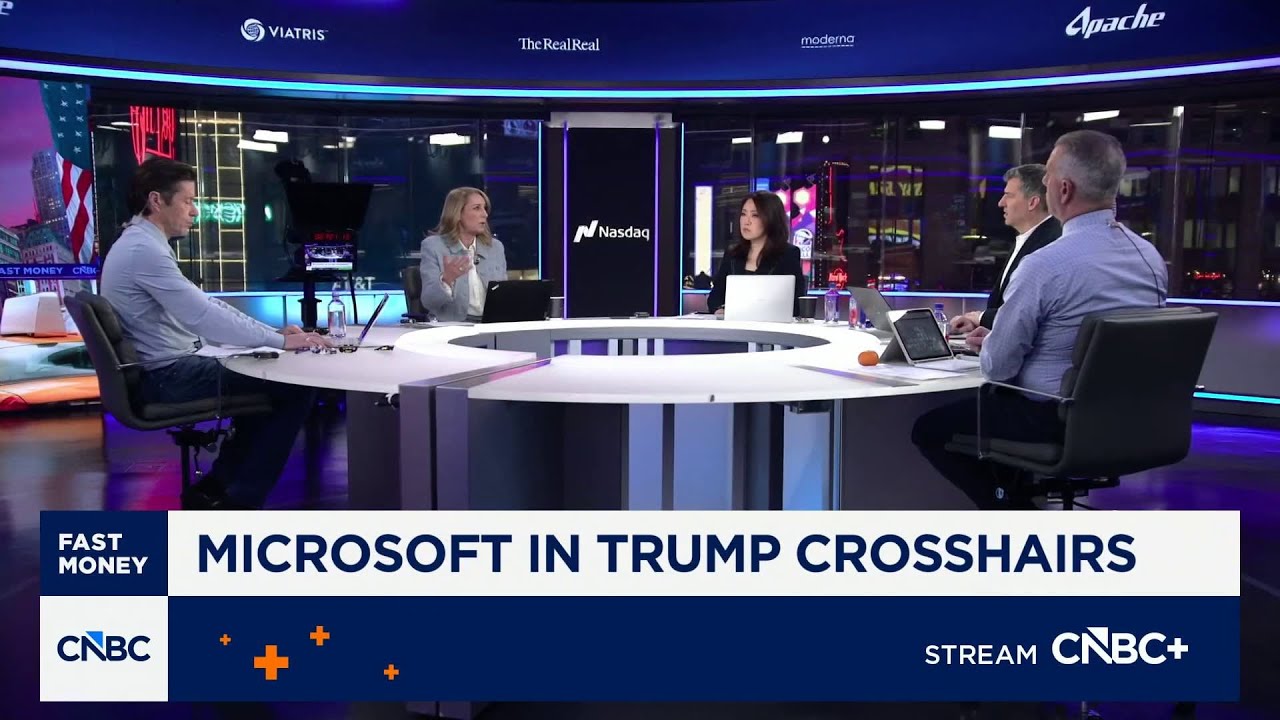
The accelerating consumption of energy required to power the artificial intelligence boom is rapidly transforming from an internal infrastructure concern for Big Tech into a high-stakes geopolitical and regulatory liability. This shift was brought into sharp focus on CNBC’s 'Fast Money,' where traders reacted to the Trump administration setting its sights on Microsoft regarding the need to offset the profound community impact caused by the construction and operation of massive AI data centers. The core of the political challenge is simple: who bears the cost of the unprecedented electricity demand necessary to train and run large language models?
The discussion centered on the externalized costs of this boom, specifically, the rising electricity prices hitting consumers in regions heavily concentrated with these compute facilities. Melody Hahm highlighted the tangible consequences, pointing out that in Northern Virginia, the state with the most data centers in the U.S., “electricity prices [have] gone up 14% year-on-year in the fourth quarter.” Illinois, the second most concentrated state, saw a 16% jump. This data underscores a critical insight: the societal subsidy of AI’s energy needs is becoming too obvious to ignore, creating a politically potent issue that regulators are eager to address. Guy Adami concurred with the underlying principle of the regulatory pressure, noting that communities should not be “saddled with the burden of all these costs.” For major cloud providers like Microsoft, who are sinking billions into data center expansion to maintain their competitive lead in AI, this populist surge represents a significant and immediate headwind.
The financial implications of this energy squeeze are already reverberating through adjacent markets. Tim Seymour pointed toward specific energy sectors that are positioned to benefit from the relentless demand for power. He argued that natural gas, and increasingly nuclear energy, offer the necessary scale and reliability for these massive data center operations, suggesting utilities overall “look very interesting here” as infrastructure providers to the new AI economy. This perspective highlights a fundamental re-rating happening in the energy space, where traditional power sources, once viewed purely through the lens of legacy infrastructure, are now seen as indispensable partners, and potential beneficiaries, of the future of computation.
However, the regulatory pressure in the United States carries complex geopolitical risks. Dan Nathan underscored a warning previously issued by Microsoft’s leadership regarding the international AI race, specifically citing China’s structural advantages. He argued that the Chinese benefit from having “the cheapest cost of capital and they have the cheapest cost of energy,” which allows them to pursue a competitive advantage in AI development and deployment globally, often through open-source models. Nathan characterized China’s strategy as a “digital Belt and Road,” suggesting that if U.S. technology companies are forced to shoulder increasing regulatory and energy costs domestically, it could impede their ability to compete effectively on the global stage, creating a significant national security and technological gap.
For the hyperscalers like Microsoft, the political and economic pressure creates a difficult operational calculus. Data center construction is expensive, time-consuming, and now faces increasing community resistance and regulatory oversight aimed at mitigating environmental and cost impacts. Karen Finerman articulated the essential question facing these highly profitable cloud operators: “Are they going to pass the costs on to their customers? Do they eat some of it?” While the current demand for AI compute appears highly inelastic, meaning users will pay almost any price for the necessary power, the long-term viability of this model is being tested. If energy costs continue to rise and regulation forces greater community contribution, the profitability of the massive AI infrastructure buildout could erode. This suggests that the current favorable regulatory environment that has allowed the "neo-clouds" to flourish may be reaching an inflection point, forcing them to internalize costs that were previously externalized to the grid and the public. Microsoft’s willingness to engage publicly on this issue, while strategically attempting to frame it against the Chinese competitive threat, signals that this is a material risk that cannot be ignored by tech insiders or investors.