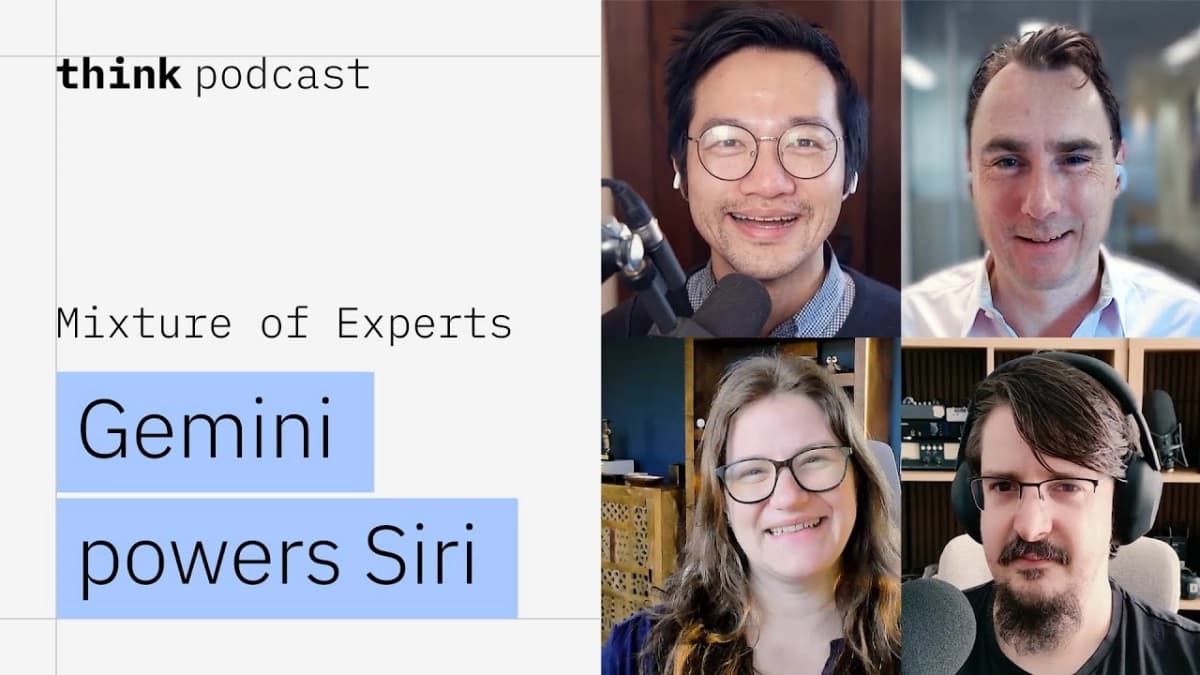
The recent announcements from Anthropic regarding Claude Cowork and Apple's partnership with Google to integrate Gemini models into Siri signal a significant pivot in the AI landscape, moving the focus from pure foundational model scale to practical, accessible, and potentially on-device utility. This shift, discussed by Tim Hwang, Volkmar Uhlig, Olivia Buzek, and Mihai Criveti on the Mixture of Experts podcast, underscores a critical tension between centralized cloud power and the burgeoning demand for edge intelligence and privacy-preserving AI.
The conversation opened with an analysis of Anthropic's Claude Cowork, which aims to bring the power of Claude Code to everyday job tasks. Mihai Criveti, Distinguished Engineer at Agentic AI, noted that while cloud-based code generation is powerful, the focus is shifting towards making these capabilities more accessible. Criveti observed that the move is "a step towards making cloud code a lot more accessible to the casual audience," suggesting that the current state of AI tools is finally reaching a threshold where even non-developers can leverage advanced capabilities without needing deep technical knowledge or terminal access. This democratization of AI functionality is a core theme, as users increasingly expect sophisticated automation woven directly into their workflows.
Olivia Buzek, Lead Developer Advocate for AI, highlighted the user experience challenges this accessibility shift presents, drawing on her experience organizing her own digital life. She recounted a personal anecdote about an AI agent organizing her downloads folder, which, while ultimately successful, was "a little bit of a rough edges" experience, creating "weird folders" and requiring manual cleanup. Buzek emphasized that for AI agents to truly succeed with a general audience, the experience must be near-flawless, noting, "If you just follow everything that the AI is telling you to do, it's like, 'Oh, it got something wrong. I'm just going to correct it.'" This points to a critical insight: the current generation of agents, while capable, still requires a level of user oversight that belies the promise of true autonomy.
The second major topic was the Apple-Google AI deal, where Gemini models will power the next generation of Siri. Tim Hwang framed this as a fascinating development, especially given Apple's historical emphasis on privacy and on-device processing. He pointed out the inherent tension: "Apple for a long time has been like on-device, on-device, on-device... and for us that means on-device." The partnership suggests that for the immediate future, Apple is prioritizing model capability over strict on-device execution for complex tasks. Hwang speculated that the deal involves Apple paying Google substantial sums, which is a reversal of the typical power dynamic where Apple dictates terms.
Volkmar Uhlig, VP and CTO of Data Platform & Engineering, provided an enterprise perspective on this dynamic. He noted that while Apple is pushing for on-device execution for privacy, the sheer scale and complexity of the required models often necessitate cloud reliance. Uhlig suggested that Apple's architecture is designed to be "agnostic" regarding the underlying model provider, allowing them to switch between providers like Google and potentially others. He also highlighted the fundamental economic reality: "I sell you a device and I don't sell you a subscription... so if I need to run code in the data center, it costs me money." This cost dynamic drives the incentive structure, pushing vendors toward cloud solutions where they can monetize usage, even if it slightly compromises the perceived privacy advantage of the hardware ecosystem.
The discussion concluded with a surprising tidbit concerning Linus Torvalds, the creator of Linux. Despite his historical skepticism, Torvalds admitted to using an AI agent for a side project involving "vibe coding." Criveti shared Torvalds' definition of "vibe" in this context: "very inefficient but entertaining." This anecdote serves as a sharp commentary on the current state of AI tools. Even the staunchly pragmatic "old guard" of open-source development are finding utility in AI for creative or exploratory coding tasks, even if they view the process itself as inefficient entertainment. This acceptance, even if qualified with skepticism, suggests that AI tools are indeed becoming indispensable across the spectrum of software development, from enterprise architecture to personal side projects.
Ultimately, the convergence of cloud-heavy foundational models like Gemini powering consumer experiences like Siri, alongside Anthropic’s push for accessible developer tools, illustrates a market where utility and capability are currently outweighing absolute on-device privacy guarantees for high-end tasks. The industry is rapidly iterating, and the next 12 to 24 months will be crucial in determining whether on-device AI can truly catch up to the scale of cloud-based intelligence without significant performance or cost trade-offs.